
Walk into any pharmacy today, and you will likely pick up a bottle with a name you don’t recognize. The label might say Metformin or Lisinopril, not the brand names your doctor wrote on the prescription pad years ago. You pay a fraction of the cost, yet the medicine works exactly the same. This isn't magic; it is the result of nearly two centuries of regulatory battles, tragic accidents, and legislative breakthroughs that transformed the American healthcare system.
The story of generic drugs in the United States is not just about cheaper pills. It is a tale of how we moved from a Wild West era of unregulated powders and liquids to a highly structured system where science, law, and economics collide. Today, generics account for more than 90% of all prescriptions dispensed in the U.S., saving the healthcare system trillions of dollars. But getting here required fixing broken systems, learning from deadly mistakes, and rewriting the rules of intellectual property.
The Early Days: Standardizing Medicine (1820-1906)
Before there were "generics" or "brands," there was just medicine-and a lot of bad medicine. In the early 19th century, if you bought a drug, you had no idea what was actually inside the bottle. Quality varied wildly depending on who made it and where they sourced their ingredients.
The turning point began in 1820 when eleven physicians met in Washington, D.C., to create the U.S. Pharmacopeia. This was the first compendium of standard drugs, establishing baseline definitions for purity and strength. For the first time, doctors had a reference book to check if a supplier’s product matched the accepted standard. However, this was voluntary. There was no government agency forcing compliance.
As trade expanded, so did fraud. By 1848, Congress passed the Drug Importation Act, requiring the U.S. Customs Service to inspect imported medicines to stop adulterated products from entering the country. It was a small step, but it acknowledged that the government had a role in protecting public health from foreign contaminants. Later, in 1888, the American Pharmaceutical Association published the National Formulary to help prevent counterfeiting of branded products, further solidifying the concept that specific chemical compositions should have consistent quality.
Yet, without enforcement, these standards were often ignored. The real shift came in 1906 when President Theodore Roosevelt signed the Federal Food and Drugs Act. This was the first federal legislation requiring product labeling to prevent misbranding and adulteration. It gave the government the power to take action against products causing substantial injury or death. This law laid the groundwork for what would eventually become the Food and Drug Administration (FDA).
Tragedy Drives Regulation: The Safety Era (1906-1962)
Legislation rarely moves forward until something goes terribly wrong. The most harrowing example in U.S. pharmaceutical history occurred in 1937. A company called S.E. Massengill Company marketed a new antibiotic called sulfanilamide as a liquid elixir because it tasted better. To dissolve the powder, they used diethylene glycol-a toxic solvent also known as antifreeze. No safety testing had been done on humans. The result was catastrophic: 107 people, mostly children, died from kidney failure.
This tragedy shocked the nation and directly led to the 1938 Federal Food, Drug, and Cosmetic Act (FDCA). For the first time, manufacturers were required to prove that a new drug was safe before marketing it. They had to submit data to the FDA for clearance. This shifted the burden of proof from the government to the manufacturer, a fundamental change that still defines drug regulation today.
In 1951, the Durham-Humphrey Amendment refined this system by defining which drugs required medical supervision. It created the distinction between prescription and over-the-counter drugs that we use today. If a drug needed a doctor’s oversight to be used safely, it became a prescription-only medication. This classification helped streamline the market but didn't yet address the issue of competition between different manufacturers of the same drug.
The next major shock came in 1961 with the publication of The Silent Spring by Rachel Carson and subsequent reports linking the morning sickness drug thalidomide to severe birth defects. Although thalidomide was never approved for sale in the U.S. thanks to an FDA reviewer named Frances Kelsey, the incident highlighted that safety alone wasn't enough. Drugs also needed to work. In 1962, Congress passed the Kefauver-Harris Drug Amendments, requiring manufacturers to prove both safety and efficacy. All drugs on the market between 1938 and 1962 had to submit efficacy data for evaluation. This was a massive undertaking that cleaned up the market but also raised barriers to entry for new competitors.
The Birth of Modern Generics: The Hatch-Waxman Act (1984)
By the early 1980s, the U.S. drug market was stuck. Brand-name companies held patents that prevented anyone else from making their drugs. Meanwhile, generic manufacturers couldn't get approval because they weren't allowed to mention brand names in their applications, fearing lawsuits. The system was gridlocked. Patients paid high prices, and innovation slowed because big pharma faced little competition after patents expired.
The solution arrived in 1984 with the Drug Price Competition and Patent Term Restoration Act, commonly known as the Hatch-Waxman Act. Named after its sponsors, Senator Orrin Hatch and Representative Henry Waxman, this legislation created the modern framework for generic drugs. It struck a delicate balance between encouraging generic competition and protecting the intellectual property rights of innovator companies.
The key innovation was the Abbreviated New Drug Application (ANDA). Before Hatch-Waxman, a generic manufacturer had to repeat costly clinical trials to prove safety and efficacy, even if the drug was identical to an existing one. The ANDA process allowed generics to skip those trials. Instead, they only had to demonstrate bioequivalence-proving that the generic version absorbed into the bloodstream at the same rate and extent as the brand-name drug. This drastically reduced the cost and time to bring generics to market.
Hatch-Waxman also introduced a mechanism for patent disputes. If a generic company wanted to launch a drug while the brand-name patent was still active, they could file a Paragraph IV certification, challenging the validity of the patent. In response, the brand-name company could sue, triggering a 30-month stay on FDA approval while the lawsuit played out. This period became a strategic tool for brand-name companies to delay competition, a loophole that remains controversial today.
| Metric | Pre-1984 | Post-1984 (Recent Data) |
|---|---|---|
| Generic Prescription Share | 19% | Over 90% |
| Average Review Time for ANDA | N/A (No standardized process) | 10 months (reduced from 30 months pre-GDUFA) |
| Approval Rate | Low (due to complex litigation) | 95% (as of 2021) |
| Cost Savings to Healthcare System | Minimal | $373 billion in 2021 alone |
Modernization and Efficiency: The GIVE Initiative and Beyond (2007-Present)
Despite its success, the generic approval process became bogged down by backlogs in the 2000s. In 2007, the FDA launched the Generic Initiative for Value and Efficiency (GIVE) to modernize and streamline approvals. Around the same time, President George W. Bush signed the Food and Drug Administration Amendments Act (FDAAA), which revised user-fee programs and enhanced post-market safety authorities.
The introduction of user fees, formalized under the Generic Drug User Fee Amendments (GDUFA) in 2012, allowed the FDA to hire more reviewers and improve infrastructure. The results were dramatic. Since GDUFA implementation, the agency reduced ANDA review times from 30 months to just 10 months. Approval rates jumped from 45% to 95%. This efficiency meant that patients got access to affordable alternatives much faster after patent expirations.
However, the industry has faced new challenges. As major blockbusters lost patent protection simultaneously in the mid-2010s, the market shifted from "giant patent cliffs" to a landscape dominated by older, off-patent drugs. While overall generic prices declined, some essential medications saw extreme price volatility. According to research published in JAMA, prices for 15% of generic drugs increased by more than 100% between 2013 and 2017. This happened because competition dried up for certain niche drugs, leaving few manufacturers willing to produce them at low margins.
Quality control has also been a concern. Between 2018 and 2022, the FDA reported 1,234 drug shortages, 65% of which involved generic drugs. These shortages are often linked to global supply chain vulnerabilities. Approximately 80% of active pharmaceutical ingredients (APIs) for U.S. generic drugs are manufactured outside the United States, primarily in China and India. Any disruption in these regions can ripple through the U.S. healthcare system, causing shortages of critical medications like antibiotics and heart drugs.
The Economic Impact: Saving Trillions
The economic argument for generic drugs is undeniable. In 2022, generic drugs accounted for 90.5% of all prescriptions dispensed in the United States but represented only 23.4% of total drug expenditures. The Congressional Budget Office estimated in 2019 that generic drugs reduce prescription drug spending by 80-85% compared to brand-name equivalents.
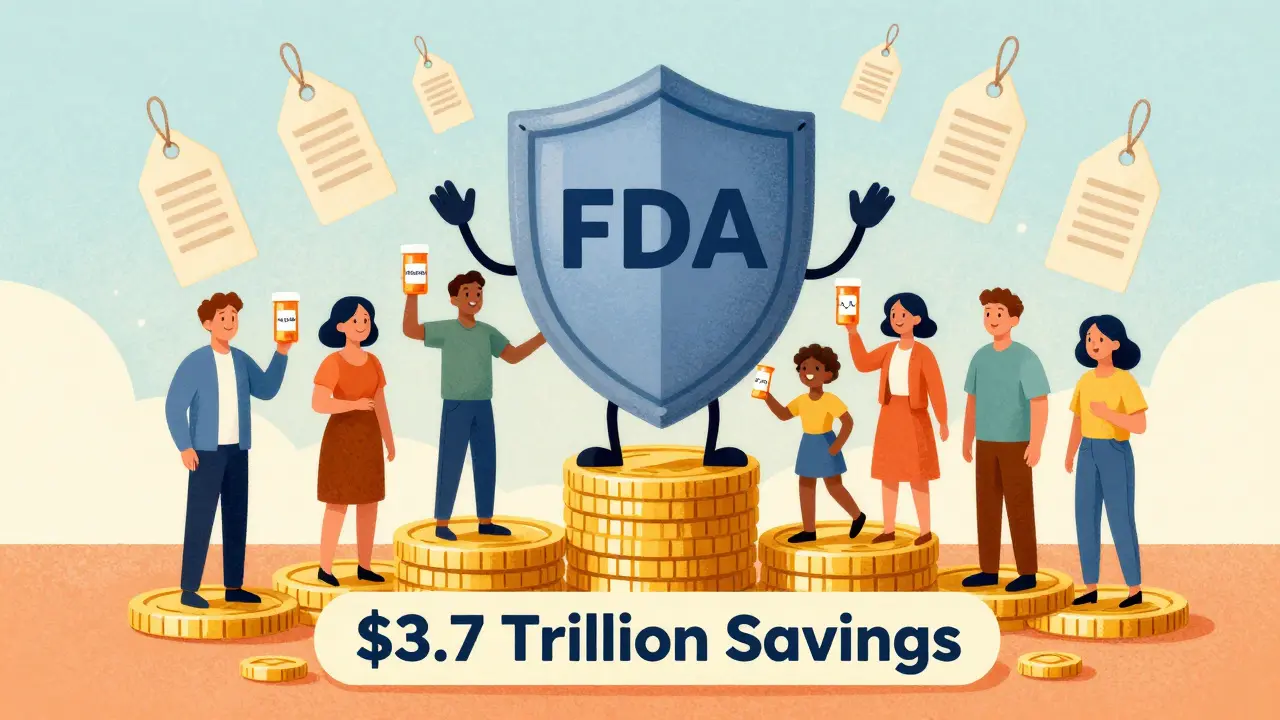
Cumulative savings exceed $3.7 trillion over the past decade. For patients, this means lower copays and improved adherence to treatment plans. For insurers and government programs like Medicare and Medicaid, it frees up resources for other healthcare needs. The 1965 amendments to the Social Security Act, which created Medicare and Medicaid, explicitly encouraged the use of generic products to safeguard against inflated pricing. This policy direction has proven to be one of the most effective cost-containment strategies in U.S. history.
Looking ahead, the next frontier is biosimilars. These are generic versions of biologic drugs, which are larger, more complex molecules derived from living organisms. Unlike small-molecule generics, biosimilars require more extensive testing to ensure similarity. Industry analysts at IQVIA project that biosimilars will represent the next wave of competition for high-cost biologic drugs, potentially offering similar savings for conditions like rheumatoid arthritis and cancer.
Protecting Competition: The CREATES Act
To maintain the benefits of generics, lawmakers continue to refine the rules. In 2019, Congress passed the Creating and Restoring Equal Access to Equivalent Samples (CREATES) Act. This law addresses a tactic used by brand-name manufacturers to block generic competition: restricted distribution practices. By controlling the supply of their brand-name drugs, companies could prevent generic manufacturers from obtaining samples needed to conduct bioequivalence studies. The CREATES Act requires brand-name companies to provide samples within 30 days upon request, unless they can prove significant risk. As of December 2022, the FDA reported 27 enforcement actions taken under this law, signaling a stricter stance on anti-competitive behavior.
What is the difference between a brand-name drug and a generic drug?
Brand-name drugs are developed by the original company that discovered the compound, holding exclusive patent rights for a set period. Generic drugs contain the same active ingredient, strength, dosage form, and route of administration as the brand-name drug. They must meet the same quality, purity, and potency standards set by the FDA. The main differences are usually in appearance (color, shape) and inactive ingredients (fillers, binders), which do not affect therapeutic effect.
Why are generic drugs so much cheaper than brand-name drugs?
Generic drugs are cheaper because manufacturers do not bear the costs of initial research, development, and clinical trials. Under the Hatch-Waxman Act, they only need to prove bioequivalence, which is significantly less expensive. Additionally, once multiple generic manufacturers enter the market, competition drives prices down further. Brand-name companies charge higher prices to recoup their R&D investments during the patent exclusivity period.
Are generic drugs as safe and effective as brand-name drugs?
Yes. The FDA requires generic drugs to be bioequivalent to their brand-name counterparts, meaning they deliver the same amount of active ingredient into a patient's bloodstream in the same amount of time. They undergo rigorous manufacturing inspections and quality control checks. While rare issues can occur, such as recalls due to contamination, the overall safety profile is statistically identical to brand-name drugs.
What is the Hatch-Waxman Act, and why is it important?
The Hatch-Waxman Act, passed in 1984, established the legal framework for generic drug approval in the U.S. It created the Abbreviated New Drug Application (ANDA) process, allowing generics to bypass costly clinical trials by proving bioequivalence. It also balanced patent protections for innovators with mechanisms for generic competition, leading to a surge in generic usage from 19% to over 90% of prescriptions.
Why do some generic drugs experience price spikes despite being off-patent?
Price spikes can occur when there are very few manufacturers producing a specific generic drug. If one or two companies exit the market due to low margins or production issues, the remaining suppliers may raise prices. This is more common for older, less profitable drugs where competition is minimal. Regulatory efforts like the CREATES Act aim to encourage more competition to stabilize prices.
How does the FDA ensure the quality of generic drugs?
The FDA inspects manufacturing facilities worldwide, reviews batch records, and conducts laboratory testing of finished products. Facilities must comply with Current Good Manufacturing Practices (cGMP). The FDA also monitors adverse event reports and drug shortages. With over 13,000 manufacturing facilities overseen globally, the agency uses risk-based inspections to prioritize high-risk sites.
What role do biosimilars play in the future of generic drugs?
Biosimilars are generic versions of biologic drugs, which are complex proteins produced in living cells. Unlike small-molecule generics, biosimilars cannot be identical copies but must be highly similar with no clinically meaningful differences. As many high-cost biologics lose patent protection, biosimilars are expected to drive significant cost savings in treating conditions like cancer, diabetes, and autoimmune diseases, mirroring the impact of traditional generics.
The history of generic drugs in the United States is a testament to the power of regulation to protect public health while fostering economic efficiency. From the early pharmacopeias to the sophisticated bioequivalence standards of today, each step has been driven by the need to balance innovation with access. As the market evolves toward biosimilars and faces global supply chain challenges, the lessons of the past remind us that vigilance, competition, and clear regulations remain essential for a healthy pharmaceutical ecosystem.