
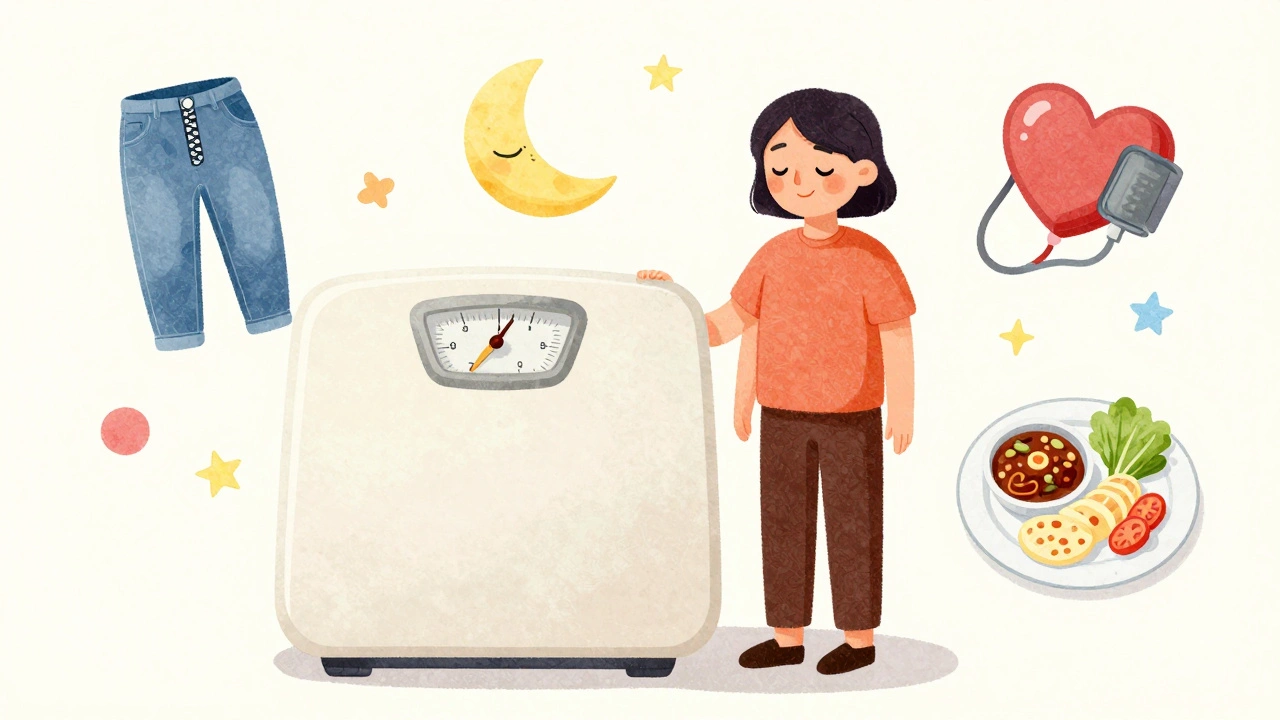
What if the number on the scale doesn’t tell you the whole story? You’ve been eating better, moving more, sleeping deeper - yet the scale hasn’t budged in weeks. Maybe it even went up. You start to wonder: Is all this effort pointless? It’s not. You’re making progress. You just can’t see it on the scale.
Why the Scale Lies to You
The scale doesn’t know the difference between fat loss and muscle gain. It doesn’t care if your blood sugar is stable, your joints feel lighter, or you finally slept through the night without waking up gasping. It just shows a number - and that number can jump up or down by a few pounds in a single day because of water, salt, hormones, or what you ate for dinner. A 2023 review from Mather Hospital found that daily weight fluctuations of 2 to 5 pounds are completely normal and often unrelated to actual body fat changes. For women, the menstrual cycle alone can cause a 3-pound swing. A salty meal, a late night, or even a glass of wine can throw the number off. If you’re measuring success by that one digit, you’re setting yourself up for frustration - not motivation.What Are Non-Scale Victories?
Non-scale victories (NSVs) are real, measurable improvements in your health that have nothing to do with pounds lost. They’re the quiet wins: the way your clothes fit differently, the energy you didn’t know you were missing, the confidence that comes from climbing stairs without winded. These aren’t vague feelings. They’re concrete changes tracked by dietitians, doctors, and patients alike. The term has been formally used in clinical nutrition since at least 2021, with healthcare providers using NSVs to measure progress when weight doesn’t move - and often, when it shouldn’t be the focus at all.Four Categories of Real Progress
Progress isn’t one-dimensional. It shows up in four key areas:- Biochemical: Your blood work improves. HbA1C drops from 6.8 to 5.9. Blood pressure falls from 140/90 to 120/80. Cholesterol levels shift in the right direction. These changes mean your body is healing - even if your weight stayed the same.
- Functional: You can do things you couldn’t before. You tie your shoes without bending over awkwardly. You carry groceries up two flights of stairs without stopping. You no longer need a seat belt extender on planes. Your grip strength improves. Your balance steadies.
- Behavioral: You’re making smarter choices consistently. You cook dinner at home four nights a week. You swap soda for sparkling water. You eat when you’re hungry and stop when you’re full - not because you’re on a diet, but because you finally listen to your body.
- Psychosocial: Your mind feels lighter. You feel less anxious about food. You say no to dessert without guilt. You sleep better. You laugh more. You stop checking your reflection in the mirror every five minutes.
These aren’t fluff. They’re clinical indicators. A 2023 study referenced by the National Institutes of Health found that patients in obesity treatment considered NSVs just as important as weight loss - sometimes more.
Real Examples from Real People
You don’t need to guess what these victories look like. Here’s what people actually report:- “I stopped checking my blood sugar three times a day. My levels are steady now.”
- “I ran a 5K last month. I never thought I could.”
- “I wore my favorite jeans to a wedding - and they zipped up without struggling.”
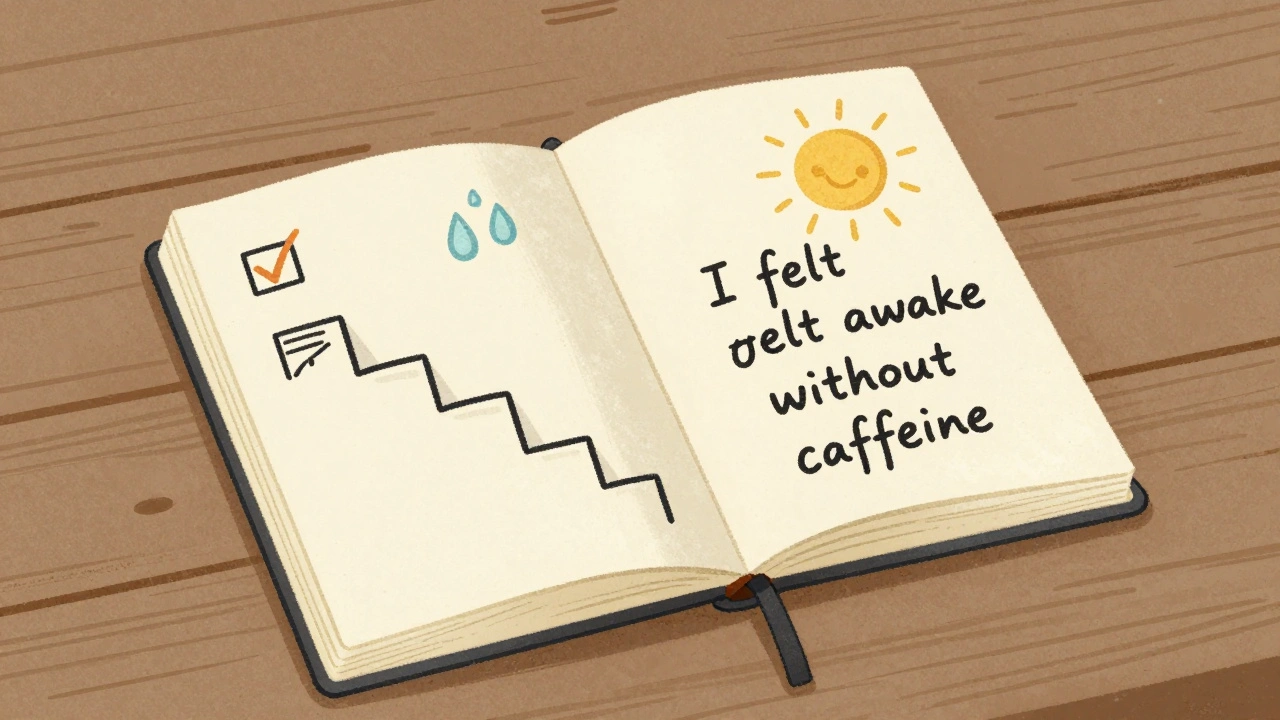
- “I don’t need caffeine after lunch anymore. I just feel awake.”
- “I cried when I realized I didn’t hate looking in the mirror anymore.”
- “I cooked a full meal from scratch for the first time in years. It tasted good. I felt proud.”
These aren’t just feel-good stories. They’re signs your body is responding to healthier habits - and that’s what lasts.
How to Track Your Own Non-Scale Victories
You can’t measure what you don’t track. Start simple:- Choose one area to focus on this week: energy, sleep, movement, or food mindset.
- Write down one specific goal: “I’ll walk 20 minutes after dinner, four days this week.”
- At the end of the week, ask: Did I do it? How did I feel afterward?
- Celebrate it - even if the scale didn’t move.
Use the SMART framework: Specific, Measurable, Achievable, Relevant, Time-bound.
Examples:
- “I’ll drink 8 glasses of water every day for the next 14 days.”
- “I’ll eat breakfast with protein every morning for a month.”
- “I’ll try one new vegetable each week for the next 30 days.”
- “I’ll sleep 7 hours a night, 5 nights a week, for the next month.”
Keep a notebook, a note on your phone, or a sticky note on your mirror. Write down one NSV every day. After a month, look back. You’ll be amazed.
Why This Works Better Than Weight Loss
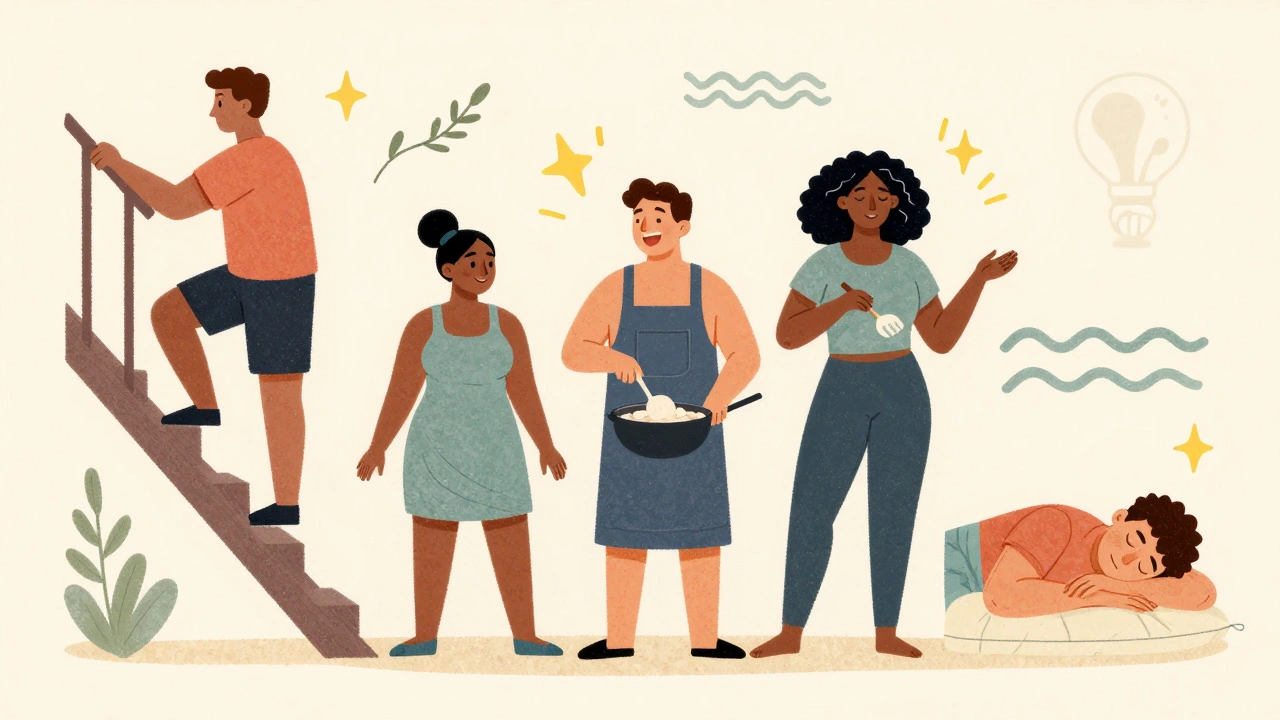
Weight loss is often temporary. Behavior change is permanent. When you focus on the scale, you’re chasing a number. When you focus on NSVs, you’re building a better life. You’re learning to move with ease. To eat without fear. To rest without guilt. To feel strong - not thin. A 2023 report from Dietitians On Demand found that patients who tracked NSVs were more likely to stick with healthy habits long-term. Why? Because they saw progress every single day - not just on the days the scale dropped. And here’s the truth: you can be at a healthy weight and still be unhealthy. Or you can carry extra weight and be metabolically fit. Blood pressure, cholesterol, energy levels, mood, sleep, mobility - these are the real markers of health. Not the scale.What to Do When You’re Stuck
If you’re feeling discouraged, ask yourself:- Have I slept better this month?
- Do I have more energy in the afternoons?
- Have I eaten more home-cooked meals?
- Do I feel less anxious about food?
- Can I do something now that I couldn’t do three months ago?
If you answered yes to even one of these - you’re winning.
Don’t wait for the scale to validate your effort. Your body is changing. Your habits are strengthening. Your life is improving - even if the number hasn’t budged.
Final Thought: Progress Isn’t Linear
Health isn’t a straight line from A to B. It’s messy. It’s slow. It’s full of ups and downs. Some weeks you’ll feel unstoppable. Other weeks, you’ll feel like you’re back at square one. But NSVs remind you: you’re not back at square one. You’re further along than you think. You don’t need to lose 20 pounds to be proud of yourself. You just need to notice the small wins - and hold onto them.Because the goal isn’t to fit into a smaller dress. The goal is to live a life where you feel strong, calm, and free - no matter what the scale says.
What exactly counts as a non-scale victory?
A non-scale victory is any measurable improvement in your health or habits that doesn’t involve weight. Examples include: sleeping better, having more energy, lowering blood pressure, cooking more meals at home, feeling less anxious about food, climbing stairs without getting winded, or finally fitting into your favorite jeans. These are real signs of progress - even if the scale hasn’t moved.
Why isn’t the scale a good measure of health progress?
The scale measures total body weight - not fat, muscle, water, or bone. Daily fluctuations of 2-5 pounds are normal and caused by hydration, sodium intake, hormones, or even bowel movements. You can lose fat and gain muscle at the same time, and the scale won’t reflect that. Two people can weigh the same but have completely different body compositions and health markers. Weight alone doesn’t tell you if you’re healthier.
Can I still lose weight while focusing on non-scale victories?
Absolutely. But the focus shifts from chasing a number to building habits that naturally lead to sustainable change. When you eat more whole foods, move regularly, sleep well, and manage stress, weight loss often follows - without obsession. Many people find that once they stop fixating on the scale, their body finds its natural, healthy weight - without dieting.
How long does it take to see non-scale victories?
Some show up in days: better sleep, less bloating, more energy. Others take weeks or months: improved lab values, increased strength, reduced medication needs. The key is consistency, not speed. Track small wins daily, and over time, they stack up into life-changing results.
What if I don’t notice any non-scale victories?
Start by tracking one small habit for a week - like drinking more water or walking after dinner. Often, you’ll notice changes you didn’t realize were happening: you’re less tired, your skin looks clearer, you’re not reaching for snacks at 3 p.m. Sometimes, progress is subtle. You don’t always feel it - but your body knows. Keep showing up, and the wins will come.


Helen Maples, December 5, 2025
The scale is a tyrant disguised as a tool. I used to check it three times a day, convinced my worth was tied to that number. Then I stopped. Within two weeks, I noticed I could tie my shoes without groaning. My blood pressure dropped 15 points. I started sleeping through the night. None of that showed up on the scale. But I felt it. That’s the real victory. Stop letting a machine dictate your self-worth.
Ashley Farmer, December 6, 2025
I love how this breaks down progress into real, human terms. For me, the biggest NSV was finally saying no to dessert without feeling guilty. For years, I thought that meant I was depriving myself. Turns out, it meant I was listening. I didn’t lose weight for months, but I stopped bingeing. That was the turning point. You don’t need to look different to feel different. And that’s enough.
David Brooks, December 7, 2025
OH MY GOD I CRIED WHEN I READ THE PART ABOUT WEARING MY FAVORITE JEANS TO A WEDDING. I DID THAT LAST SUMMER. I HADN’T WORN THEM IN 7 YEARS. I DIDN’T EVEN TRY TO LOSE WEIGHT THAT YEAR-I JUST STARTED WALKING EVERY DAY AND COOKING THINGS THAT DIDN’T COME IN A BOX. AND THEN-BAM-THEY ZIPPED. I DIDN’T EVEN CARE THAT THE SCALE WAS STILL THE SAME. I FELT LIKE A NEW PERSON. THIS POST IS A GIFT. THANK YOU.
Jennifer Anderson, December 7, 2025
so i started writin down one thing every day like the post said. not even big stuff. like 'drank water before coffee' or 'took the stairs'. after a month i looked back and i was like... wow i did like 200 of these. i didnt lose weight but i stopped craving sugar at 3pm. and i sleep like a rock now. the scale is just a number. my body knows what it's doin. ps: i spelled 'doin' wrong on purpose lol
Sadie Nastor, December 8, 2025
thank you for this 🙏 i’ve been stuck for 11 months. scale hasn’t moved. i thought i was failing. then i started noticing: i laugh more now, i don’t check my reflection every 10 minutes, i actually enjoy cooking. last week i danced in my kitchen while making soup. no one saw it. but i felt it. that’s my NSV today. i don’t need a number to prove i’m doing better. just needed to hear someone else say it’s okay to feel proud anyway. 💛