
You walk into your local pharmacy, hand over a prescription for a cholesterol medication, and the pharmacist hands you a pill bottle with a price tag that feels manageable. You might not think twice about it, but that low price is the result of a complex economic engine designed specifically to undercut expensive brand-name drugs. In fact, generic medications are drugs that contain the same active ingredients, dosage form, strength, route of administration, quality, performance characteristics, and intended use as their brand-name counterparts, yet they typically cost 80% to 85% less than the original branded versions. It’s not magic, and it’s not charity. It’s economics driven by competition, regulation, and the sheer scale of production. If you’ve ever wondered why your insurer pushes hard for generics or why your copay drops from $50 to $5 when you switch, the answer lies in how these drugs are approved, manufactured, and sold. Let’s break down exactly where those savings come from and what they mean for your wallet and the broader healthcare system.
The Regulatory Shortcut: How Generics Skip the Billions
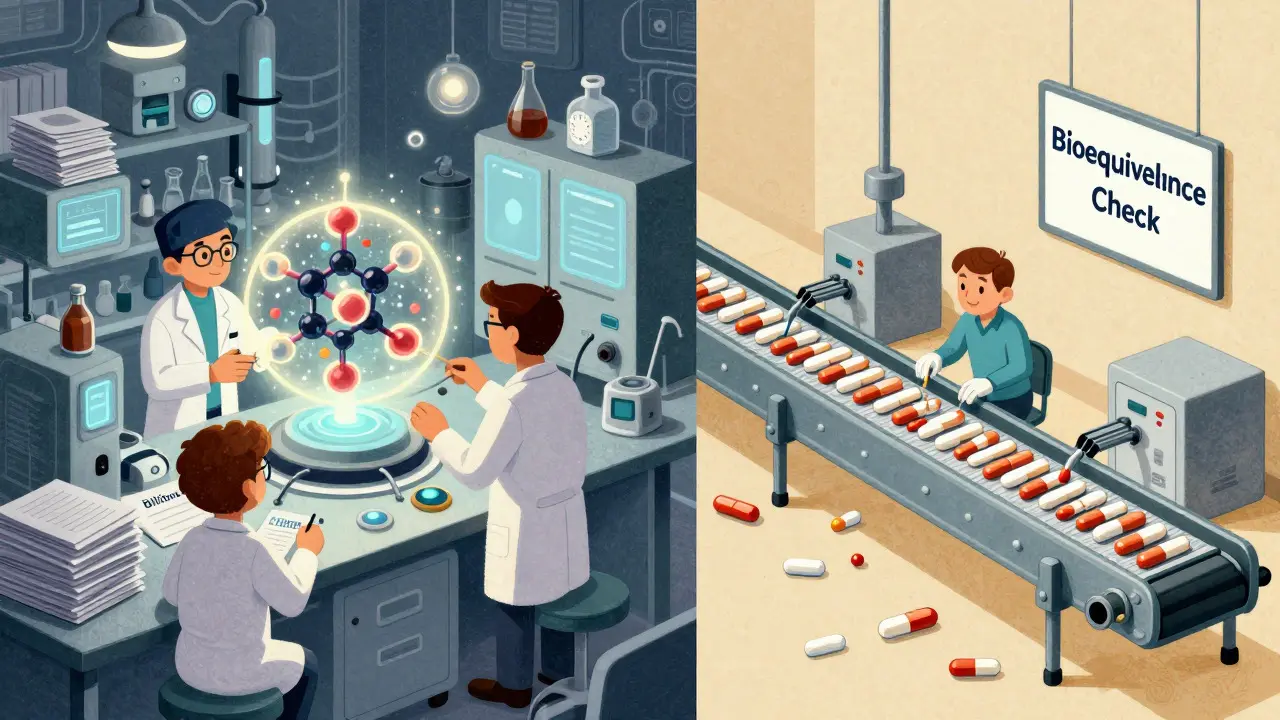
To understand the price difference, you first have to look at what goes into making a brand-name drug. When a pharmaceutical company develops a new medication, they spend billions of dollars on research and development (R&D). They run years of clinical trials to prove the drug works and is safe. This process is risky; most drugs fail before they ever reach the market. To recoup those massive investments, companies set high prices once the drug hits the shelves. Generic manufacturers don’t face this burden. Thanks to the Hatch-Waxman Act passed in 1984, generic makers can use an Abbreviated New Drug Application (ANDA) pathway. Instead of running full clinical trials, they only need to prove bioequivalence. This means showing that the generic version enters the bloodstream at the same rate and extent as the brand-name drug. No new safety studies are needed. No multi-year efficacy trials. Just proof that it does the same job chemically and biologically. This shortcut slashes development costs from hundreds of millions to just a few million dollars. Without the R&D overhead, generic companies can sell their products at a fraction of the brand price and still make a healthy profit. The Food and Drug Administration (FDA) confirms that generics must meet the exact same standards for quality, strength, purity, and stability as brand-name drugs, so you aren’t trading safety for savings-you’re just paying less for the same therapeutic outcome.
The Power of Competition: Why Prices Plummet
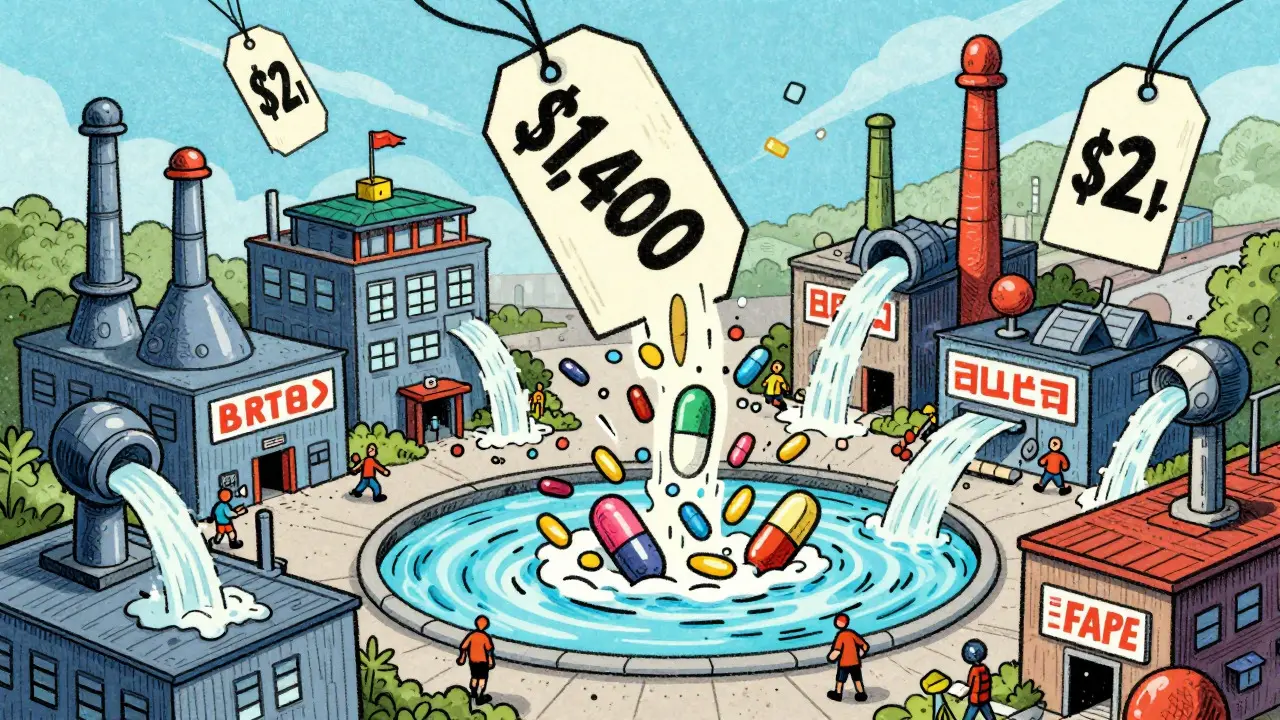
If one generic company enters the market, prices drop. If three do, they crash. This is the core driver of generic affordability. According to the FDA’s 2022 report on estimating cost savings, the entry of generic competition typically reduces prices to 15-20% of the brand-name drug’s price within the first year alone. Consider the case of lurasidone hydrochloride tablets, originally sold under the brand name Latuda. Before generics arrived, a 30-day prescription cost around $1,400. Once generic competitors entered the market, the price per unit fell from approximately $47 to less than $2. That single shift generated over $4.4 billion in savings for patients and insurers. Similarly, pemetrexed (Alimta) saw its average 30-day prescription drop from $3,800 to around $500 after generic competition kicked in. The more manufacturers that join the fray, the lower the price goes. The FDA notes that prices decline by about 20% in markets with roughly three competitors after three years of generic availability. As additional manufacturers enter, the downward pressure intensifies. This isn’t theoretical-it’s a consistent pattern seen across thousands of drug approvals. The Federal Trade Commission (FTC) backs this up, stating that generics typically cost 80-85% less than brand equivalents precisely because multiple companies are fighting for market share, driving prices down through pure competition.
| Drug Type | Brand Price (Avg. 30-Day) | Generic Price (Avg. 30-Day) | Estimated Savings |
|---|---|---|---|
| Lurasidone (Latuda) | $1,400 | <$60 | >$4.4 Billion (System-wide) |
| Pemetrexed (Alimta) | $3,800 | ~$500 | $68 Million (System-wide) |
| Average Generic Copay | $56.12 (Brand) | $6.16 (Generic) | ~89% Lower Out-of-Pocket |
Who Actually Saves Money? Patients and Insurers
The savings don’t just stay in the pockets of big pharma executives or disappear into abstract accounting columns. They flow directly to two groups: patients and health insurers. In 2022 alone, generic and biosimilar medicines generated a record $408 billion in savings for America’s patients and healthcare system, up from $373 billion the previous year. Over the last decade, that total has reached $2.9 trillion. For patients, the impact is immediate and tangible. The average copay for a generic drug is $6.16, compared to $56.12 for a brand-name drug. That’s nearly nine times higher for brands. Furthermore, 93% of generic prescriptions are dispensed for under $20, whereas only 59% of brand-name drugs fall into that category. If you’re managing chronic conditions like hypertension or depression, tools like GoodRx show average discounts of 58% to 67% on cash prices, making long-term treatment financially sustainable. Insurers benefit too, which is why they structure formularies to incentivize generic use. By steering patients toward cheaper alternatives, insurance companies keep premiums lower for everyone. However, there’s a catch. Not all generics are priced equally. A 2022 study in JAMA Network Open found that some "high-cost" generics were 15.6 times more expensive than lower-cost therapeutic alternatives with equivalent clinical value. In Colorado’s commercial plans, replacing these overpriced generics would have saved insurers 88.3% of their spending. This highlights a critical point: while generics are generally cheap, the specific manufacturer and pharmacy network matter.
The Hidden Costs: Pharmacy Benefit Managers and Spread Pricing
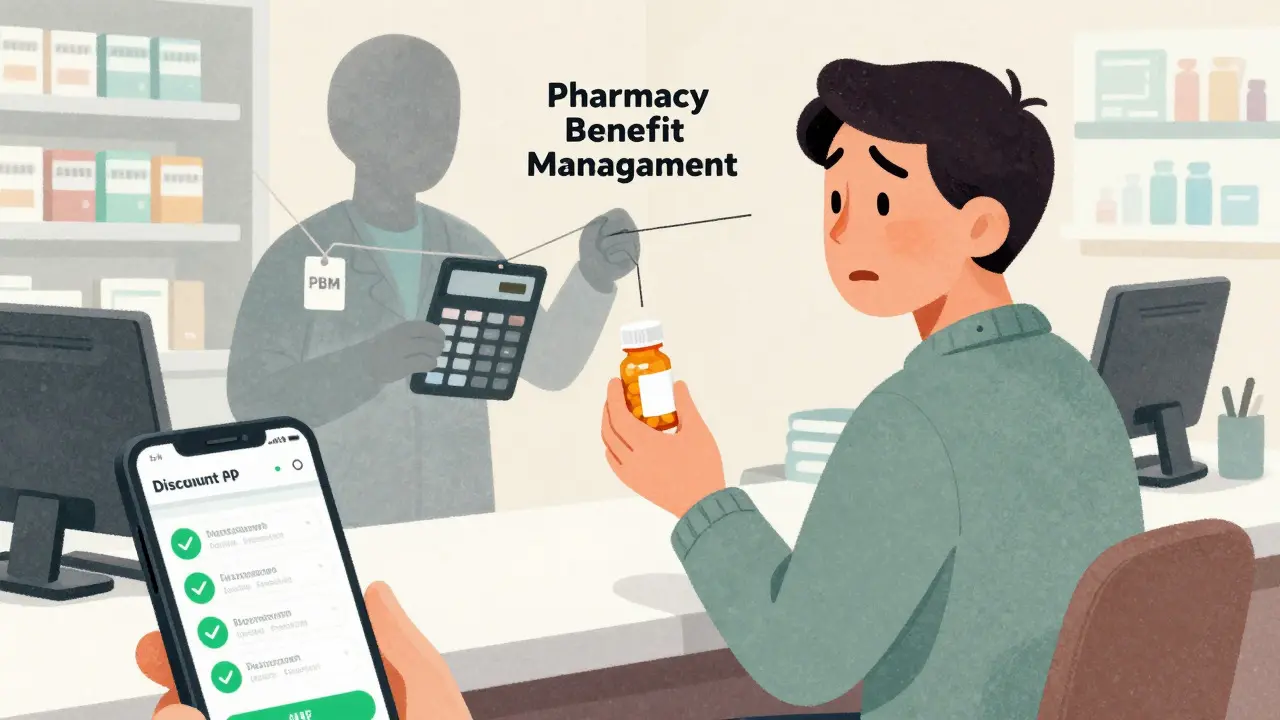
If generics are so cheap, why do some patients still see surprisingly high bills? Enter Pharmacy Benefit Managers (PBMs), the middlemen between insurers, pharmacies, and drug manufacturers. PBMs negotiate prices on behalf of insurers, but their business model can sometimes work against transparency. One controversial practice is "spread pricing." Here’s how it works: a PBM might pay a pharmacy $10 for a generic drug but charge the insurer $15, keeping the $5 difference as profit. While this doesn’t always hurt the patient directly if their copay is fixed, it inflates the overall cost of care for the insurance pool. Dr. Aaron Kesselheim from Harvard Medical School noted in a 2021 Health Affairs analysis that spread pricing can sometimes result in higher net costs for certain generic medications, undermining the potential savings. Additionally, PBMs may incentivize pharmacies to stock higher-priced generics if those manufacturers offer rebates. This creates a situation where the "cheapest" option on paper isn’t actually the cheapest for the system. Plan sponsors and patients alike need to be aware that not all generics offer equivalent value. Periodic reviews of specific products driving spending can reveal opportunities to switch to truly low-cost alternatives.
Navigating Your Options: How to Maximize Savings
Knowing that generics save money is one thing; actually capturing those savings requires a bit of strategy. First, talk to your doctor. Ask them to write prescriptions without "dispense as written" instructions unless absolutely necessary. This allows pharmacists to substitute the generic version automatically. Most states allow this substitution by default, but explicit permission ensures no roadblocks. Second, compare prices. Don’t assume your insurance plan offers the best deal for every drug. A 2023 economic evaluation published in PMC found that patients could have spent less on 11.8% of prescriptions filled for generic drugs if they purchased from transparent pricing models like the Mark Cuban Cost Plus Drug Company instead of using insurance. Uninsured individuals saw median savings of $6.08 per prescription. Even insured patients with high-deductible plans often find better rates by paying cash with a coupon from services like GoodRx or SingleCare. Third, consider mail-order options for maintenance medications. For chronic conditions requiring daily pills, mail-order pharmacies often provide bulk discounts that brick-and-mortar stores can’t match. The learning curve for comparing prices is low-most patients spend only 5-7 minutes per prescription using free digital tools. While elderly patients might need assistance with digital literacy, the time investment pays off quickly. One study in JAMA Internal Medicine found that patients who actively compared generic prices saved an average of $287 annually.
The Future of Generic Affordability
Looking ahead, the landscape of generic medications continues to evolve. The FDA approved 700 generic drug applications in 2022, and preliminary data for 2023 shows similar momentum. The Inflation Reduction Act of 2022 includes provisions expected to save Medicare beneficiaries $105 billion on prescription drugs through 2031, largely by accelerating generic and biosimilar competition. However, challenges remain. The FDA identified 202 "at-risk" generic medications vulnerable to shortage in early 2023, which can temporarily inflate prices due to scarcity. Additionally, brand manufacturers often use "evergreening" tactics-making minor changes to a drug to extend patent protection-and engaging in "pay-for-delay" agreements to keep generics off the market longer. The Department of Justice continues to investigate these antitrust issues, aiming to ensure that competition drives prices down as intended. Despite these hurdles, the consensus among healthcare economists is clear: generic competition remains the single most effective mechanism for reducing pharmaceutical costs. With blockbuster drugs losing patent protection regularly, the Congressional Budget Office projects continued annual savings of $250-350 billion through 2030. For patients, staying informed and proactive about generic options is the best way to harness these systemic savings.
Are generic medications as effective as brand-name drugs?
Yes. The FDA requires generic drugs to be bioequivalent to their brand-name counterparts, meaning they contain the same active ingredients, dosage form, strength, and intended use. They must meet identical standards for quality, purity, and stability. While inactive ingredients (like dyes or fillers) may differ, the therapeutic effect is the same.
Why do some generic drugs still seem expensive?
Not all generics are priced equally. Factors include the number of manufacturers competing, pharmacy benefit manager (PBM) rebate structures, and "spread pricing" practices. Some generics may have limited competition or be part of complex insurance contracts that don't reflect true wholesale costs. Comparing prices across pharmacies or using cash-pay discount programs can often reveal lower options.
How much can I save by switching to generics?
On average, generic drugs cost 80-85% less than brand-name equivalents. The average copay for a generic is $6.16 compared to $56.12 for a brand. In 2022, generics generated $408 billion in savings for the U.S. healthcare system. Individual savings vary based on insurance plans and specific medications, but many patients save hundreds of dollars annually by choosing generics.
What is the Hatch-Waxman Act?
Passed in 1984, the Hatch-Waxman Act created a streamlined approval process for generic drugs called the Abbreviated New Drug Application (ANDA). It allows generic manufacturers to skip costly clinical trials by proving bioequivalence to existing brand-name drugs, significantly reducing development costs and enabling faster market entry.
Should I use my insurance or pay cash for generics?
It depends on your specific plan and the drug. For many generic medications, especially those with low wholesale costs, paying cash with a discount coupon (like GoodRx) can be cheaper than using insurance, particularly if you have a high deductible. Always compare the out-of-pocket cost with and without insurance before filling your prescription.