

PDE5 Inhibitor & Nitrate Safety Checker
Select the medication you took recently and when, then select the nitrate you are considering taking. This tool calculates if it is safe based on FDA/ACC guidelines.
1. Which PDE5 Inhibitor did you take?
2. When did you take it?
3. Do you need a Nitrate?
Status
Select your medication and time above to see the safety status.
Important Disclaimer
This tool provides general information based on standard clinical guidelines (FDA/AHA). It does not replace professional medical advice. Individual factors like kidney function, age, and other medications can affect metabolism. If you experience chest pain after taking a PDE5 inhibitor, do NOT take nitroglycerin without consulting emergency services first.
Imagine you’re dealing with angina, so your doctor prescribes nitroglycerin to keep your heart happy. A few weeks later, you visit a urologist for erectile dysfunction (ED) issues and get handed a box of Sildenafil. You take both because they help different problems, right? Wrong. That specific combination can trigger a sudden, dangerous crash in your blood pressure. It’s not just a mild dizzy spell; it’s a medical emergency waiting to happen. The interaction between Phosphodiesterase type 5 (PDE5) inhibitors and nitrates is one of the most critical drug interactions in modern medicine, yet thousands of patients still slip through the cracks every year.
| Point | Detail |
|---|---|
| The Risk | Severe hypotension (dangerously low blood pressure) leading to fainting, heart attack, or stroke. |
| The Mechanism | Nitrates boost cGMP production; PDE5 inhibitors stop its breakdown. Together, they cause excessive vasodilation. |
| The Rule | Avoid nitrates for at least 24 hours after taking Sildenafil/Vardenafil/Avanafil, and 48 hours after Tadalafil. |
| The Exception? | New studies suggest stable heart disease patients might tolerate controlled use, but guidelines haven't changed yet. |
| Action Item | Tell every doctor about all meds. Check labels for "nitrate" warnings. Never mix without explicit clearance. |
Why These Two Drug Classes Clash So Badly
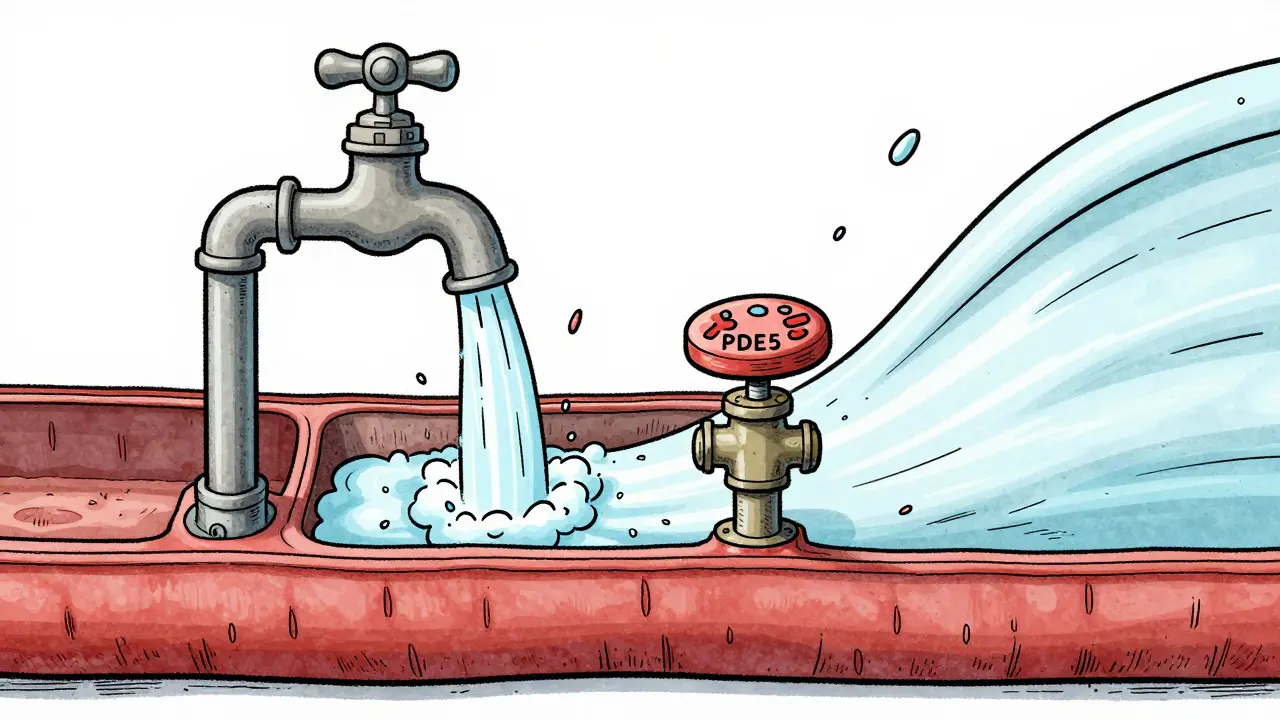
To understand why this mix is risky, you have to look at what happens inside your blood vessels. Both PDE5 inhibitors and nitrates work by widening your blood vessels (vasodilation), but they hit the same target from opposite ends. Think of it like draining a bathtub. Nitrates turn on the tap to fill the tub with water called cyclic guanosine monophosphate (cGMP). This chemical tells your smooth muscles to relax, letting blood flow more freely. Normally, an enzyme called phosphodiesterase type 5 acts as the drain, breaking down cGMP when it’s time for vessels to tighten up again.
PDE5 inhibitors block that drain. They stop the enzyme from working, so cGMP builds up. When you add nitrates to the mix, you are turning on the tap full blast while simultaneously plugging the drain. The result? A massive accumulation of cGMP. Your blood vessels dilate way beyond what your body can handle, causing systemic vascular resistance to plummet. This leads to a sharp drop in blood pressure. Clinical trials have shown systolic blood pressure drops of over 30 mmHg in nearly a quarter of patients who took avanafil with sublingual nitroglycerin. For some, that’s enough to cause syncope (fainting) or reduce blood flow to the heart muscle itself.
The Specific Drugs Involved
Not all ED medications are created equal, nor are all nitrates. Knowing the names matters because the duration of risk varies significantly. The four main PDE5 inhibitors approved by the FDA include:
- Sildenafil (Viagra): The original blockbuster. Half-life is short (3-5 hours).
- Vardenafil (Levitra): Similar profile to Sildenafil.
- Tadalafil (Cialis): Known as "The Weekend Pill." Its half-life is much longer, around 17.5 hours.
- Avanafil (Stendra): Newer, faster-acting, with higher specificity for the PDE5 enzyme.
On the other side, we have organic nitrates. These are commonly used for angina (chest pain) and heart failure. Common forms include:
- Glyceryl trinitrate (GTN/Nitroglycerin): Often taken as a spray or tablet under the tongue for acute attacks.
- Isosorbide mononitrate/dinitrate: Usually taken daily as pills to prevent angina.
- Transdermal patches: Sticky patches applied to the skin that release nitrates slowly.
Don’t forget recreational drugs. "Poppers," which contain amyl nitrite, are also nitrates. People sometimes combine poppers with ED meds for enhanced sexual experience, unaware that they are triggering the exact same dangerous physiological cascade. If you use poppers, you must treat them as a strict contraindication for PDE5 inhibitors.
How Long Do You Have to Wait?
This is where many patients get tripped up. The wait time isn't arbitrary; it depends on how long the PDE5 inhibitor stays active in your system. The American Heart Association and FDA provide clear guidelines based on pharmacokinetics.
| PDE5 Inhibitor | Half-Life | Minimum Time to Wait Before Nitrate Use |
|---|---|---|
| Sildenafil | 3-5 hours | 24 hours |
| Vardenafil | 4-5 hours | 24 hours |
| Avanafil | ~5 hours | 24 hours |
| Tadalafil | 17.5 hours | 48 hours |
If you take Tadalafil on Friday night, you shouldn’t touch a nitrate until Sunday morning at the earliest. With Sildenafil, Saturday morning is safer. But here’s the catch: if you are on a daily nitrate regimen (like Isosorbide Mononitrate), you generally cannot take any PDE5 inhibitor unless your cardiologist has specifically cleared you and adjusted your treatment plan. It’s not just about timing a single dose; it’s about steady-state levels in your blood.
Real-World Risks and Patient Experiences
You might think, "My doctor knows best, so I'm safe." But data suggests otherwise. A study analyzing electronic health records found that only about 27% of patients co-prescribed these drugs received a documented warning. Another survey showed 6.3% of Sildenafil prescriptions were filled within 24 hours of a nitrate prescription. That means people are walking out of pharmacies with two conflicting scripts and no idea they could pass out on their way home.
Personal stories highlight the danger. One patient reported passing out after taking nitroglycerin just 12 hours after his Sildenafil dose, despite his cardiologist saying it was safe. Another noted that his urologist never mentioned the nitrate risk until he asked specifically after bypass surgery. These aren't rare anomalies; they reflect gaps in communication between specialists. Urologists focus on ED; cardiologists focus on the heart. Neither always checks the other's list thoroughly.
The symptoms of this interaction aren't subtle. You might feel intense lightheadedness, nausea, sweating, and blurred vision. In severe cases, the drop in blood pressure reduces coronary perfusion pressure. Paradoxically, this can worsen angina or even trigger a myocardial infarction (heart attack) because the heart muscle doesn't get enough oxygen-rich blood, even though the vessels are wide open. Strokes are another potential outcome due to reduced cerebral perfusion.

Is the Contraindication Absolute?
For decades, the answer was a hard "no." However, recent research is shaking things up. A large Danish nationwide cohort study tracking over 35,000 events found no statistically significant association between concomitant use and cardiovascular adverse events in stable patients. Some experts argue that in carefully selected patients with stable ischemic heart disease, the theoretical risk might be overstated.
Despite this emerging evidence, major bodies like the American College of Cardiology and the European Medicines Agency remain cautious. Current guidelines still label the combination as contraindicated. Why? Because the stakes are high. While some patients might tolerate it, others-especially those with underlying left ventricular dysfunction or volume depletion-can crash hard. Until definitive randomized controlled trials (like the ongoing NIH study NCT05211098) prove it’s safe for broader populations, sticking to the old rules is the smartest move.
Practical Steps to Stay Safe
So, how do you navigate this minefield? Here is a checklist for anyone managing both heart conditions and ED.
- Consolidate Your Med List: Keep a physical card or digital note with every medication you take, including supplements and recreational drugs like poppers. Show this to every new doctor.
- Ask Direct Questions: Don’t assume. Ask your urologist: "I take nitroglycerin/isosorbide for my heart. Is this ED med safe for me?" Ask your cardiologist: "I want to try ED meds. What are my options given my nitrates?"
- Watch for Hidden Nitrates: Be aware that some chest pain remedies or herbal supplements might contain nitrate-like compounds. Read labels carefully.
- Emergency Protocol: If you take a PDE5 inhibitor and develop chest pain, tell paramedics immediately. They need to know NOT to give you standard nitroglycerin for the heart attack. This information can save your life in the ER.
- Consider Alternatives: If you absolutely need nitrates, ask about non-PDE5i treatments for ED, such as alprostadil injections or vacuum erection devices, which don't interact with blood pressure meds in the same way.
The interaction between PDE5 inhibitors and nitrates is a classic example of why drug synergy can be deadly. It’s not just about side effects; it’s about overwhelming a physiological pathway. By understanding the mechanism-the cGMP buildup-and respecting the washout periods, you can manage both your heart health and your quality of life without risking a catastrophic drop in blood pressure. Communication is your best defense. Make sure every provider knows what you’re taking, and never self-medicate with nitrates after taking an ED pill.
Can I take aspirin with PDE5 inhibitors and nitrates?
Yes, aspirin does not interact with PDE5 inhibitors or nitrates in the same dangerous way. It affects platelets, not the cGMP vasodilation pathway. However, always consult your doctor before adding any new medication, especially if you have bleeding risks.
What should I do if I accidentally took both?
Sit or lie down immediately to prevent falling if you faint. Drink water if you can swallow safely. Seek emergency medical attention, especially if you feel dizzy, confused, or have chest pain. Tell the responders exactly what you took and when.
Are dietary nitrates safe with PDE5 inhibitors?
Generally, yes. Foods rich in nitrates like beetroot, spinach, and arugula raise nitric oxide levels slightly, but not enough to cause the severe hypotensive crisis seen with pharmaceutical nitrates. Moderate consumption is usually safe, but extreme supplementation should be discussed with your doctor.
Does Tadalafil require a longer wait time than Viagra?
Yes. Tadalafil (Cialis) has a half-life of approximately 17.5 hours, compared to Sildenafil's 3-5 hours. Therefore, you must wait at least 48 hours after taking Tadalafil before using nitrates, whereas the wait for Sildenafil is 24 hours.
Can I use nitrate creams for anal fissures with ED meds?
It depends on the concentration and absorption. Topical nitrates can still enter the bloodstream. Even if local, systemic absorption occurs. Consult your specialist; they may advise stopping the cream temporarily or choosing a different ED treatment to avoid unpredictable blood pressure drops.


Owen John, August 30, 2026
It’s almost poetic, isn’t it? The pharmaceutical industry sells us one drug to fix the plumbing and another to keep the pressure up, yet they act shocked when we mix them. I’ve always suspected that the guidelines are more about liability protection than actual physiological nuance. If a stable patient can tolerate it in a Danish cohort study, why do American doctors still treat this like radioactive waste? It feels like gatekeeping health knowledge for the masses.
Betty Childers, August 31, 2026
This is such a common issue actually. My dad had exactly this problem. He took his daily nitrate and then popped a blue pill for date night. Ended up in the ER with BP of 70/40. Scary stuff. Glad you wrote this out clearly.
Thhomas Fox, September 1, 2026
Nice breakdown. Communication is key here.
Alex Brown, September 2, 2026
The bathtub analogy is particularly effective for laypeople because it visualizes the accumulation rather than just stating 'vasodilation.'
We often underestimate how counterintuitive pharmacokinetics are to the average person. People think of drugs as on/off switches, not dynamic curves with half-lives. When you explain that Tadalafil lingers for two days while Sildenafil fades faster, it changes the behavioral model from 'take before sex' to 'plan your weekend around your heart meds.'
I also appreciate the mention of poppers. That demographic often skips the pharmacy consultation entirely, assuming recreational use bypasses medical contraindications. It doesn't. The cGMP pathway doesn't care if the molecule came from a prescription bottle or a small glass vial at a club.
Perhaps the most critical takeaway is the emergency protocol. Paramedics default to nitrates for chest pain. If a patient has taken a PDE5i within the last 24-48 hours, administering nitroglycerin can be fatal. This is a piece of information that should arguably be on every ED medication box, not just buried in the fine print or discussed only if the patient remembers to ask.
Ultimately, this interaction highlights the fragmentation of modern healthcare. The urologist treats the erection; the cardiologist treats the artery. Neither owns the whole patient. Until electronic health records truly talk to each other in real-time across different specialties, patients remain the primary safety net. We have to be our own advocates, carrying that list of medications everywhere, because no algorithm currently protects us from human oversight quite perfectly.
joyce Hogewoning, September 3, 2026
oh my god this is so true i literally almost died because of this exact thing like 3 years ago and i was so mad at my doctor for not telling me but honestly i probably wouldnt have listened anyway cause who reads the pamphlet right?? its wild how dangerous these combos are when you dont know the science behind it
Amy Zalkin, September 4, 2026
omg yes!! i had no idea about the tadalafil 48 hour rule until i read this. i thought since it wears off after a day or two it was chill but nope. glad i checked labels now lol. thanks for sharing!
Maneesh kv, September 6, 2026
Bro this is HUGE info 🚨🚨 Most guys just go buy Cialis online and ignore their heart meds totally! 💊💔 You gotta respect the biology man! Your vessels don't lie! 🫀 Stay safe everyone, check those interactions! 👍👍
Lilian Binda, September 7, 2026
dis is exactly what happens when people stop reading instructions. in nigeria we say if you want to play with fire you must expect heat. these drugs are serious business not candy. doctors should warn patients properly and patients should listen. simple.
John Park, September 9, 2026
the mechanism described is reductive though. it ignores the role of endothelial function variability in older adults. not everyone metabolizes cGMP at the same rate due to genetic polymorphisms in PDE5 expression. treating it as a binary switch is bad science imo. also the danish study cited has selection bias issues regarding 'stable' definitions. typical pharma-friendly narrative pushing for broader usage despite risks.
Fabian Saldana, September 9, 2026
Excellent resource for anyone navigating these waters. It is vital to remember that consistency in communication with healthcare providers saves lives.
By maintaining an open dialogue about all substances consumed, including over-the-counter supplements and recreational items, individuals can proactively manage their cardiovascular health without sacrificing quality of life.
Let this serve as a reminder to review your medication regimen regularly and seek clarification whenever new prescriptions are introduced. Safety first, always.
Colin Finch, September 9, 2026
Blimey, that drop in pressure sounds absolutely terrifying! Imagine fainting mid-date 😱. Brilliantly explained though, especially the bit about the drain and the tap. Makes perfect sense now why the wait times differ. Must share this with my grandad, he's always popping pills like sweets.
Kathleen McGrath, September 11, 2026
So helpful! I didn't realize beetroot was okay but poppers were not. Good to know. Thanks for explaining it simply.
Lemuel Gomez, September 13, 2026
I agree with the point about specialist silos.; it really is the core issue here.; urologists and cardiologists rarely speak directly.; this leaves the patient in the middle.; holding all the data.; and making the final call.; which is unfair.; but necessary.;
Emmanuel Umana, September 13, 2026
In many cultures, men hesitate to discuss sexual health openly. This leads to self-medication without proper guidance. Education is the bridge. We must normalize these conversations.
Kaylyn Mello, September 13, 2026
yeah totally agree with the communication part. its scary how easy it is to miss things when you see different doctors. good post