
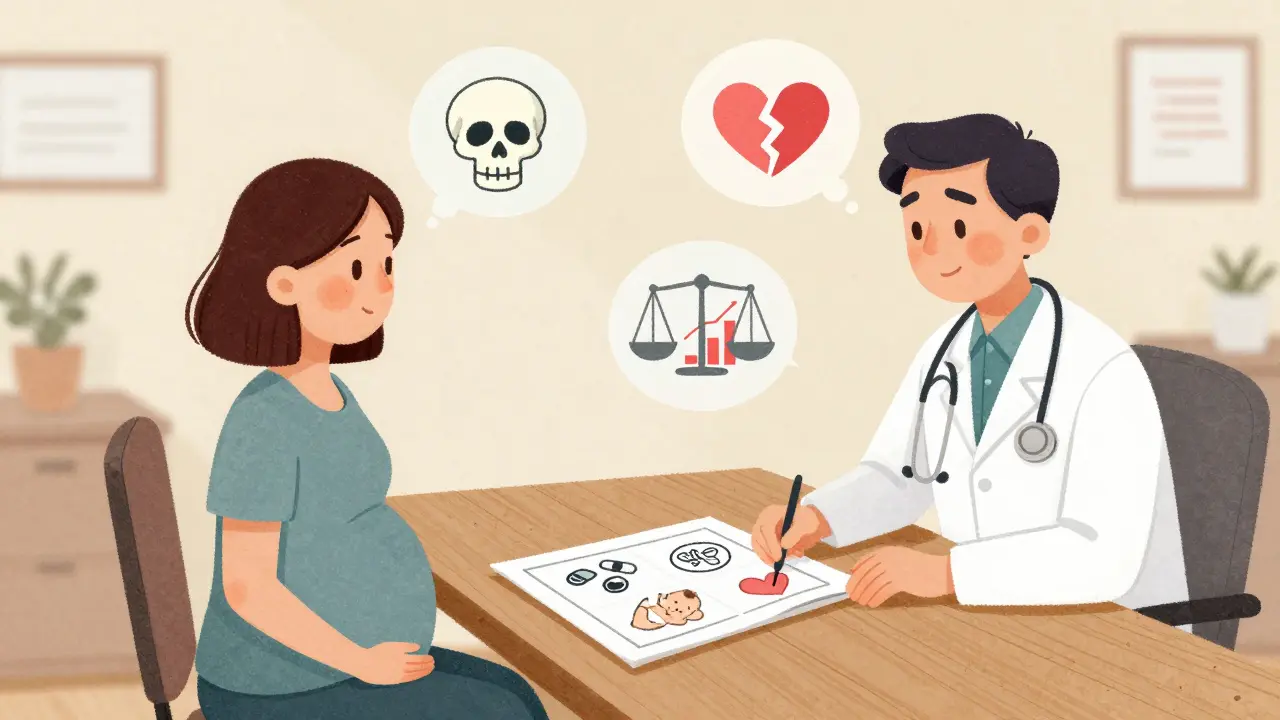
When you’re pregnant and managing a mental health condition, the question isn’t just whether to take medication-it’s how to decide, with confidence, in a world full of fear and conflicting advice.
Every year, thousands of pregnant people face this exact crossroads. They’ve been stable on antidepressants or mood stabilizers. Then comes the pregnancy test. Suddenly, every article, every well-meaning friend, every online forum screams: Stop now. It’s dangerous. But what if stopping means falling apart?
Here’s the truth no one tells you: There is no risk-free choice. Not taking medication carries real danger. So does taking it. The only way forward is shared decision-making-a process where you and your provider weigh real numbers, not myths, to find the path that protects both you and your baby.
Why Shared Decision-Making Isn’t Just a Buzzword
Shared decision-making isn’t about handing you a pamphlet and saying, ‘You decide.’ It’s a structured conversation built on facts, values, and trust. The British Association for Psychopharmacology and the American College of Obstetricians and Gynecologists both say this approach is the standard of care-not a suggestion, but a requirement.
Why? Because untreated depression, anxiety, or bipolar disorder during pregnancy increases the risk of preterm birth by 62%, and maternal suicide risk by 20%. These aren’t rare outcomes. They’re documented, measurable, and preventable.
Meanwhile, the fear of birth defects from medications often outweighs the actual risk. For example, paroxetine (Paxil) carries a slightly higher chance of heart defects-rising from about 8 in 1,000 births to 10 in 1,000. That’s a 25% increase, but the absolute risk is still low. Compare that to the 30-50% higher chance of preterm birth if depression goes untreated. Which risk are you really trying to avoid?
Which Medications Are Actually Safe?
Not all psychiatric medications are created equal. Some have decades of safety data. Others? Not so much.
SSRIs are the first-line choice for depression and anxiety during pregnancy. Sertraline (Zoloft), citalopram (Celexa), escitalopram (Lexapro), and fluoxetine (Prozac) are all considered low-risk options. Studies involving over 15,000 pregnant women show no consistent link to major birth defects-with one exception: paroxetine. That’s why most providers avoid it unless other options have failed.
For bipolar disorder, lamotrigine is the go-to. It’s been studied in thousands of pregnancies and shows no increased risk of major malformations. Lithium works too, but it needs careful monitoring. Pregnancy changes how your body processes it-your kidneys work faster, your blood volume increases-so your dose might need adjusting every few weeks. Regular blood tests are non-negotiable.
Now, the big red flag: valproic acid (Depakote). It increases the risk of neural tube defects from 0.1% to 1-2%. That’s a 10- to 20-fold jump. It’s also linked to lower IQ and autism risk in children. If you’re on this drug and planning pregnancy, switch before conception. No exceptions.
Bupropion (Wellbutrin) has a small association with miscarriage and heart defects. Tricyclics like nortriptyline are less studied but can be used if SSRIs don’t work. For psychosis, older antipsychotics like haloperidol and chlorpromazine have better safety data than newer ones like risperidone or olanzapine-because the newer ones just haven’t been studied enough in pregnancy.
The Real Danger: Stopping Medication Without a Plan
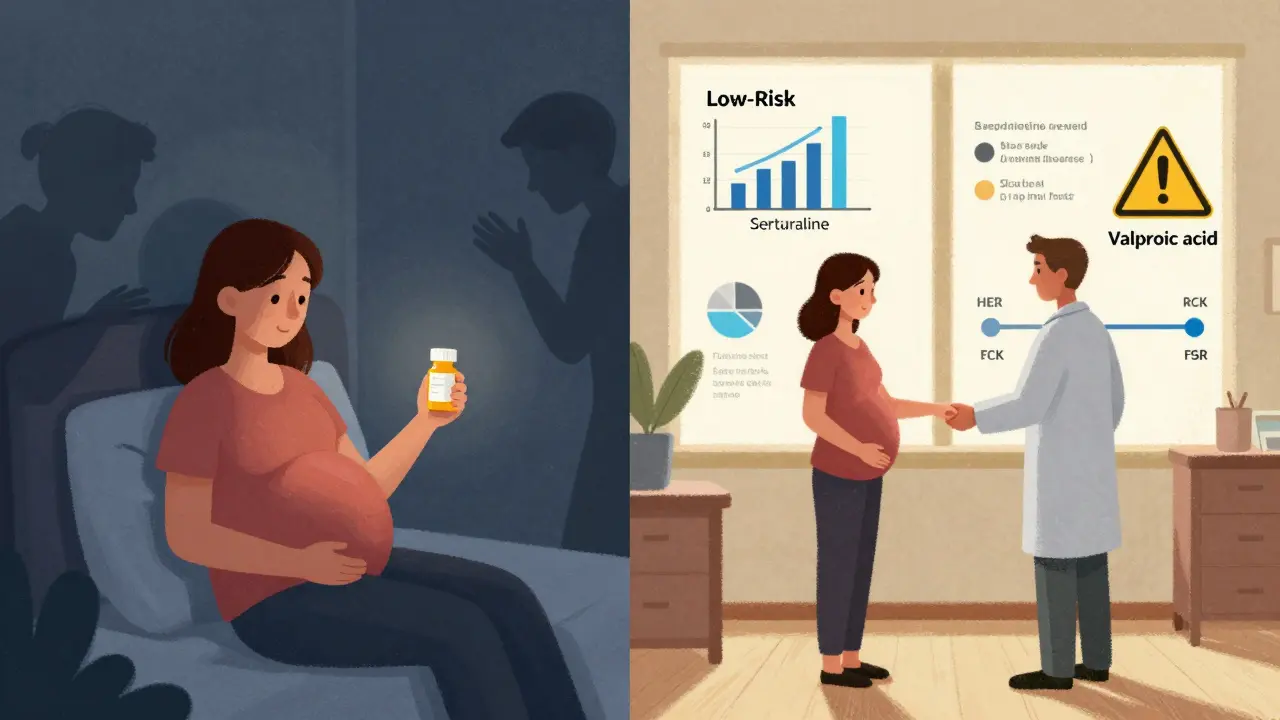
Here’s what the data doesn’t show you: 68% of pregnant people say they weren’t properly informed about their medication risks before getting pregnant. And 42% stopped taking their meds on their own-because they were scared.
The result? A 2022 survey by Postpartum Support International found that women who stopped medication without medical guidance were far more likely to be hospitalized after birth. One Reddit user wrote: ‘I went off my SSRI at 8 weeks. By 16 weeks, I couldn’t get out of bed. By 20 weeks, I was crying in the OB’s office, begging for help.’
Dr. Lee Cohen from Massachusetts General Hospital says it plainly: ‘If you stop treatment for severe depression during pregnancy, you have an 80% chance of relapse.’ That’s not a guess. That’s what the registry data shows.
Stopping medication doesn’t make you ‘brave.’ It makes you vulnerable. And the baby? They’re caught in the middle.
What Shared Decision-Making Actually Looks Like
This isn’t a one-time chat. It’s a process.
Step 1: Know your baseline. How many episodes have you had? How long were you stable before pregnancy? If you’ve had three major depressive episodes in the past five years, your relapse risk is over 70% if you stop meds. That’s not a number you ignore.
Step 2: Get the real numbers. Your provider should show you absolute risks, not percentages. ‘Paroxetine increases heart defect risk from 8 in 1,000 to 10 in 1,000’ is clearer than ‘slightly higher risk.’ ACOG’s free decision aid breaks this down for 24 medications-and it’s updated quarterly with new data.
Step 3: Plan for the worst. What if your anxiety spikes at 24 weeks? What if you can’t sleep, can’t eat, can’t get out of bed? Have a back-up plan: who to call, what dose to adjust, when to go to the ER. Most women who have this plan report feeling calmer, not more anxious.
And yes-document it. A 2021 AMA study found that when providers documented shared decision-making, malpractice claims dropped by 65%. It’s not about covering your back. It’s about making sure your voice is heard.
What’s New in 2026
The field is moving fast. The National Pregnancy Registry has tracked over 15,700 women since 2010. Now, they’re using that data to build predictive tools.
A pilot study from Massachusetts General Hospital used machine learning to predict individual responses to medication with 82% accuracy. That means in the near future, your provider won’t just say, ‘Most women tolerate sertraline.’ They’ll say, ‘Based on your age, weight, history of anxiety, and previous medication response, 8 out of 10 women like you stayed stable on 100mg of sertraline.’
By 2026, real-time data from the registry will be integrated into clinical tools. You’ll see your own risk profile-not a population average. That’s the future of care.
What You Can Do Right Now
If you’re pregnant or planning to be:
- Don’t wait until you’re 12 weeks along to talk about meds. Start the conversation before conception. Stability for at least 3 months before pregnancy cuts relapse risk by 40%.
- Ask for the ACOG Mental Health Medication Decision Aid. It’s free, evidence-based, and updated quarterly.
- If your OB doesn’t know about it, ask for a referral to a perinatal psychiatrist. 87% of ACOG members now consult them regularly-this isn’t rare anymore.
- Write down your fears. Write down your priorities. Is it avoiding any medication? Is it staying functional? Is it avoiding hospitalization? Bring that list to your appointment.
You’re not being selfish for wanting to stay well. You’re being responsible. A mother who is mentally stable is the best thing for her child-not a mother who’s medicated but terrified, or one who’s unmedicated but broken.
There’s no perfect choice. But there is a right choice-for you, right now. And it starts with a conversation, not a fear.
Are SSRIs safe during pregnancy?
Yes, most SSRIs like sertraline, citalopram, escitalopram, and fluoxetine are considered safe and are first-line treatments for depression during pregnancy. Studies show no consistent link to major birth defects. The exception is paroxetine, which has a small increased risk of heart defects and is generally avoided unless other options fail.
Can I breastfeed while taking mental health medication?
Many psychiatric medications are compatible with breastfeeding. Sertraline passes into breast milk in very low amounts and is often preferred. Fluoxetine builds up more in milk and may affect some infants, so it’s used more cautiously. Lithium requires close monitoring but can be used with proper dosing. Always discuss your specific medication with your provider before breastfeeding.
What if I’m on valproic acid and just found out I’m pregnant?
Contact your psychiatrist and obstetrician immediately. Valproic acid carries a 1-2% risk of neural tube defects and increased autism risk. Do not stop it abruptly-this can trigger seizures or mania. Your providers will help you switch to a safer alternative like lamotrigine as quickly and safely as possible.
Is it safe to stop my medication cold turkey during pregnancy?
No. Stopping abruptly can cause withdrawal symptoms and dramatically increase your risk of relapse-up to 80% for severe depression. Always taper under medical supervision. The risks of untreated illness often outweigh the risks of continuing medication.
How do I know if I need medication instead of therapy alone?
If you’ve had moderate to severe depression, anxiety, or bipolar disorder in the past, or if therapy alone hasn’t kept you stable in the past, medication is often necessary. Therapy helps-but for many, it’s not enough to prevent hospitalization, self-harm, or severe functional impairment during pregnancy. Your history matters more than your current mood.
Where can I find reliable information about medication safety in pregnancy?
The National Pregnancy Registry for Psychiatric Medications (womensmentalhealth.org) and the ACOG Mental Health Medication Decision Aid are the most reliable sources. Avoid relying on forums, social media, or anecdotal stories. These tools use real data from over 15,000 pregnant women and are updated quarterly.
What Comes Next
If you’re reading this and feeling overwhelmed, that’s normal. But you’re not alone. You’re not failing. You’re doing the hard work of protecting your health-and your baby’s future.
Reach out to your provider. Ask for the decision aid. Bring a friend or partner to your appointment. Write down your questions. You deserve to make this choice with clarity, not fear.
The goal isn’t to be perfect. It’s to be present. And that starts with a conversation-yours, your provider’s, and your baby’s.


Laia Freeman, January 30, 2026
OMG YES. I went off my Zoloft because my mom said it would make the baby a robot 😭 Then I spent 3 months crying in the shower and barely holding it together. My OB was like 'why didn’t you TALK to someone???' I didn’t know it was okay to ASK. This post is a lifeline.
paul walker, January 30, 2026
I was on lamotrigine during both pregnancies. My doc adjusted my dose every 3 weeks like clockwork. Blood tests were annoying but worth it. I have two healthy kids and zero regrets. You dont have to choose between being a mom and being well.
Pawan Kumar, January 31, 2026
This is precisely the kind of pharmaceutical propaganda pushed by Big Pharma and their affiliated medical institutions. The FDA has never conducted long-term studies on neurodevelopmental outcomes. Why are we ignoring the 2023 Lancet meta-analysis that links SSRIs to increased autism rates? The data is suppressed.
Kacey Yates, February 1, 2026
Valproic acid = stop immediately. No debate. I’ve seen the outcomes. Neural tube defects aren’t a risk they’re a guarantee if you dont switch. If your doc doesnt have a plan for you by week 6 you need a new doc. Period.
ryan Sifontes, February 2, 2026
Whatever. I stopped everything cold turkey. I’m fine. My kid’s fine. Everyone else is just overreacting. Why do people need pills to be happy? Maybe just… breathe?
Laura Arnal, February 3, 2026
This is everything. 🙏 I was terrified to tell my OB I was on Lexapro. She said ‘thank you for being honest’ and pulled up the ACOG tool right then. I cried. You’re not weak for needing help. You’re strong for asking. 💕
Jasneet Minhas, February 4, 2026
Interesting how Western medicine equates stability with chemical dependency. In my village in Punjab, we use turmeric, meditation, and family circles. No pills. No fear. Perhaps the real problem is not the illness… but the system that profits from it.
Eli In, February 5, 2026
I’m from the Philippines and we don’t talk about mental health at all. My mom said ‘just pray harder’ when I told her I was depressed. I’m so glad this exists. Thank you for giving me words to explain what I feel. 🌏❤️
Megan Brooks, February 5, 2026
The ethical framework here is compelling. The autonomy of the pregnant individual is paramount, yet the potential harm to the fetus necessitates a nuanced, evidence-based dialogue. One must consider not only the pharmacokinetic variables but also the psychosocial determinants of maternal well-being. This is not merely medical-it is existential.
Robin Keith, February 5, 2026
But… what if the real issue isn’t the medication… but the fact that society expects women to be perfect? To be both emotionally available and chemically inert? To carry a child without breaking? We’re told to be strong… but punished when we need help. So we take pills… but feel guilty. And then we blame the pills… when the real poison is the expectation itself. Do you see it? Do you see the trap?
Sheryl Dhlamini, February 6, 2026
I didn’t even know about the ACOG tool. My OB just handed me a pamphlet that said ‘some meds are safe.’ I had to Google everything myself. Why is this information so hard to find?
Doug Gray, February 7, 2026
The paradigm shift toward individualized risk profiling using ML is inevitable. We’re moving from population-based heuristics to predictive analytics grounded in longitudinal biometric datasets. This isn’t just clinical-it’s epistemological. The future of perinatal psychiatry is algorithmic.