
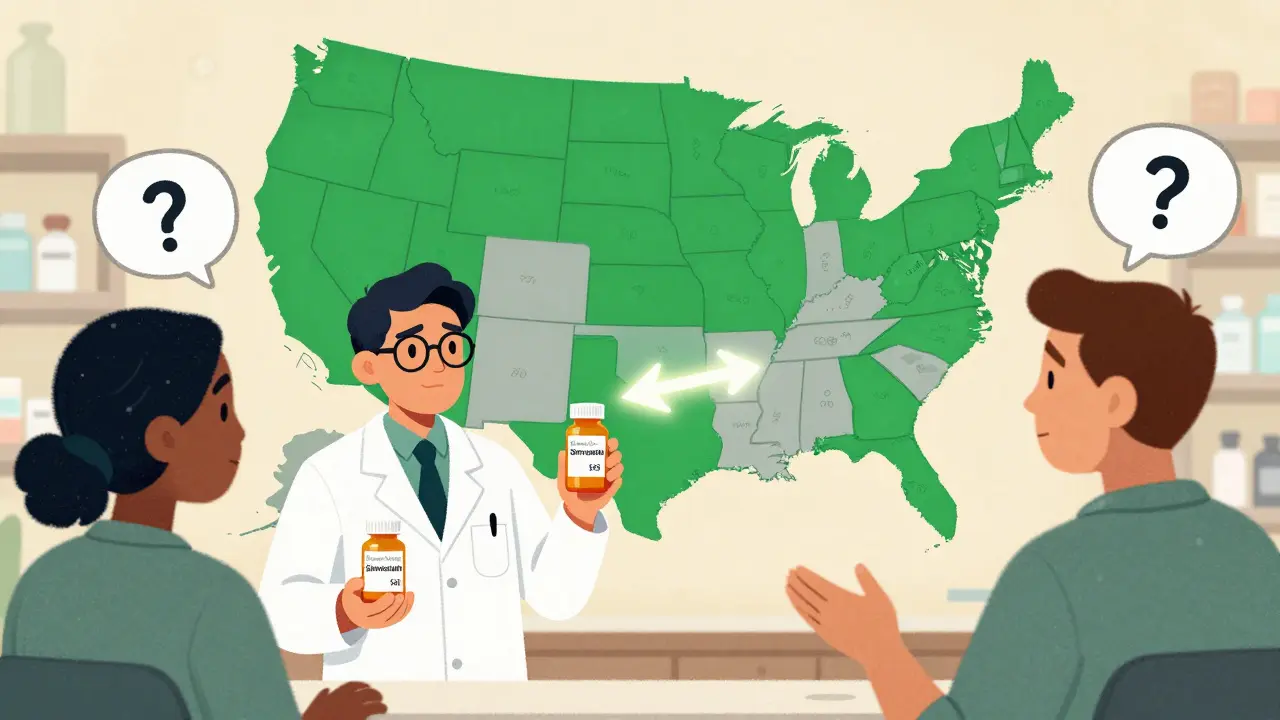
When you pick up a prescription, you might assume the pharmacist will always give you the cheapest version of your medicine. But that’s not true everywhere. In some states, pharmacists must swap your brand-name drug for a generic. In others, they can only do it if you say yes. These differences aren’t just paperwork-they directly affect how much you pay, whether you take your medicine, and even your health outcomes.
What’s the Real Difference Between Mandatory and Permissive Substitution?
Mandatory substitution means the law forces pharmacists to give you the generic version of a drug-unless your doctor specifically says not to. Permissive substitution means the pharmacist can switch it, but doesn’t have to. That tiny word-must vs. can-changes everything.
As of 2020, 19 states, including Alabama, Colorado, Maine, and West Virginia, require pharmacists to substitute generics whenever possible. That means if your prescription says "Simvastatin" and a generic is available, the pharmacist is legally obligated to give you the cheaper version. In the other 31 states, the pharmacist has the choice. They might swap it. They might not. It depends on their judgment, workload, or whether they think you’ll object.
This split didn’t come from the federal government. It came from states. After the Hatch-Waxman Act of 1984 let generic drugs enter the market, Congress decided: let each state figure out how to handle substitutions. That’s why today, you could walk into the same pharmacy in two different states with the same prescription-and walk out with two different medications.
It’s Not Just About Swapping-It’s About Consent, Notification, and Liability
There are four key rules that make these laws different beyond just "must" or "can":
- Duty to substitute: Is it required or optional?
- Notification: Does the pharmacist have to tell you they switched the drug-even if the bottle says "generic"?
- Consent: Do you have to sign or say yes before the switch?
- Liability: If something goes wrong after the switch, is the pharmacist protected from being sued?
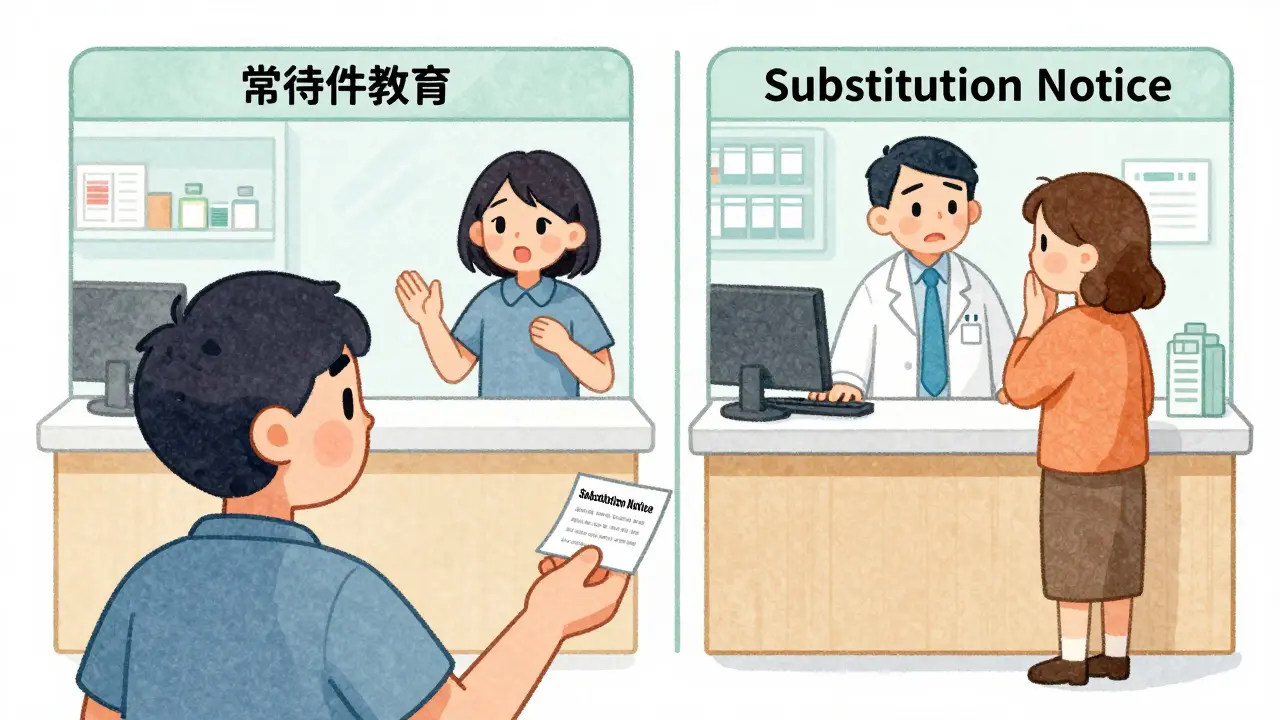
Thirty-one states and Washington, D.C., require pharmacists to notify you separately-like handing you a slip or telling you aloud-that a substitution happened. That’s separate from the label on the bottle. Seven states plus D.C. go further: they require your explicit consent. You have to say "yes" before they can swap it.
And here’s the scary part: 24 states don’t protect pharmacists from legal liability if you have a bad reaction after a generic substitution. That means even if the drug is FDA-approved as equivalent, the pharmacist could still be sued. No wonder some pharmacists play it safe and don’t swap anything unless they’re forced to.
How Much Does This Actually Affect Your Health and Wallet?
The numbers don’t lie. In states with mandatory substitution and no consent rule, nearly 98% of prescriptions for simvastatin-a common cholesterol drug-were filled with the generic version within six months of its patent expiring. In states that required patient consent, only 32% were.
That’s a 66-percentage-point gap. And it’s not just about convenience. When people don’t get generics, they often skip doses, delay refills, or stop taking the drug entirely because they can’t afford it. A 2011 study found that states with mandatory substitution filled 48.7% of simvastatin prescriptions with generics. In permissive states? Just 30%. That’s almost a 20-point difference in access.
Think about that. If you’re paying $150 for a brand-name drug instead of $25 for the generic, and you skip a month because you can’t afford it, your blood pressure or cholesterol might spike. That could lead to a hospital visit. That’s not hypothetical. Medicaid data shows these substitution laws directly impact emergency care costs.
The Congressional Budget Office estimated that increasing generic use by just 1% saves Medicare Part D $160 million a year. Multiply that across all states and all drugs, and you’re talking billions. These aren’t small savings-they’re life-or-death financial decisions.
Why Do Some States Fight Against Generic Substitution?
It’s not about safety. The FDA requires generics to be identical in active ingredients, strength, dosage, and performance to brand-name drugs. The difference? The filler, the color, the shape. Not the effect.
So why the resistance? Mostly, it’s about money. Brand-name drug companies spend millions lobbying in states with permissive substitution laws. They fund patient education campaigns that say things like, "Don’t risk your health with generics," even though the science says otherwise. They push for consent requirements, notification rules, and even "Dispense as Written" forms that make substitution harder.
Some states also create extra barriers for certain drugs-especially those with a narrow therapeutic index (NTI), like warfarin or levothyroxine. These drugs need to be in a very tight range to work safely. Some pharmacists fear even tiny differences in generics could cause problems. But studies show that when generics are properly regulated, substitution for NTI drugs is just as safe. Still, 11 states have extra rules for these drugs, making substitution harder even when it’s medically appropriate.
Biologics and Biosimilars: A Whole New Layer of Complexity
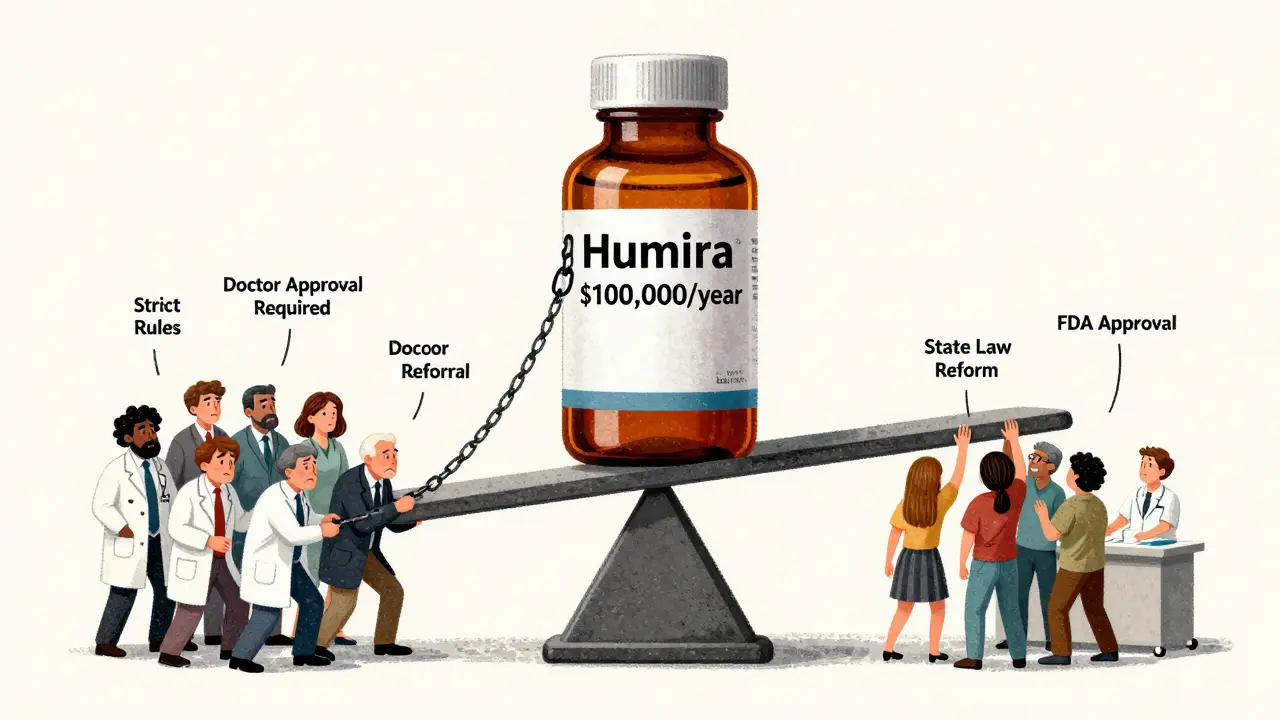
Now imagine the same rules-but for drugs that cost $100,000 a year. That’s where biologics come in: drugs made from living cells, like Humira or Enbrel. Their cheaper versions are called biosimilars. But here’s the catch: 45 states treat biosimilars completely differently than regular generics.
In most states, you can’t swap a biologic for a biosimilar unless your doctor approves it in writing. Some require the pharmacist to notify the doctor first. Others demand extra documentation or even prohibit substitution entirely. Only nine states and D.C. treat biosimilars the same way they treat regular generics.
Why? Because biologics are complex. They’re harder to copy exactly. And while the FDA says biosimilars are safe and effective, some doctors and patient groups remain cautious. But that caution is expensive. Biologics make up just 2% of prescriptions but 42% of total drug spending in Medicare Part D. If states made biosimilar substitution easier, billions could be saved.
What Does This Mean for You as a Patient?
If you’re on a chronic medication-especially one that’s expensive-know your state’s rules. If you’re in a mandatory substitution state, you’ll get the generic unless your doctor writes "Dispense as Written" on the prescription. If you’re in a permissive state, you might need to ask. Don’t assume the pharmacist will switch it.
Check your prescription label. If it says "generic" but you didn’t get a notification or ask for it, you might be in a state that doesn’t require consent. That’s fine-if you’re okay with it. But if you want the brand, speak up. You have the right to refuse substitution in every state.
And if you’re worried about safety: don’t be. Generics work the same. The FDA’s Orange Book is the official list of approved interchangeable drugs. Pharmacists use it to decide what they can swap. If your drug is listed there, it’s safe to substitute.
What Can You Do to Get the Best Deal?
- Ask your pharmacist: "Is this a generic? Can you substitute if I want?"
- Check your state’s pharmacy board website for current substitution laws.
- If you’re on a high-cost drug, ask your doctor to write "Dispense as Written" only if you truly need the brand.
- Use mail-order pharmacies-they often have better generic access and lower prices.
- Don’t let fear of generics stop you. They’re not inferior. They’re just cheaper.
Bottom line: the law is your ally-if you know how to use it. In states that force substitution, you’re getting the best price automatically. In states that don’t, you have to ask. Either way, you’re entitled to know what you’re getting-and you’re entitled to save money.
Do pharmacists have to tell me if they switch my brand-name drug to a generic?
In 31 states and Washington, D.C., pharmacists are legally required to notify you separately-like handing you a slip or telling you verbally-that a substitution happened. This is in addition to the "generic" label on the bottle. In other states, they don’t have to say anything unless you ask.
Can I refuse a generic substitution even if my state requires it?
Yes. Every state allows you to refuse a generic, even if substitution is mandatory. You just need to tell the pharmacist you want the brand-name version. Some states require the pharmacist to honor your request without question. Others may ask your doctor to confirm the request, but you still have the final say.
Are generics really as safe and effective as brand-name drugs?
Yes. The FDA requires generics to have the same active ingredients, strength, dosage form, and route of administration as the brand. They must also meet the same strict manufacturing standards. Differences in inactive ingredients (like fillers or dyes) don’t affect how the drug works in your body. Studies consistently show generics are just as safe and effective.
Why do some doctors write "Dispense as Written" on prescriptions?
Doctors use "Dispense as Written" (or "Do Not Substitute") to prevent the pharmacist from switching to a generic. This is usually done for drugs with a narrow therapeutic index-like thyroid meds or blood thinners-where even small differences might matter. But it’s also used when patients have had bad experiences with generics in the past, or when doctors are influenced by pharmaceutical marketing.
Do state substitution laws apply to biosimilars the same way they do to regular generics?
No. Most states have stricter rules for biosimilars. In 45 states, pharmacists can’t substitute a biosimilar for a biologic unless the doctor specifically allows it, often requiring written approval. Some states also require the pharmacist to notify the prescribing doctor or keep extra records. This is because biologics are more complex and expensive, and regulators are being more cautious-even though studies show biosimilars are safe.
What’s Next for Generic Substitution Laws?
The trend is clear: more states are moving toward mandatory substitution. The number jumped from 14 in 2014 to 19 in 2020. As drug prices keep rising and public pressure grows, more legislatures will likely follow suit.
But the big challenge ahead is biosimilars. With biologics making up nearly half of all drug spending, states will need to balance cost savings with safety concerns. Expect more debates over notification rules, recordkeeping, and whether pharmacists should be allowed to switch without doctor approval.
For now, the message is simple: know your rights. Ask questions. Don’t assume you’re getting the cheapest option. And if you’re paying too much for a drug that has a generic version-you’re not alone. The system is designed to save you money. You just need to know how to use it.


Paul Huppert, December 31, 2025
So if I’m in a permissive state, I gotta ask every time? Feels like I’m negotiating for my own health. I just want my meds to work, not play detective.
Hanna Spittel, January 2, 2026
GENERICS ARE A GOVERNMENT PLOY TO CONTROL US 😈 The fillers? They’re laced with microchips. I’ve seen the videos. 🤫💊
Brady K., January 3, 2026
Let me get this straight - we’ve got a $400 billion pharma industry lobbying to keep people paying $150 for pills that are chemically identical to $25 generics... and we call this capitalism? 🤡
It’s not a free market - it’s a rigged casino where the house prints the pills and the patients pay the rent. The FDA says it’s safe? Cool. But the real question is: who’s profiting from your confusion?
John Chapman, January 4, 2026
YES YES YES! I switched to generic lisinopril and saved $120/month. My blood pressure’s better too. 🙌 Don’t let fear cost you your health - or your rent.
Robb Rice, January 5, 2026
It's interesting to note that the variation in state laws reflects a deeper tension between federal regulatory authority and state-level autonomy in healthcare policy. While the FDA ensures equivalence, the legal framework governing substitution remains fragmented - a patchwork that complicates patient access across state lines.
Stewart Smith, January 5, 2026
My pharmacist never says anything. I just assume it’s generic unless I see the brand name. Guess I’m lucky I live in a mandatory state.
Also, I still don’t trust the blue pill that looks nothing like the white one. Weird, right?
Retha Dungga, January 6, 2026
why do we even have brands if they do the same thing 🤔 money is the only god now and we are all just sacrifices at the altar of profit 🕊️💸
Jenny Salmingo, January 8, 2026
I’m from Texas and we don’t get generics unless I ask. I just started saying "give me the cheap one" and now I save $80 a month. It’s not hard. Just speak up.
Sara Stinnett, January 9, 2026
Oh wow, so the FDA says it’s fine - but the real truth is that Big Pharma spends more on lobbying than on actual R&D. And we’re supposed to trust their "safety" claims?
Let’s be real: if generics were truly equal, why do they make brand-name drugs taste better? Because taste = placebo = profit. You think your body can’t tell the difference? It’s not the pill - it’s your brain being manipulated.
linda permata sari, January 10, 2026
OH MY GOD I JUST REALIZED - I’ve been paying $140 for my thyroid med for YEARS because I thought the brand was "better"...
I asked for the generic last week. Same pill. Same results. I cried. Not from sadness - from rage. Why didn’t anyone tell me?!?
Brandon Boyd, January 11, 2026
You don’t need to be a scientist to get this: if the FDA says it’s equivalent, it’s equivalent.
Stop letting fear and marketing dictate your health choices. Ask your pharmacist. Ask your doctor. If they’re not helping you save money, they’re not doing their job. You’ve got power - use it.
Branden Temew, January 12, 2026
So let me get this straight - we have a system where the law forces pharmacists to give you the cheaper version… unless the doctor writes "do not substitute" - which is often just because they got a free lunch from a pharma rep.
That’s not healthcare. That’s corporate theater with a stethoscope.
Urvi Patel, January 14, 2026
Let me be clear - generics are for peasants. Real people take brand-name drugs because they’re made with superior quality control and scientific integrity. You think the FDA doesn’t know the difference? They just don’t care.
anggit marga, January 14, 2026
why usa make laws like this we in nigeria we just take what pharmacy give us no papers no consent no drama money is money and medicine is medicine
Joy Nickles, January 16, 2026
Okay so I just looked up my state’s law and it says pharmacists must notify me - but my pharmacist gave me the generic AND didn’t say a word. I called the board. They said "it’s a gray area."
GRAY AREA?!?! I’m not a math problem. I’m a person who needs to know if my meds changed. This system is BROKEN. And no, I won’t stop complaining.