
Most people with IgA deficiency never know they have it. They live normal lives, never needing special care-until they need a blood transfusion. Then, what seems like a routine medical procedure can turn life-threatening. This isn’t rare. IgA deficiency affects about 1 in every 500 people in the UK and US, making it the most common primary immune disorder. But because it often causes no symptoms, many doctors don’t test for it unless something goes wrong-like a severe allergic reaction during a transfusion.
What Exactly Is IgA Deficiency?
Immunoglobulin A (IgA) is the body’s first line of defense in your nose, throat, lungs, and gut. It’s the antibody that stops germs from sneaking in through your mucous membranes. When your body doesn’t make enough IgA-less than 7 mg/dL-you have selective IgA deficiency. Your IgG and IgM levels stay normal, so your immune system still works in many ways. But without IgA, you’re more vulnerable to infections in your respiratory and digestive tracts. About 90% of people with this condition never have symptoms. The other 10% might get frequent ear infections, sinusitis, bronchitis, or pneumonia. Some develop chronic diarrhea, celiac disease, or autoimmune disorders like rheumatoid arthritis. Allergies are also common-eczema, asthma, hay fever-happening in about a quarter of symptomatic patients. Diagnosis is simple: a blood test. If your IgA level is below 7 mg/dL and your other antibodies are normal, that’s it. No fancy scans, no biopsies. Just a lab result. But because most people don’t get tested unless they’re having problems, many cases go undiagnosed until a transfusion triggers a reaction.The Hidden Danger: Blood Transfusions and Anti-IgA Antibodies
Here’s where things get dangerous. About 20 to 40% of people with IgA deficiency develop anti-IgA antibodies. These antibodies don’t cause problems on their own. But if you get blood that contains IgA-like standard donated red blood cells or plasma-your immune system attacks it. And that attack can be deadly. Reactions happen fast. In 85% of cases, symptoms start within the first 15 minutes of a transfusion. You might get hives, swelling, or a drop in blood pressure. In the worst cases, your airway closes, your heart struggles, and you go into anaphylactic shock. About 1 in 1,000 transfusions in IgA-deficient patients leads to a severe reaction. And up to 10% of those reactions are fatal. Why does this happen? Because your body sees IgA as a foreign invader. Even tiny amounts-less than 0.02 mg/mL-are enough to trigger a reaction. That’s why standard blood products are unsafe. A single unit of packed red blood cells can contain 10 to 20 mg of IgA. For someone with anti-IgA antibodies, that’s a bomb.How to Stay Safe During a Transfusion
If you know you have IgA deficiency, you must take steps before any surgery, hospital stay, or blood transfusion. Here’s what works:- Get tested for anti-IgA antibodies before any transfusion. An ELISA test checks for these antibodies. It’s about $150-$200, but it could save your life.
- Use IgA-depleted blood products. These are specially processed to remove nearly all IgA. They’re the gold standard.
- Washed red blood cells are an alternative. The blood is spun in a centrifuge to wash away plasma and IgA. This removes 98% of the protein, but it takes 30-45 minutes extra prep time.
- Never accept standard blood. Even if you’ve had transfusions before without issues, your antibody levels can change. Each exposure increases your risk.
What Hospitals and Doctors Should Know
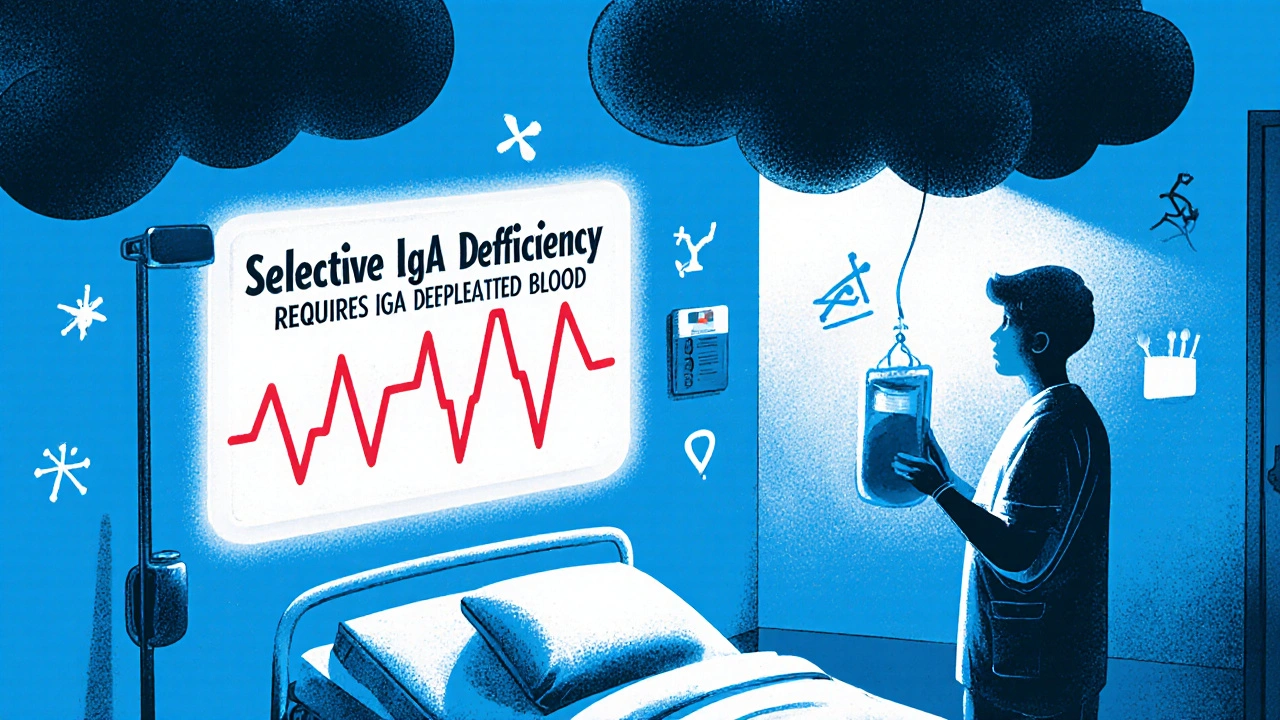
Too often, transfusion reactions happen in emergency rooms because no one knew the patient had IgA deficiency. About 78% of severe reactions occur when medical records aren’t available. That’s why carrying proof matters. The Immune Deficiency Foundation recommends every IgA-deficient person wear a medical alert bracelet or carry a card that says:“Selective IgA Deficiency - Requires IgA-Depleted Blood Products or Washed Red Blood Cells.”Doctors aren’t always trained on this. A 2023 patient survey found that 42% of IgA-deficient people had encountered healthcare workers who didn’t know how to handle their condition. That’s unacceptable. Hospitals should have protocols in place. Blood banks should flag IgA-deficient patients in their systems. And every transfusion service should stock IgA-depleted units.
Other Health Risks to Watch For
Even if you never need a transfusion, IgA deficiency can affect your long-term health. About 20-30% of people with this condition develop autoimmune diseases. The most common? Celiac disease. If you have IgA deficiency and digestive issues, get tested for celiac with a tissue transglutaminase antibody test-even if you’re not losing weight or having diarrhea. You’re also at higher risk for chronic lung infections. Over time, repeated pneumonia or bronchitis can lead to bronchiectasis-permanent damage to your airways. That’s why annual lung function tests and regular check-ups with an immunologist are important. Some people develop allergies to foods or environmental triggers. If you’ve had unexplained rashes, asthma, or anaphylaxis to foods like milk or eggs, IgA deficiency could be part of the puzzle.
What’s New in Treatment?
There’s no cure for IgA deficiency. But research is moving forward. A new experimental therapy uses lab-made human IgA to replace what the body can’t make. As of October 2023, only 12 patients worldwide had received it in clinical trials. Early results show promise-no reactions, improved mucosal immunity. But it’s years away from being available. For now, the best treatment is prevention: avoiding infections, managing autoimmune conditions, and always using safe blood products. Some patients who need frequent transfusions get pre-medication-steroids and antihistamines-before each unit. This cuts reaction rates by 75%.Living Well With IgA Deficiency
The good news? Most people with IgA deficiency live full, normal lives. Life expectancy is nearly the same as the general population-95% of patients have no reduction. Only those with severe complications like bronchiectasis or autoimmune organ damage face shorter lifespans. If you’ve been diagnosed:- Carry your medical alert card everywhere.
- Register your condition with your GP and local hospital.
- Ask your immunologist about annual celiac and lung tests.
- Inform all surgeons, dentists, and ER staff before any procedure.
- Join a patient support group. Many feel isolated-knowing others who understand helps.
Frequently Asked Questions
Can IgA deficiency be outgrown?
No. Selective IgA deficiency is a lifelong condition. While a small number of children may develop normal IgA levels by adulthood, this is rare-less than 5% of cases. Most people remain deficient for life. That’s why long-term precautions, especially around transfusions, are essential.
Can I donate blood if I have IgA deficiency?
No. People with IgA deficiency should not donate blood. Their blood contains anti-IgA antibodies, which can cause severe reactions in recipients who are also IgA-deficient. Even if you’ve never had a reaction yourself, you could unknowingly harm someone else. Blood banks screen donors for immunodeficiencies and will exclude you if you’ve been diagnosed.
Is IgA deficiency hereditary?
Yes. It often runs in families. If a parent has IgA deficiency, their children are about 50 times more likely to have it than the general population. Genetic testing isn’t routine, but if you have a family history and you’re diagnosed, it’s worth asking relatives to get tested-especially if they have frequent infections or autoimmune conditions.
Can vaccines cause problems for people with IgA deficiency?
No. Vaccines are safe and recommended. In fact, staying up to date on pneumococcal, flu, and COVID-19 vaccines is crucial because you’re more vulnerable to respiratory infections. The only exception is live vaccines in severely immunocompromised patients-but IgA deficiency alone doesn’t count as severe immunocompromise. Always check with your immunologist before getting any vaccine.
Why don’t all hospitals use IgA-depleted blood automatically?
Because most patients don’t know they have IgA deficiency until it’s too late. IgA-depleted blood is expensive and takes longer to prepare. Blood banks only stock it on request. Without a diagnosis or alert, hospitals use standard blood. That’s why patient education and medical alert systems are so important. Awareness saves lives.


Peter Lubem Ause, November 28, 2025
Wow, this is one of those topics that flies under the radar until it almost kills you. I didn’t realize IgA deficiency was this common-1 in 500 is insane. And the fact that a routine transfusion can turn deadly because of a protein you can’t even see? That’s terrifying. I’ve had blood work done before and never thought to ask about antibodies. This needs to be standard screening, not a last-minute emergency check.
Also, the part about anti-IgA antibodies developing over time? That’s wild. Even if you’ve had transfusions before without issue, your body can change. It’s like your immune system wakes up one day and says, ‘Hey, this guy’s not welcome.’
Medical alert bracelets should be mandatory. Not optional. Not ‘if you feel like it.’ If you’ve got this, you’re walking around with a silent time bomb. Hospitals need to treat this like a peanut allergy-no exceptions, no assumptions.
And why isn’t IgA-depleted blood just standard inventory? It’s not like it’s rocket science. They wash blood for other conditions. Why not this? Cost shouldn’t trump safety. Not when 10% of reactions are fatal.
I’m telling my doctor about this tomorrow. I’ve got a cousin with chronic infections and autoimmune issues. She’s never been tested. This could be her missing puzzle piece.
Also, can we talk about how weird it is that you can’t donate blood if you have this? You’re basically a walking hazard. That’s a weird twist-your condition makes you unsafe for others, even though you’re the one at risk. Irony at its finest.
And yeah, celiac link? Totally makes sense. My uncle had unexplained diarrhea for years. Turned out he had both. No one connected the dots until he was 60. We need better awareness in primary care.
This isn’t just a rare disorder. It’s a systemic failure in how we handle invisible immune conditions. We wait for someone to almost die before we pay attention. That’s not healthcare. That’s negligence dressed up as protocol.
linda wood, November 29, 2025
So let me get this straight-we’re telling people to carry a card because doctors are too lazy to ask the right questions? 😒
And yet we still use ‘standard’ blood like it’s 1985. No wonder people die in ERs.
Also, why is this not on every pre-op checklist? Like, come on.
And don’t even get me started on ‘it’s rare’-it’s not rare. It’s just ignored.
Someone’s gotta start a petition. I’ll sign it.
Also, can we just make medical alert bracelets cool again? Like, with neon colors and memes? I’d wear one with ‘I’m not allergic to peanuts, I’m allergic to ignorance’ on it.
LINDA PUSPITASARI, November 29, 2025
OMG this is so important!! 🙏 I didn’t know IgA deficiency could be this dangerous 😱 I just had surgery last month and they gave me regular blood-what if I had antibodies?? 😨 I’m calling my doctor first thing Monday to get tested!!
Also the part about washing blood? That’s genius!! Why isn’t this common knowledge??
And YES to medical alert bracelets!! I’m getting one with a little heart and ‘IgA Deficient’ on it 💙
Also my cousin has celiac and weird allergies-this explains SO MUCH!!
PLEASE SHARE THIS WITH EVERYONE YOU KNOW!!
Also vaccines are safe?? Thank god!! I was scared to get my flu shot 😅
Also can we make a TikTok about this?? I’ll do it!!
Thank you for writing this!! You saved lives!! 🤍
gerardo beaudoin, November 29, 2025
This is the kind of info that should be taught in high school health class. I had no idea. I’ve had two transfusions and never thought to ask. I’m lucky I didn’t react. But now I’m gonna get tested. My mom’s got chronic bronchitis-maybe she’s got this too. Simple blood test, big consequences. Why isn’t this standard?
Sullivan Lauer, November 30, 2025
Let me tell you something-this isn’t just a medical footnote. This is a quiet epidemic hiding in plain sight. Every year, people die in hospitals because someone didn’t think to ask, ‘Do you have any immune disorders?’ They assume ‘no symptoms’ means ‘no risk.’ That’s not just ignorance-it’s arrogance.
Imagine being a kid with recurrent ear infections, and your doctor says, ‘You’ll grow out of it.’ Then, ten years later, you’re in the ER, your blood pressure’s crashing, and the nurse says, ‘We don’t have that kind of blood here.’
And the fact that blood banks don’t stock IgA-depleted units unless you specifically request it? That’s like saying, ‘We don’t stock epinephrine unless you have a known allergy.’
People with this condition are walking targets. And the system treats them like they’re being dramatic. No. They’re being smart. They’re the ones who survived long enough to learn the hard way.
And the 42% of patients who ran into doctors who didn’t know what IgA was? That’s not a statistic. That’s a failure of medical education. That’s a failure of leadership. That’s a failure of humanity.
I’ve got a friend who almost died during a C-section. They gave her regular blood. She went into shock. They didn’t know why. It took three days to diagnose. Three days. She lost a kidney. She’s 32 now. She has a medical alert bracelet. She carries a laminated card in her wallet. She doesn’t trust hospitals anymore. And she’s not wrong.
This isn’t about science. It’s about dignity. About not dying because no one bothered to look up the right word in the textbook.
Joy Aniekwe, December 2, 2025
Oh wow, so now we’re blaming patients for not knowing they have a condition that’s *deliberately* not tested for unless they’re already dying? How convenient.
Let me guess-the hospitals are too ‘budget-constrained’ to stock IgA-depleted blood, but they’ll spend $12,000 on a new MRI machine that sits unused 80% of the time?
And the fact that you can’t donate blood if you have this? That’s just poetic justice. The system makes you a burden, then punishes you for being one.
Also, ‘It’s rare’-said every doctor who’s never met someone with it. 1 in 500. That’s like every classroom having one kid with this. And yet, we act like it’s a myth.
Who’s really at fault here? The patient who doesn’t know? Or the system that refuses to look?
Sara Shumaker, December 4, 2025
There’s something deeply human here-how we treat invisible conditions. We only value what we can see, measure, or name. IgA deficiency doesn’t show up on X-rays. It doesn’t make you cough. It doesn’t leave bruises. So we assume it doesn’t exist.
But the body remembers. The immune system remembers. And when it finally strikes back, it doesn’t whisper. It screams.
It’s not just about blood transfusions. It’s about how we define ‘health.’ Is health the absence of symptoms? Or is it the presence of awareness? Of preparation? Of dignity?
If a tree falls in the forest and no one knows you’re allergic to IgA… does your life still matter?
Maybe the real disorder isn’t the lack of IgA. It’s the lack of curiosity.
Robert Bashaw, December 6, 2025
Imagine your body is a castle. IgA is the moat. You’ve got no moat. So germs just waltz in like they own the place. Fine. You live with it. You’re a quiet knight.
Then one day, you get invited to a feast. You walk in. Everyone’s handing you wine. You take a sip. Boom. The whole castle explodes.
Why? Because the wine? It’s made with IgA. And your body sees it like a traitor. Like a spy. Like the enemy wearing your own uniform.
So now you’re not just a knight without a moat-you’re a knight who just got betrayed by the very thing meant to save you.
And the guards? They’re asleep. They don’t even know what a moat is.
That’s this. That’s literally this.
Andrew Keh, December 7, 2025
I’ve worked in a hospital for 18 years and never once saw a protocol for IgA deficiency. It’s not in the training manuals. It’s not on the checklist. It’s not even in the EMR dropdown. We don’t test for it unless someone dies. That’s not medicine. That’s roulette with IV lines.
Patients need to be empowered, yes-but the system needs to be rebuilt. We can’t keep waiting for tragedies to teach us what we should’ve known in 1995.
Steven Howell, December 8, 2025
It is an unfortunate reality that the current infrastructure of blood banking and transfusion medicine is not adequately equipped to address the needs of patients with selective IgA deficiency. The absence of standardized protocols across institutions, coupled with the lack of mandatory screening in preoperative evaluations, constitutes a significant systemic deficiency in patient safety. Furthermore, the economic disincentives for blood banks to maintain specialized inventory-despite the demonstrable risk of mortality-represent a failure of prioritization within the broader healthcare ecosystem. It is not sufficient to rely on patient advocacy alone; regulatory mandates and institutional accountability must be enforced.
Matthew Higgins, December 9, 2025
Man, I had no idea. I thought IgA deficiency was just like… being kinda sick sometimes. Not ‘I might die if I get a blood bag.’
My aunt had a transfusion after her hip surgery. She got super sick. They thought it was an infection. Took them a week to figure it out.
She’s fine now. But she carries that card everywhere. Even to the grocery store.
Also, I’m gonna get tested. Just in case. Better safe than… you know.
Also, can we make a meme? ‘Me trying to explain IgA deficiency to my doctor’ 😅
tushar makwana, December 10, 2025
Wow this is very important. In India, many people don’t even know what IgA is. Doctors think if you don’t have fever, you are fine. But this is silent danger. My cousin had many infections since childhood. Now he is 28 and has asthma and eczema. Maybe he has this. I will tell him to test. Also, in rural hospitals, they don’t have special blood. They give normal. Many people die. This must change. Thank you for sharing.
Sohini Majumder, December 11, 2025
Okay so like… IgA deficiency? Sounds like a fancy way of saying ‘my immune system is a glitchy iPhone.’
And now we’re supposed to carry a laminated card like it’s a VIP pass to not die??
Also, ‘IgA-depleted blood’? That’s just blood with the boring parts removed. Like, what’s next? ‘Gluten-free plasma’?
And why is this even a thing? Why don’t we just fix the immune system? Like, with a software update?
Also, I have a friend who’s ‘allergic to everything’ and she’s never been tested. She’s probably just… bad at life.
Also, why is this article so long? I fell asleep at paragraph 3. 😴
Richard Thomas, December 11, 2025
The persistence of this clinical oversight is emblematic of a broader epistemological failure within contemporary medical practice. The conflation of asymptomatic status with clinical insignificance represents a fundamental misapprehension of immunological homeostasis. The absence of overt pathology does not equate to the absence of physiological vulnerability. Furthermore, the logistical and economic constraints imposed upon blood banking institutions reflect a prioritization of fiscal efficiency over bioethical imperatives. The requirement for patient-initiated disclosure of IgA deficiency constitutes a dereliction of institutional duty. Standardized pretransfusion screening protocols, universally implemented and legislatively mandated, are not merely advisable-they are ethically non-negotiable.
Mary Kate Powers, December 13, 2025
This is such an important post. I’m an immunology nurse and I see this happen more than people realize. So many patients come in with no idea they have IgA deficiency-until they’re in shock. I’ve had to stop transfusions mid-stream because of reactions. It’s terrifying.
But here’s the good news: if you know, you’re safe. Testing is easy. The blood is available. It just takes one person asking the question.
So if you’ve had unexplained reactions to blood, or frequent infections, or autoimmune issues-ask. Get tested. Carry the card. Tell your family.
You’re not being dramatic. You’re being smart.
And if you’re a doctor? Stop assuming. Start asking.
Peter Axelberg, December 14, 2025
I’ve been living with this for 40 years. Never had a reaction. But I’ve had three transfusions. All washed cells. Always. No exceptions.
My wife doesn’t even know I have it. I didn’t tell her until we were married 10 years. I didn’t want to scare her.
But now I tell everyone. Because if you don’t know, you can’t protect yourself.
And hospitals? They’re still clueless. I had to show a nurse the Wikipedia page once. She said, ‘Is that real?’
It’s real. And it’s life or death.
So if you’re reading this and you’ve had unexplained transfusion reactions? Get tested. Don’t wait for the next one to be your last.
Latika Gupta, December 14, 2025
Do you think IgA deficiency is why I always get sick after flying? I think I might have it. I’ve had like 5 colds this year. And I’m always tired. Should I get tested? I don’t have insurance. Can I just go to the ER and ask? They’ll test me, right? Or should I just take vitamin C? I heard that helps.
Scott Collard, December 16, 2025
1 in 500. That’s 660,000 Americans. And yet we treat this like a footnote.
Meanwhile, we spend billions on ‘precision medicine’ for cancer that affects 1 in 10,000.
Who gets care? Who gets ignored?
It’s not about the science.
It’s about who we decide is worth saving.
Brandy Johnson, December 18, 2025
Another example of American medical incompetence. In Germany, they screen for this automatically. In Japan, they have dedicated IgA-depleted blood banks. Here? We wait for someone to die before we act.
Pathetic. And the fact that patients have to beg for basic care? This is why I don’t trust this system.
Also, why is this even a thing? Why can’t we just make everyone’s IgA levels normal? Is it too hard? Or are we just lazy?