

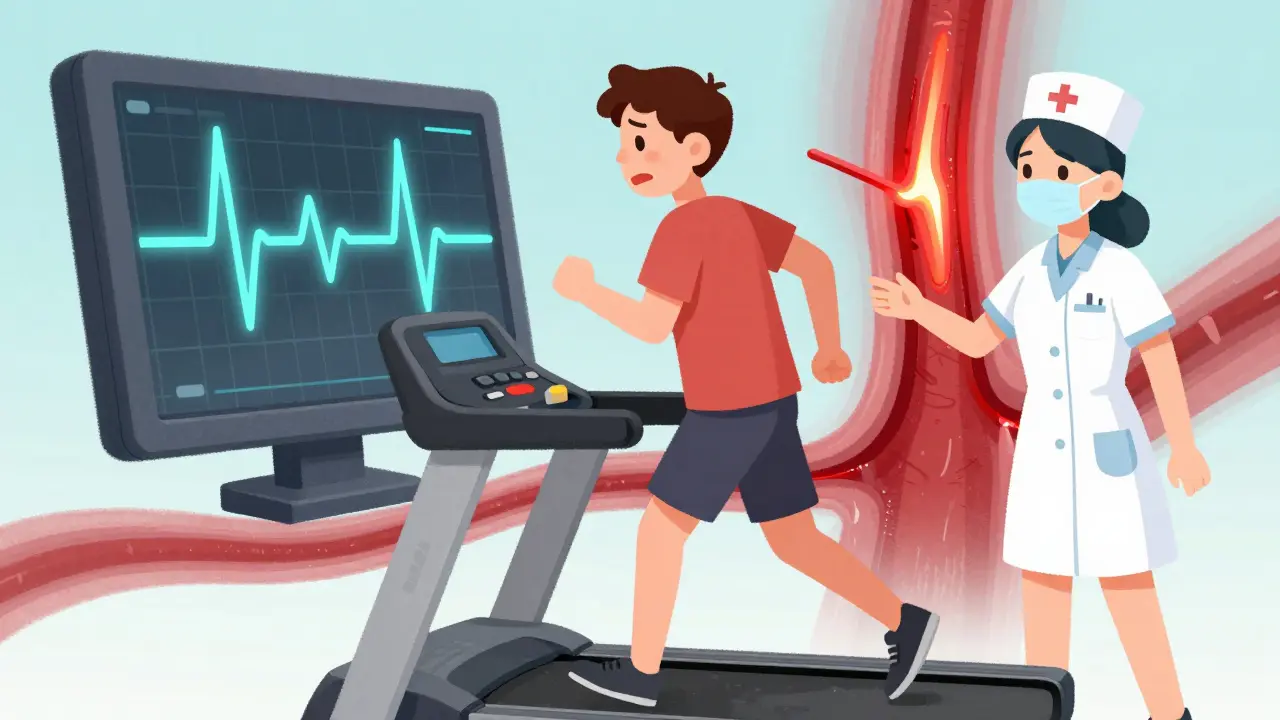
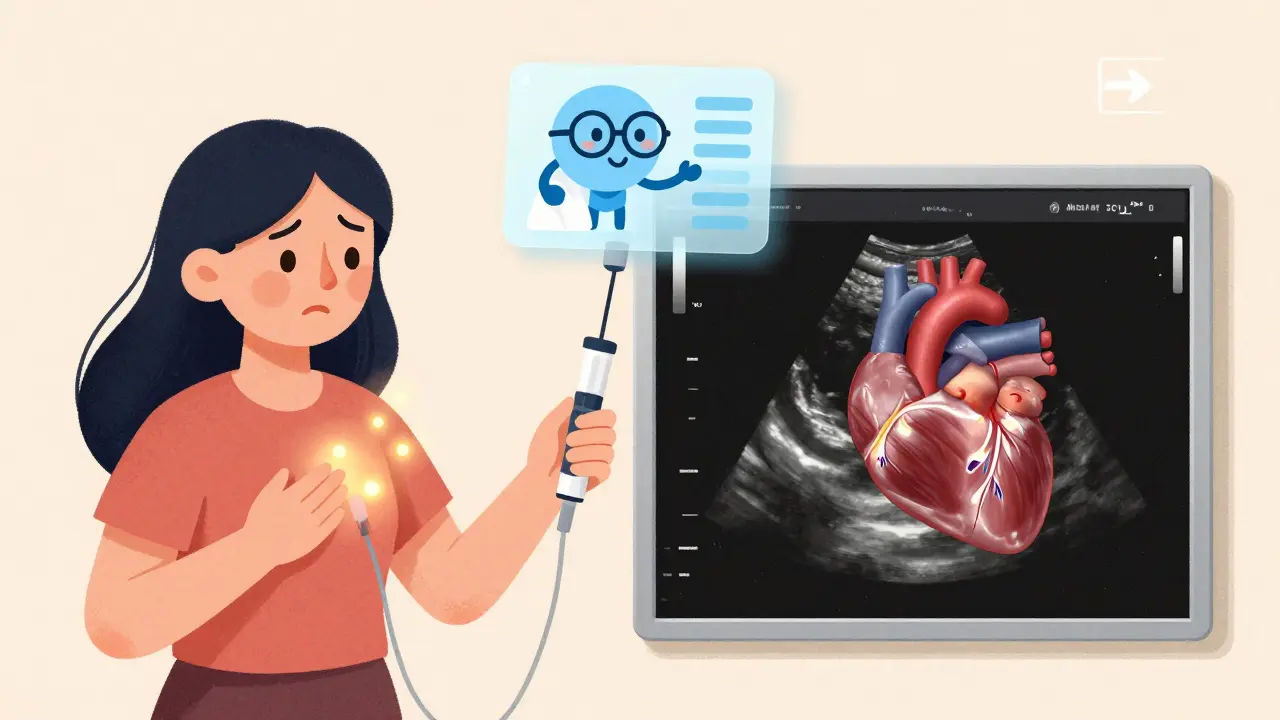
When your doctor says you need an ECG or a stress test, it’s not because they’re being overly cautious-it’s because they’re looking for signs your heart isn’t getting what it needs. These tests aren’t scary, but they’re powerful. They can catch problems long before you feel chest pain or shortness of breath. And for millions of people every year, they’re the difference between catching a silent issue early and facing a major cardiac event. An ECG, or electrocardiogram, records your heart’s electrical signals. It’s quick, painless, and done while you’re lying still. Electrodes stick to your chest, arms, and legs, and in under five minutes, your heart’s rhythm is mapped out on a graph. It can tell if you’ve had a past heart attack, if your heart is beating too fast or too slow, or if there’s an abnormal pattern in how electricity moves through your heart muscle. But here’s the catch: a resting ECG won’t always show problems that only show up when your heart is working hard. That’s where the stress test comes in. A stress test pushes your heart to work harder-either by making you walk or run on a treadmill, or by giving you medicine that mimics the effects of exercise. While you’re under stress, your heart rate, blood pressure, and ECG are monitored closely. If a part of your heart isn’t getting enough blood, it’ll show up on the monitor as a change in the waveform or a drop in blood pressure. This is how doctors spot blocked arteries before they cause a heart attack. The most common type of stress test uses the Bruce protocol on a treadmill. It starts slow-1.7 miles per hour with a 10% incline-and gets harder every three minutes. Most people last between 6 and 12 minutes. You’re not expected to run a marathon. You just need to push until you’re tired, short of breath, or your heart starts acting up. If you can’t exercise because of arthritis, lung disease, or other issues, doctors use chemicals like adenosine or dobutamine. These drugs make your heart beat faster and work harder without you moving a muscle. You might feel flushed, dizzy, or have chest pressure, but it lasts only a few minutes and passes quickly. Studies show that a standard ECG stress test catches about 68% of coronary artery disease cases. That’s not perfect, but it’s a solid starting point. When doctors add ultrasound imaging-called stress echocardiography-the accuracy jumps. This version shows your heart pumping in real time. If a section of the heart wall doesn’t move well under stress, it’s a strong sign that a coronary artery is blocked. Stress echo has a specificity of 88%, meaning it rarely gives false alarms. And it doesn’t use radiation. Nuclear stress tests are more sensitive-they catch up to 85% of blockages-but they involve a small amount of radioactive tracer. The radiation dose is about 9-12 mSv, which is similar to what you’d get from natural background radiation over three to four years. Thanks to new FDA guidelines, facilities have cut radiation exposure by 35% since 2021 by using smarter imaging techniques. Costs vary. A CT scan of your heart runs around $400. A stress echo costs about $514. A nuclear stress test? Around $946. But here’s something surprising: research from the PROMISE trial found no big difference in long-term healthcare costs between using CT scans and stress tests. So the most expensive option isn’t always the best. Women face unique challenges. Studies show ECG stress tests miss more cases in women, especially premenopausal women. Why? Their heart disease often affects tiny blood vessels, not the big arteries. That’s called microvascular dysfunction. New research at Stanford shows combining stress echo with speckle-tracking strain analysis can detect this in 89% of cases-up from just 68%. The American College of Cardiology now recommends stress echo as the first choice for women with symptoms and intermediate risk. What about false results? About 25% of intermediate-risk patients get inconclusive results. That means another test is needed. Movement during the ECG can cause interference. Some people don’t reach their target heart rate during chemical stress tests. And anxiety? It’s common. Nearly 37% of patients worry about the results before they even walk in. Preparation matters. Don’t drink coffee, tea, or soda for 24 hours before the test. Caffeine blocks the effects of stress medications. Wear comfortable clothes and walking shoes. No jewelry. No lotions on your chest-those interfere with the electrodes. If you’re having a chemical stress test, you might be asked to skip your morning heart medication. After the test, you can usually go home right away. No recovery time. No downtime. Your doctor will give you a preliminary result before you leave. A full report follows within a few days. Real people share their experiences. One Reddit user, 'CardiacWarrior87,' said his treadmill test caught silent ischemia his resting ECG missed. Another, 'AnxiousPatient22,' described the chemical stress test as feeling like she was dying for three minutes-but the tech reassured her it was normal. That’s the thing: side effects are temporary. The benefits last a lifetime. The global market for cardiac stress testing is growing fast-projected to hit $4.1 billion by 2027. More than 11 million stress tests are done in the U.S. every year. Hospitals do most of them, but outpatient clinics are catching up. And new tech is making it easier. The FDA-cleared Cardiac Dynamics StressPal lets doctors run stress tests in doctor’s offices, nursing homes, even ambulances. It matches standard treadmill results 94% of the time. Artificial intelligence is stepping in too. Machine learning algorithms now help interpret ECG patterns with 18-22% greater accuracy than human reading alone. This isn’t science fiction-it’s happening in clinics right now. So what’s next? Stress tests aren’t going away. But as CT angiography becomes cheaper and more accurate, they might be used less for low-risk patients. For those with symptoms, risk factors, or abnormal resting ECGs? They’re still the gold standard. If you’ve been told you need one of these tests, don’t panic. You’re not being singled out. You’re being cared for. These tests are simple, safe, and life-saving. They don’t fix your heart-they just show what’s going on. And that’s the first step to taking control.
How ECG and Stress Tests Work Together
An ECG gives you a snapshot. A stress test gives you a movie. Together, they tell a complete story. A resting ECG might look normal-even if you have blocked arteries. But when your heart is forced to pump harder during a stress test, those blockages become obvious. Blood can’t flow fast enough. The heart muscle gets starved of oxygen. That’s when the electrical pattern changes. The ECG picks it up. The doctor sees it. And suddenly, a silent problem becomes a treatable one. That’s why doctors don’t just order an ECG and call it a day. If you have chest discomfort, shortness of breath with activity, or risk factors like high blood pressure, diabetes, or a family history of heart disease, they’ll want to see how your heart holds up under pressure. The combination is especially important for people over 50, especially men, and women with diabetes or metabolic syndrome. These groups are more likely to have hidden coronary artery disease that doesn’t show up on a resting test. It’s not just about blockages. Stress tests can also detect arrhythmias that only happen during exertion. Some people develop dangerous heart rhythms when they’re active-like ventricular tachycardia. A resting ECG won’t catch that. But during a stress test, the monitor will show it immediately. That’s when doctors can recommend a pacemaker, medication, or further testing. And if you’ve had a heart attack before? Stress testing helps determine how much damage was done and whether your heart can handle daily activities safely. It guides rehab programs and helps decide if you’re ready to return to work or resume exercise. This isn’t guesswork. It’s science built over 120 years. Willem Einthoven’s 1903 ECG machine laid the foundation. Today’s digital systems, combined with ultrasound and AI, are taking it further than anyone imagined.
What Happens During a Stress Test?
You’ll arrive at the clinic or hospital, usually without fasting, but without caffeine. You’ll change into a hospital gown and lie down while electrodes are placed on your chest, arms, and legs. A blood pressure cuff goes on your arm. A pulse oximeter clips to your finger. If you’re doing a treadmill test, you’ll start walking slowly. Every three minutes, the speed and incline increase. The goal is to reach 85% of your maximum heart rate-that’s 220 minus your age. So if you’re 60, they want you to hit about 136 beats per minute. You’ll be asked to report any symptoms: chest pain, dizziness, extreme shortness of breath, or leg fatigue. The staff will watch your ECG closely. If your blood pressure drops, your heart rhythm goes haywire, or your ECG shows signs of ischemia, they’ll stop the test immediately. If you’re having a chemical stress test, you’ll sit or lie down. A nurse will start an IV. Then they’ll slowly give you medicine-adenosine, dipyridamole, or dobutamine. You’ll feel a warm flush, maybe a headache, or a tightness in your chest. It lasts 1-3 minutes. Your heart rate spikes. Your blood pressure rises. And your ECG is monitored just like during exercise. Either way, the test ends when you reach your target, feel too uncomfortable, or your heart shows signs of trouble. You’ll be monitored for another 5-10 minutes while you rest, to make sure everything returns to normal. The whole process takes about 30-60 minutes, depending on the type. But the actual stress portion? Only 10-15 minutes. It’s not pleasant, but it’s not dangerous. These tests are done under close supervision. Emergency equipment and trained staff are always on hand. And the results? Many clinics give you a quick readout before you leave. The full report comes later, but you’ll usually know if something was found right away.
When Is a Stress Test Not Recommended?
Stress tests are safe for most people-but not everyone. You shouldn’t have one if you’ve had a heart attack in the last two days. Your heart is still healing. Pushing it now could be dangerous. Same goes for unstable angina, severe uncontrolled high blood pressure, or acute heart failure. If you’re short of breath even at rest, or your legs are swollen and you can’t lie flat, your doctor will wait. Serious arrhythmias like ventricular tachycardia or uncontrolled atrial fibrillation also make stress testing risky. You need to stabilize first. People with severe aortic stenosis (a narrowed heart valve) can’t handle the increased demand on the heart. Stress tests can trigger fainting or cardiac arrest in these cases. And if you’ve had a recent stroke or major surgery, you’ll need to wait. Your body needs time to recover. Sometimes, it’s not about safety-it’s about usefulness. If your risk of heart disease is very low, a stress test might just give you a false alarm. If your risk is very high, you might skip straight to a CT angiogram or cardiac catheterization. Stress tests work best for people with intermediate risk: enough symptoms to worry about, but not enough to assume the worst. Your doctor will weigh your age, symptoms, risk factors, and resting ECG before deciding if a stress test is right for you.
What Do the Results Mean?
There are three main outcomes: normal, abnormal, or inconclusive. A normal result means your heart’s electrical activity, blood pressure, and heart rate responded well to stress. No signs of reduced blood flow. No dangerous rhythms. No drop in blood pressure. That’s good news. It means your coronary arteries are likely open and your heart is functioning properly. An abnormal result can mean several things. ST-segment depression on the ECG is the most common sign of reduced blood flow to the heart muscle. That’s ischemia. It doesn’t always mean you have a blocked artery-it could be microvascular disease. But it’s a red flag that needs follow-up. If your blood pressure drops during exercise instead of rising, that’s a serious sign. It often points to severe heart disease. If you can’t exercise for more than 5 minutes, that’s also a concern. Each extra minute you can go reduces your risk of a future cardiac event by 12%. If you stop early, your prognosis is worse. Inconclusive results happen in about 25% of intermediate-risk patients. Maybe your heart rate didn’t go high enough. Maybe the ECG was too noisy. Maybe the images were unclear. In those cases, doctors will order another test-usually stress echocardiography or a nuclear scan. The report you get back will include your exercise time, peak heart rate, blood pressure response, ECG changes, symptoms, and whether any new wall motion abnormalities showed up on ultrasound. It’s detailed. And it’s used to guide your next steps: lifestyle changes, medication, or further testing.
Common Myths About ECG and Stress Tests
Myth 1: “If I don’t feel chest pain, I don’t need a stress test.” False. Many people with blocked arteries have no symptoms at rest. That’s called silent ischemia. It’s why stress tests exist. Myth 2: “Stress tests are only for older people.” No. Younger people with diabetes, obesity, or a family history of early heart disease can benefit too. The American Heart Association recommends screening for high-risk individuals as early as age 40. Myth 3: “The radiation from nuclear stress tests is dangerous.” The dose is low and tightly controlled. Since 2021, radiation exposure has dropped by 35%. The risk of cancer from one test is less than 1 in 1,000. The risk of missing a heart problem? Much higher. Myth 4: “I’ll be stuck in the hospital for days.” Nope. You walk in, you do the test, you walk out. No hospital stay. No recovery. You can drive yourself home. Myth 5: “If my ECG is normal, I’m fine.” Not true. A resting ECG misses up to half of coronary artery disease cases. That’s why stress testing is needed. Understanding these myths helps you ask the right questions. Don’t accept vague answers. Ask: “What are we looking for? What happens if we find something? What are the alternatives?” Knowledge reduces fear. And fear is the biggest barrier to getting tested.


Kevin Motta Top, December 19, 2025
Been through a stress test last year after my BP spiked. Felt like I was gonna die, but the tech was chill and said, 'You're doing great, just keep walking.' Turned out I had silent ischemia. Scary, but glad they caught it. Now I walk 5 miles a day. Your heart's a muscle-use it or lose it.
Also, skip the coffee. I didn't and my test got delayed 45 mins. Dumb move.
Alisa Silvia Bila, December 19, 2025
My mom had a nuclear stress test last month. She was terrified of the radiation, but the nurse showed her the numbers-less than a cross-country flight. She cried after it was over, not from pain, but relief. That’s the thing nobody tells you: it’s not the test that’s scary. It’s the waiting.
Also, wear socks. The cold floor is worse than the IV.
Frank Drewery, December 21, 2025
Just want to say thanks to whoever wrote this. I’ve been avoiding getting tested for years because I thought it was for 'old people' or 'people who smoke.' Turns out I’m 42, diabetic, and my resting ECG was borderline. This post made me book the appointment. No more denial. 🙌
Anna Sedervay, December 23, 2025
While I appreciate the clinical precision of this exposition, I must raise a concern regarding the uncritical promotion of nuclear stress testing. The FDA's 35% reduction in radiation exposure is statistically negligible when viewed through the lens of cumulative ionizing radiation burden. Furthermore, the PROMISE trial’s conclusion is methodologically flawed due to its reliance on self-reported healthcare utilization metrics, which are notoriously susceptible to recall bias. One must also consider the corporate interests of imaging conglomerates-Medtronic, GE Healthcare-that fund much of the current research. The true gold standard remains the invasive coronary angiogram, which, despite its invasiveness, provides definitive anatomical data. Why settle for indirect inference when direct visualization is available? The medical-industrial complex thrives on obfuscation.
And please, do not use the word 'dumb' in reference to caffeine consumption. Such colloquialisms undermine the rigor of medical discourse.
Matt Davies, December 23, 2025
Man, I’ve had three of these tests. First one felt like I was running from a bear. Second one, the meds made me feel like I’d swallowed a hot coal. Third? I just laughed. My heart’s been through wars I didn’t even know I was fighting. These tests are like your body’s Yelp reviews-sometimes the reviews suck, but they save your life.
Also, if you’re doing a chemical test, bring a hoodie. You’ll sweat like you just finished a sauna.
Dev Sawner, December 23, 2025
It is regrettably evident that the author has failed to adequately address the confounding influence of beta-blocker withdrawal prior to chemical stress testing. Furthermore, the omission of reference to the 2023 ESC guidelines on microvascular angina is a glaring scholarly deficiency. The assertion that 'stress tests are the gold standard' is not only outdated but dangerously misleading in the context of contemporary cardiovascular risk stratification, wherein coronary CT angiography with fractional flow reserve (FFR-CT) has demonstrated superior diagnostic accuracy in intermediate-risk populations. The reliance on ECG-based ischemia detection is archaic. One must question the institutional inertia that perpetuates such suboptimal protocols. This is not medicine-it is procedural tradition masquerading as science.
Moses Odumbe, December 25, 2025
Just got my stress test results back 🤯
Turns out I’m fine 😌
Also, I cried during the chemical part 😭
And yes, I drank coffee before. But I’m alive. So. 🤷♂️☕️
Meenakshi Jaiswal, December 25, 2025
As a nurse who’s run hundreds of stress tests, let me say this: if you’re nervous, it’s okay. We’ve seen it all. The guy who screamed 'I’m dying!' and then high-fived us after? He’s now a marathon runner. The woman who thought the IV was a snake? She’s back for her annual check-up. This test doesn’t define you. It just gives your heart a voice. And if you’re a woman with diabetes or high blood pressure? Please, push for stress echo. Your tiny vessels matter too. You’re not being overtested-you’re being seen.
Also, wear a button-up shirt. No one wants to wrestle with a t-shirt during electrode placement.
Mahammad Muradov, December 25, 2025
It is patently irresponsible to suggest that stress tests are 'safe' for the general population. The psychological trauma inflicted upon patients, particularly those with pre-existing anxiety disorders, is rarely quantified in clinical literature. Furthermore, the normalization of radiation exposure via comparison to 'background radiation' constitutes a dangerous form of medical propaganda. The human body is not a reactor. One does not casually accept cumulative ionizing exposure as if it were a daily vitamin. The promotion of these tests without explicit, long-term longitudinal safety data constitutes a violation of the Hippocratic Oath. The medical establishment prioritizes volume over vigilance. This is not healthcare. It is industrialized fear-mongering disguised as prevention.