
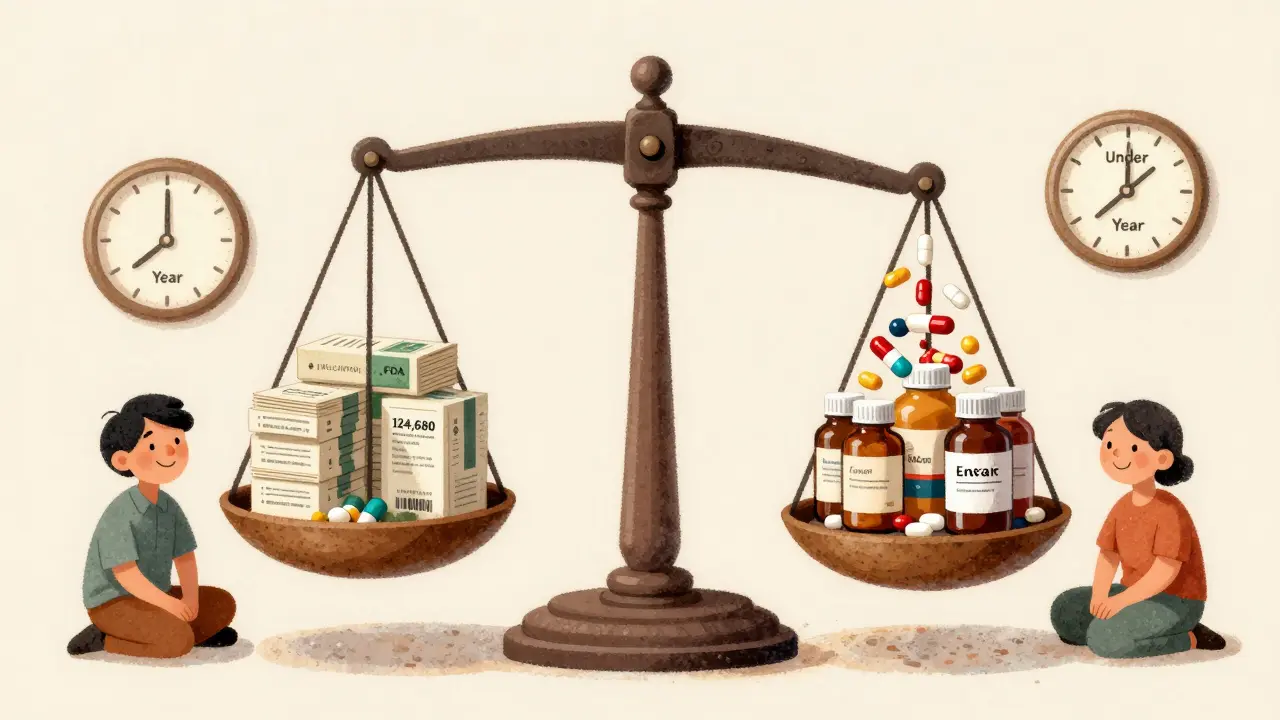
Every year, Americans fill over 4 billion prescriptions for generic drugs. These are the same medicines as brand-name pills, but cost 80-85% less. Behind every cheap bottle of lisinopril or metformin is a complex, costly, and often slow process to get FDA approval. Before 2012, waiting 3 years just to get a generic drug approved was normal. Today, thanks to a little-known funding system called GDUFA, that wait has dropped to under a year for most applications. Here’s how user fees from drug makers are keeping the FDA running and getting life-saving generics to patients faster.
What Is GDUFA and Why Does It Matter?
GDUFA stands for Generic Drug User Fee Amendments. It’s not a law that creates new rules-it’s a funding deal. Congress lets the FDA collect fees from companies that make generic drugs. In return, the FDA promises to review those applications faster and more predictably. This isn’t a handout. It’s a performance contract. The FDA gets more money to hire reviewers, upgrade tech, and inspect factories. The industry gets faster approvals and clearer feedback.
Before GDUFA, the FDA had no steady funding for generic reviews. It relied only on congressional budgets, which didn’t keep up with the flood of applications. By 2011, over 1,500 generic drug applications were sitting in limbo, some for more than five years. Patients waited. Hospitals rationed. Prices stayed high because competition was blocked.
GDUFA changed that. Signed into law in 2012 and renewed in 2017 and 2022, it’s now running through 2027. It’s the reason 97% of first-round review comments are now specific, actionable, and delivered within 10 months-something that rarely happened before. The FDA now processes over 1,100 generic applications each year. Without GDUFA, that volume would collapse under its own weight.
How the Fees Work: Four Types, One Goal
Generic drug makers pay four kinds of fees under GDUFA. Each one targets a different part of the approval process.
- Application fees: $124,680 per ANDA (Abbreviated New Drug Application) submitted. This covers the FDA’s review of the drug’s safety, effectiveness, and manufacturing quality. Compare that to brand-name drug fees, which are over $3.4 million-GDUFA fees are less than 4% of that.
- Program fees: $385,400 per year for every company with at least one approved generic drug. This pays for the overall infrastructure: staff, systems, training, and oversight.
- Facility fees: $25,850 per year for every factory that makes active ingredients or finished pills for a generic drug. This ensures the FDA can inspect plants regularly. If your factory isn’t referenced in an approved drug, you don’t pay.
- DMF fees: $25,850 for each Drug Master File (Type II) that contains details about ingredients or manufacturing processes. This fee is only charged when the file is first used in an application or when the holder requests a completeness check.
These fees aren’t optional. If you want your generic drug approved in the U.S., you pay. The FDA doesn’t approve applications faster because you paid-it approves them faster because the fees let them hire more reviewers and reduce backlogs. Payment deadlines are strict: program fees by April 1, facility fees by October 1, and application/DMF fees when you submit.
Why Fees Are Lower Than for Brand Drugs
It might seem unfair that brand-name drugs pay 25 times more than generics. But the math makes sense. Generic drug makers submit over 1,100 applications a year. Brand-name companies submit about 70. The FDA doesn’t need the same level of resources for each generic application because they’re copies of already-approved drugs. The science is simpler. The testing is standardized. The review process is more routine.
Still, volume matters. Reviewing 1,100 applications is like reviewing 1,100 different versions of the same puzzle. It’s not harder-it’s just more. GDUFA gives the FDA the staff and tools to handle that volume without burning out. The result? Over 60% of generic applications are now reviewed and acted on within 15 months. That’s down from 30-36 months before 2012.
That speed translates to real savings. A 2022 FTC report found GDUFA helped increase timely generic entries by 15% after brand-name patents expired. Over the last decade, that’s saved U.S. consumers an estimated $1.7 trillion.
Who’s Getting Hit the Hardest?
Not everyone benefits equally. Small generic manufacturers feel the pinch the most. The $25,850 facility fee might seem small to a big company like Teva or Sandoz, which operate dozens of factories. But for a small firm with one plant, that fee can eat up 15% of their entire regulatory budget.
According to the Generic Pharmaceutical Association, 75% of small generic firms run only one facility. That means they pay the full facility fee without spreading the cost across multiple sites. Many can’t afford to expand production, even when demand is rising. In a 2022 comment letter, GPhA said this structure “disproportionately burdens small manufacturers.”
The FDA does offer a 75% fee reduction for qualifying small businesses-but only 18 of these were processed in FY 2022. That suggests most small companies don’t know how to apply, or find the paperwork too complex. The FDA has help desks and webinars, but the learning curve is still 3 to 6 months for new regulatory staff. That’s a long time when cash flow is tight.
What’s Working-and What’s Still Broken
On paper, GDUFA is a success. Review times are down. Transparency is up. Feedback is clearer. The FDA met 97% of its first-cycle review goals in 2021. A Duke-Margolis study found generic approvals rose 22% since GDUFA launched. Evaluate Pharma’s 2023 survey showed 68% of companies rated GDUFA’s impact as positive or very positive.
But gaps remain. The FDA only hit 52% of its 15-month approval target in 2021-short of the 60% goal. Pandemic delays and more complex applications (like those involving injectables or complex generics) slowed things down. And while the FDA says it’s eliminating all pre-GDUFA backlog by September 2024, over 1,500 old applications are still pending.
Another blind spot: over-the-counter (OTC) drugs. GDUFA doesn’t cover them. That’s a $117 billion market. Think antacids, allergy pills, or cough syrups. These are regulated under monographs, not ANDAs. But the FDA still reviews them-and it’s underfunded. A 2023 Congressional report suggested expanding GDUFA to include OTC monographs could bring in $150-200 million more annually.
What’s Next for GDUFA?
GDUFA III runs until 2027. But negotiations for GDUFA IV are already underway. The FDA is pushing to use real-world evidence-data from electronic health records, pharmacy claims, or patient reports-to monitor generic drug safety after approval. That could cut post-market surveillance costs and speed up responses to safety issues.
Industry groups are wary. They worry about the cost of collecting and submitting that data. The FDA says it will design the system to be practical, not burdensome. But if GDUFA IV adds new fees without clear benefits, small companies may push back harder.
Meanwhile, the FDA is testing new tools. The DMF completeness assessment program, launched in 2022, lets companies get feedback on their ingredient files before submitting a full application. That reduces surprises later. It’s a small change-but it saves months.
Long-term, GDUFA’s model is working. The Congressional Budget Office estimates it returns $1.20 in savings for every $1.00 spent on generic drug review. That’s a rare win-win: patients get cheaper drugs faster. Manufacturers get predictable timelines. The FDA gets the resources it needs. And taxpayers don’t foot the bill.
Why This Matters to You
If you take a generic drug-whether it’s for blood pressure, cholesterol, or depression-you’re benefiting from GDUFA. The price you pay at the pharmacy is lower because competition is faster. The drug you get is safe because inspections are more frequent. The next time your prescription refills without delay, thank GDUFA.
But if you work for a small generic company, or you’re a patient in a market with only one supplier, the system still has flaws. The fees are fair in theory, but not always in practice. The FDA is improving, but it’s not perfect.
What’s clear is this: without GDUFA, the U.S. generic drug system would be broken. The funding model isn’t flashy. It doesn’t make headlines. But it’s the quiet engine behind 90% of all prescriptions filled in America.
What are generic drug user fees?
Generic drug user fees are payments made by manufacturers to the FDA under the GDUFA program. These fees fund the review of generic drug applications and inspections of manufacturing facilities. They are not taxes-they are fees tied to specific services the FDA provides, like reviewing applications and inspecting factories.
How much do generic drug companies pay in fees?
In FY 2023, the fees were: $124,680 per ANDA application, $385,400 annual program fee per company, $25,850 per manufacturing facility, and $25,850 per Drug Master File (DMF) when first referenced. These fees help cover the cost of FDA review and inspection activities.
Why are generic drug fees so much lower than brand drug fees?
Brand-name drugs (under PDUFA) pay over $3.4 million per application because their reviews are more complex, requiring full clinical trials and novel science. Generic drugs are copies, so their reviews are more routine. The FDA processes over 1,100 generic applications a year, so lower fees per application make sense when scaled across volume.
Does paying user fees guarantee faster approval?
No. Paying fees doesn’t speed up approval directly. Instead, the fees give the FDA the resources to hire more reviewers, improve systems, and reduce backlogs. That creates a faster overall process. Approval still depends on whether the drug meets safety and quality standards.
Are small generic drug makers at a disadvantage under GDUFA?
Yes. Small companies often operate just one facility and pay the full facility fee, which can be 15% or more of their annual regulatory budget. While the FDA offers a 75% fee reduction for qualifying small businesses, very few have applied-likely because the process is confusing or paperwork-heavy.
Does GDUFA cover over-the-counter (OTC) drugs?
No. GDUFA only covers prescription generic drugs approved through ANDAs. OTC drugs, like ibuprofen or antacids, are regulated under OTC monographs and are not funded by GDUFA fees. This leaves a $117 billion market underfunded and slower to update.
How has GDUFA impacted drug prices?
GDUFA has increased competition by speeding up generic drug approvals. The FTC estimates this has led to a 15% increase in timely generic entries after brand patents expire. Over the past decade, that has saved U.S. consumers an estimated $1.7 trillion in drug spending.


Siobhan K., December 21, 2025
This is the quiet hero of American healthcare. No one talks about GDUFA, but if you’ve ever filled a $4 prescription, you’re living its legacy. The FDA didn’t get better overnight-it got funded properly.
Brian Furnell, December 22, 2025
The structural inefficiencies in pre-GDUFA were catastrophic: 1,500+ applications in limbo, review cycles stretching beyond five years, and no feedback loops whatsoever. The user-fee model introduced accountability, predictability, and measurable KPIs-something the public sector rarely achieves without external pressure.
Jon Paramore, December 22, 2025
Facility fees hit small players hard. One plant = $25k. That’s not a tax-it’s a barrier to entry disguised as regulation. The 75% reduction exists, but the paperwork is a nightmare. Who’s helping these guys navigate it?
Swapneel Mehta, December 23, 2025
I never realized how much this affected my dad’s blood pressure meds. He’s been on lisinopril for 12 years, and the price dropped from $120 to $7 last year. GDUFA isn’t sexy, but it’s real.
Stacey Smith, December 24, 2025
The U.S. actually got something right for once. Other countries are jealous. We don’t need to import generics from India because we have a system that works. Stop complaining and thank the system.
Ben Warren, December 24, 2025
It is imperative to note that the user-fee paradigm, while ostensibly efficacious, represents a dangerous precedent wherein regulatory functions are increasingly subordinated to private-sector financial interests. The FDA’s independence, however tenuous, must remain sacrosanct. The potential for conflict of interest, even if unproven, cannot be dismissed a priori. Furthermore, the absence of OTC inclusion constitutes a glaring regulatory arbitrage that undermines the integrity of the entire framework.
Teya Derksen Friesen, December 26, 2025
The fact that GDUFA has saved $1.7 trillion over a decade is staggering. Imagine what we could do if we applied this model to medical devices or diagnostics. This is the blueprint for public-private collaboration done right.
Sandy Crux, December 26, 2025
Let’s be honest: this is just corporate welfare dressed up as public policy. The FDA doesn’t ‘need’ this money-it’s being manipulated by Big Pharma to maintain a controlled, slow-moving market. Why do you think the small manufacturers are being crushed? Because the system was designed to favor the big players from the start.
Hannah Taylor, December 27, 2025
gdufa? more like gdufa = government drug user fee scam. they’re not saving us money, they’re just letting big pharma control who gets approved. i heard the fda gets kickbacks from big companies to fast-track their stuff. also why are we letting indians make all our meds??
Jason Silva, December 28, 2025
GDUFA is the reason my insulin is $30 and not $300. 🙏 Big Pharma hates it because it breaks their monopoly. Small biz? Yeah, the fees suck-but the system is still 100x better than before. If you’re mad, lobby for fee waivers, not to kill the whole thing. #GenericRevolution
mukesh matav, December 29, 2025
In India, we see how long it takes to get approvals without such a system. This model works. The fees are small compared to the cost of delay. The real issue is awareness-not funding.
Peggy Adams, December 30, 2025
i don’t even know what this is but i know the fda is corrupt. they approve junk and then charge people for it. why do i have to pay for someone else’s medicine? this is all a scam.
Sarah Williams, December 31, 2025
I’m a nurse. I’ve seen patients skip doses because they can’t afford brand drugs. GDUFA doesn’t get enough credit. It’s not perfect, but it’s the reason so many people are alive today. Keep improving it, don’t tear it down.