

Statin Sleep Risk Calculator
Many people taking statins experience sleep disturbances like insomnia or vivid dreams. Not all statins affect sleep the same way. This tool helps you understand your risk based on your specific statin medication.
Many people take statins without any issues. But for some, the side effects aren’t just muscle aches or digestive problems-they’re sleepless nights and bizarre, lifelike dreams. If you’ve been on a statin and suddenly started waking up at 3 a.m. with vivid memories of flying over cities or arguing with your childhood pet, you’re not alone. And you’re not crazy. The science is mixed, but the reports are real.
What Are Statins, Really?
Statins are drugs designed to lower LDL (bad) cholesterol by blocking an enzyme your liver uses to make it. They’ve been around since the 1980s, and today, over 300 million people worldwide take them. Their job? Prevent heart attacks and strokes. And they do it well-studies show they cut major cardiovascular events by about 22% for every 1.0 mmol/L drop in LDL cholesterol. That’s why doctors keep prescribing them, even when patients complain.
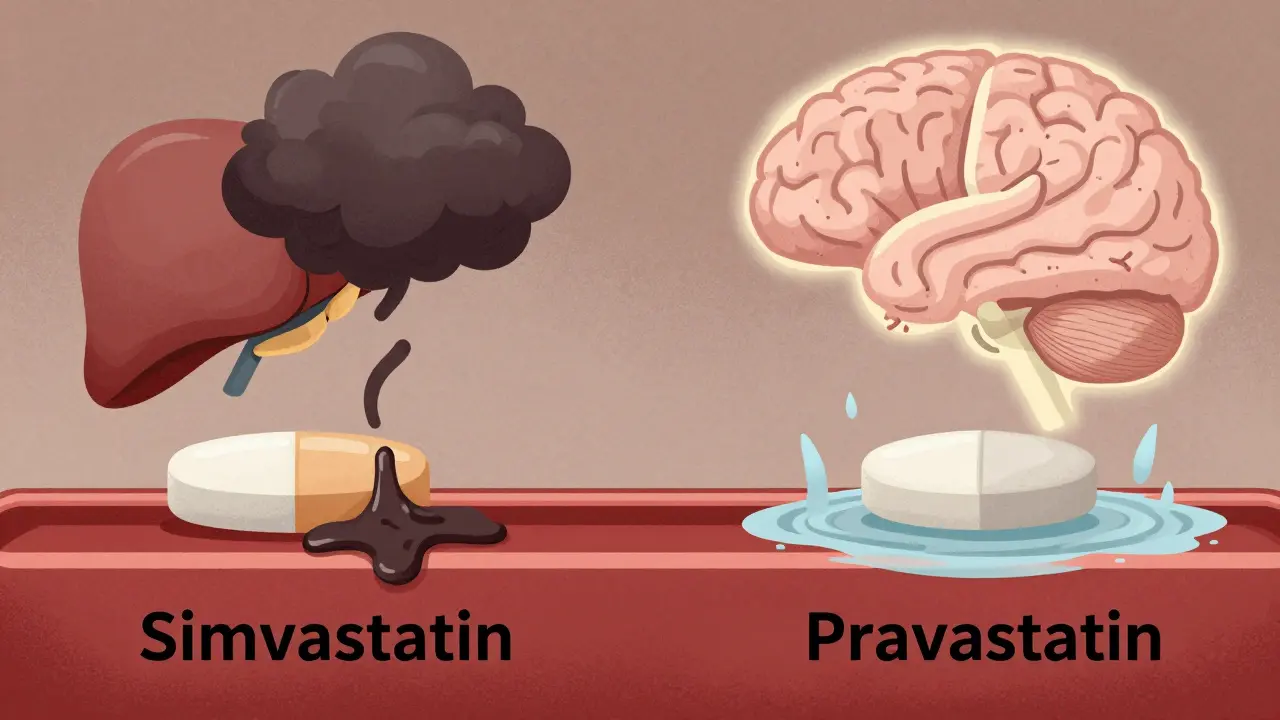
But not all statins are the same. Some, like simvastatin and lovastatin, are lipophilic, meaning they dissolve easily in fat. That lets them cross into the brain more easily. Others, like pravastatin and rosuvastatin, are hydrophilic-they’re more water-friendly and less likely to sneak into brain tissue. This difference matters when it comes to sleep.
The Sleep Connection: Real Data, Mixed Results
Back in 2007, Dr. Beatrice Golomb ran a small but telling trial. She gave 1,016 healthy adults either simvastatin, pravastatin, or a placebo. Those on simvastatin reported significantly worse sleep quality and more sleep problems than the others. Pravastatin? No difference from placebo. The takeaway? Not all statins affect sleep the same way.
Then there’s the FDA’s own database, FAERS. Between 2004 and 2014, 1,278 people reported sleep disturbances linked to statins. Simvastatin made up 42% of those reports-even though it was only used in about 29% of cases. Lovastatin and rosuvastatin also showed up more than expected. But atorvastatin? Almost no signal. And pravastatin? Almost none.
Here’s where it gets confusing. A 2018 study of 10,000 patients found people taking atorvastatin actually had fewer sleep disturbances than those on placebo. The researchers called it the nocebo effect-when you expect something bad to happen, your brain makes it real. If you’ve read online that statins cause nightmares, you might start noticing every weird dream and blame the pill.
Lipophilic vs. Hydrophilic: Why It Matters
Think of lipophilic statins like oil-based paint. They slip through fatty barriers easily-including the blood-brain barrier. That’s why simvastatin and lovastatin can reach brain regions involved in sleep regulation. Hydrophilic statins? Like water-based paint. They stay mostly in the bloodstream. Less brain exposure. Less chance of messing with your sleep.
Log P values tell us this clearly: simvastatin has a log P of 4.4. Pravastatin? Just 0.6. That’s a huge gap. And it lines up with the data. People on simvastatin report more insomnia and vivid dreams. Switching to pravastatin? Many say their dreams calm down within days.
One Reddit user, u/CholesterolConfused, wrote: “Switched from atorvastatin to pravastatin 3 weeks ago and my crazy dreams stopped immediately.” That’s not a fluke. It’s a pattern.
It Might Not Be the Statin-It’s the Muscle Pain
Here’s a twist: what if the sleep problem isn’t the statin itself, but the muscle pain it causes?
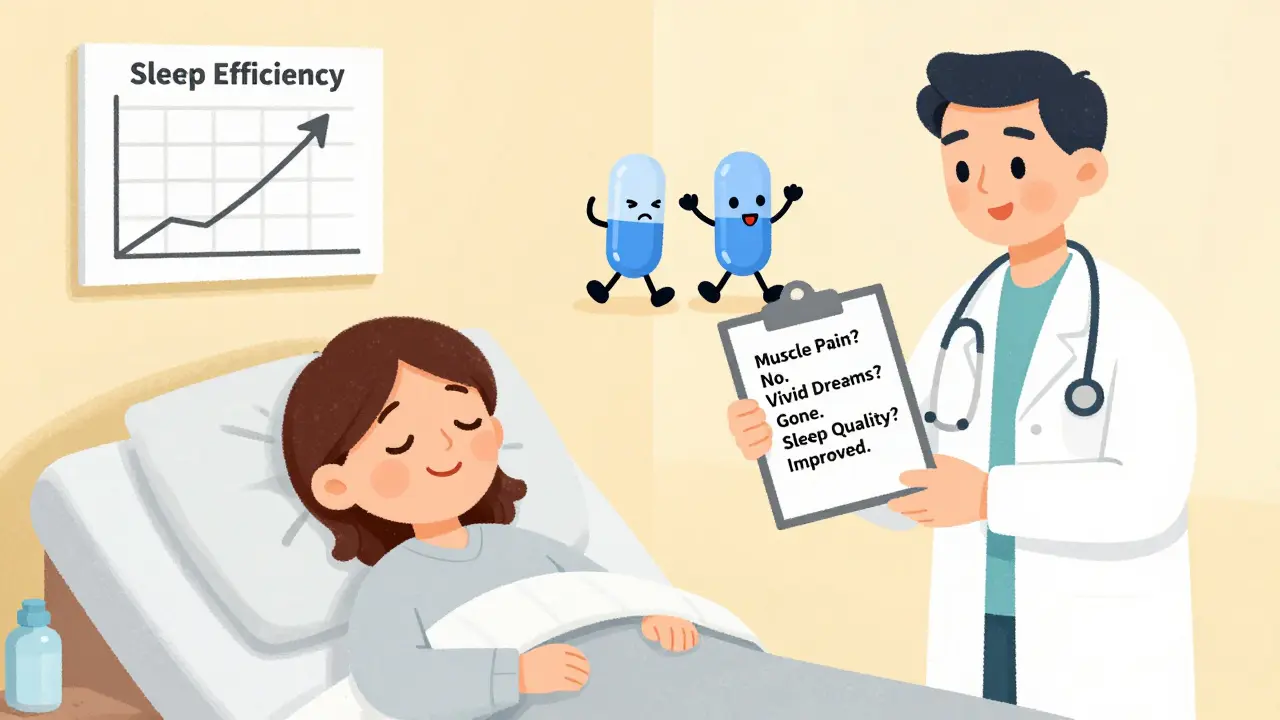
A 2024 study by Dr. L. Graves found that people with statin-associated muscle symptoms (SAMS) also had terrible sleep. But when they stopped the statin? Their sleep efficiency jumped by 3.79%. Nighttime awakenings dropped. They felt less tired during the day. The muscle pain was the real sleep thief.
That’s important. If you’re taking simvastatin and can’t sleep, it might not be the dream content-it’s the achy legs keeping you up. Or the discomfort making it hard to fall asleep. A simple fix? Try switching to a different statin, or lowering the dose. If your muscle pain improves, so might your sleep.
What Should You Do If You’re Having Sleep Issues?
Don’t quit cold turkey. Statins save lives. But if sleep is wrecked, here’s what to try:
- Track your sleep. Use a journal or app for a week. Note when you go to bed, wake up, and if dreams were intense or disturbing.
- Check which statin you’re on. If it’s simvastatin, lovastatin, or rosuvastatin, consider switching. Pravastatin or fluvastatin are better bets for sleep.
- Ask your doctor about timing. Some people find taking their statin in the morning (instead of at night) helps-though evidence is thin, it’s harmless to try.
- Give it time. If you just started, wait 2-4 weeks. Side effects often fade as your body adjusts.
- Consider a trial off. If symptoms persist, your doctor might suggest stopping the statin for 2-4 weeks. If your sleep improves, then rechallenging (taking it again) can confirm the link. If symptoms return, it’s likely the drug.
One patient in Leeds told me, “I’ve been on statins since my heart attack three months ago. I feel like they’re keeping me awake.” She switched from simvastatin to pravastatin. Within 10 days, she slept through the night. No more dreams of falling from skyscrapers.
What About the Long-Term?
Big studies-like the one led by Professor Rory Collins and the British Heart Foundation-say statins don’t cause sleep problems overall. But those studies look at averages. They don’t capture the 5-10% of people who do have trouble. And for them, it’s real.
The European Atherosclerosis Society says it best: individualized assessment. There’s no one-size-fits-all answer. Your body, your genes, your statin type, your muscle sensitivity-all matter.
Final Thoughts: Don’t Panic, But Don’t Ignore It
Statins are one of the most effective drugs ever developed for heart health. But they’re not magic. They interact with your body in complex ways. For some, sleep disruption is a sign your system is reacting.
If you’re sleeping poorly and taking a statin, it’s worth exploring. Talk to your doctor. Try switching. Track your symptoms. You might find that your sleep returns-and your heart stays protected.
Because the goal isn’t just to live longer. It’s to live well. And that includes sleeping through the night.
Can statins really cause vivid dreams?
Yes, some people report vivid, unusual, or even disturbing dreams while taking statins, especially lipophilic ones like simvastatin and lovastatin. These aren’t hallucinations-they’re intense, memorable dreams that feel unusually real. The mechanism isn’t fully understood, but it may involve statins crossing the blood-brain barrier and affecting brain chemicals linked to REM sleep. Many patients report these dreams stop within days of switching to a hydrophilic statin like pravastatin.
Which statin is least likely to affect sleep?
Pravastatin and fluvastatin are the least likely to cause sleep disturbances. Both are hydrophilic, meaning they don’t cross the blood-brain barrier easily. Studies show pravastatin has no significant effect on sleep compared to placebo. Fluvastatin also shows low association with sleep issues in large databases. Atorvastatin falls in the middle-some studies show no effect, others show slight benefit over placebo. Avoid simvastatin and lovastatin if sleep is a concern.
Should I stop taking statins if I have insomnia?
No, don’t stop without talking to your doctor. Statins reduce your risk of heart attack and stroke significantly. Instead, ask about switching to a different statin-especially one that’s hydrophilic. Many people resolve sleep issues this way without losing cardiovascular protection. If symptoms persist after switching, your doctor may consider a short statin-free trial to confirm the link.
Is there a connection between statins and muscle pain affecting sleep?
Yes. Statin-associated muscle symptoms (SAMS) - like aches, weakness, or cramps - are common and often worse at night. This discomfort can disrupt sleep just as much as vivid dreams. In fact, a 2024 study found that patients with SAMS had significantly worse sleep quality, and their sleep improved after stopping the statin. If you have both muscle pain and sleep issues, the muscle pain may be the main culprit, not the dream content.
How long does it take for sleep to improve after switching statins?
Most people notice improvement within 7-14 days after switching to a different statin. In some cases, vivid dreams stop within 48 hours. Sleep efficiency and total sleep time often improve within 2-3 weeks. If you’re switching because of muscle pain, sleep improvements may take a bit longer-up to 4 weeks-as muscle recovery lags. Always give the new statin time before deciding it’s not working.


Darlene Gomez, March 22, 2026
I was on simvastatin for two years and started having these insane dreams about flying over New York at 3 a.m. I thought I was losing my mind. Switched to pravastatin and poof - gone. No more dream adventures. I didn’t even know statins could do that. My doctor was skeptical until I showed him the research. Now he checks my statin type before prescribing. Seriously, if you’re having weird sleep stuff, don’t just blame stress. Try switching. It’s not a big deal and could save your nights.
Katie Putbrese, March 22, 2026
This is why America is falling apart. People take these pills like candy and then cry when their dreams get weird. Statins save lives. If you can’t sleep because your brain is processing all the trauma you’ve been avoiding, maybe stop blaming the medicine and start therapy. Also, pravastatin? That’s just the cheap generic. Don’t act like you’re some biohacker for switching.
Donna Fogelsong, March 22, 2026
Big Pharma knows this. They hide the sleep side effects because they know if people wake up screaming from nightmares they’ll stop taking it. That’s why FAERS data is buried. The FDA doesn’t want you to know simvastatin crosses the BBB and messes with REM. They’d rather you die of a heart attack than admit the drug messes with your mind. Wake up. This is chemical mind control disguised as prevention.
Sean Bechtelheimer, March 24, 2026
I switched from atorvastatin to pravastatin and my dreams went from 'I was fighting a dragon made of tax forms' to 'I was napping on a cloud.' 😌 Also, my wife says I stopped thrashing around at night. Worth it. Don’t let the haters scare you - your brain deserves peace.
Seth Eugenne, March 24, 2026
I’ve been a nurse for 18 years and I’ve seen this over and over. A patient on simvastatin comes in saying they haven’t slept well in weeks. We switch them to pravastatin and boom - sleep returns. It’s not placebo. It’s pharmacology. Don’t feel guilty for needing better sleep. Your body’s telling you something. Listen. 💙
rebecca klady, March 26, 2026
I had no idea this was a thing. Took simvastatin for 5 years. Never connected the dots until I read this. Now I’m on pravastatin. Slept 8 hours last night. First time in years. Thank you for writing this.
Namrata Goyal, March 27, 2026
Lol this is so basic. In India we’ve known for decades that Western meds mess with your subtle energy. Pravastatin? More like prava-statin. You’re just avoiding the root cause - your karma. Try yoga. Or at least stop eating gluten. This is why your dreams are wild - your chakras are clogged.
Zola Parker, March 28, 2026
The nocebo effect is real, but so is the fact that lipophilic statins bind to serotonin receptors in the brainstem. You’re not imagining it. You’re neurochemically hijacked. And if you think this is just about dreams, you’re missing the bigger picture - REM suppression alters emotional memory consolidation. You’re not sleeping. You’re being rewired.
florence matthews, March 29, 2026
I’m from Nigeria and my cousin had the same thing. Took simvastatin, started dreaming about ancestors yelling at her. Switched to pravastatin - dreams turned into peaceful river scenes. We laughed about it. But it’s real. Different bodies, same science. I’m glad someone wrote this. Thank you.
Kenneth Jones, March 29, 2026
I don’t care what the studies say. I’ve been on statins for 10 years. Never had a problem. Now I’m on atorvastatin. No dreams. No insomnia. If you can’t sleep, maybe you’re just not sleeping right. Stop blaming the pill. Fix your sleep hygiene. Go to bed at the same time. No screens. Maybe that’s the issue.
Mihir Patel, March 29, 2026
OMG I WAS JUST TALKING ABOUT THIS LAST NIGHT!! I was dreaming I was on a spaceship with my cat and it was singing opera?? I thought I was going crazy!! Then I read this and switched to pravastatin and now I just dream about eating pizza. BEST THING EVER 😭😭😭
Kevin Y., March 30, 2026
Thank you for this meticulously researched and empathetically presented analysis. The distinction between lipophilic and hydrophilic statins is clinically significant and often underappreciated in primary care settings. The evidence supporting pravastatin and fluvastatin as lower-risk options for patients with sleep disturbances is compelling, and the recommendation to consider statin-associated muscle symptoms as a potential confounder is both prudent and patient-centered. I will be sharing this with my colleagues in cardiology and primary care. Well done.