
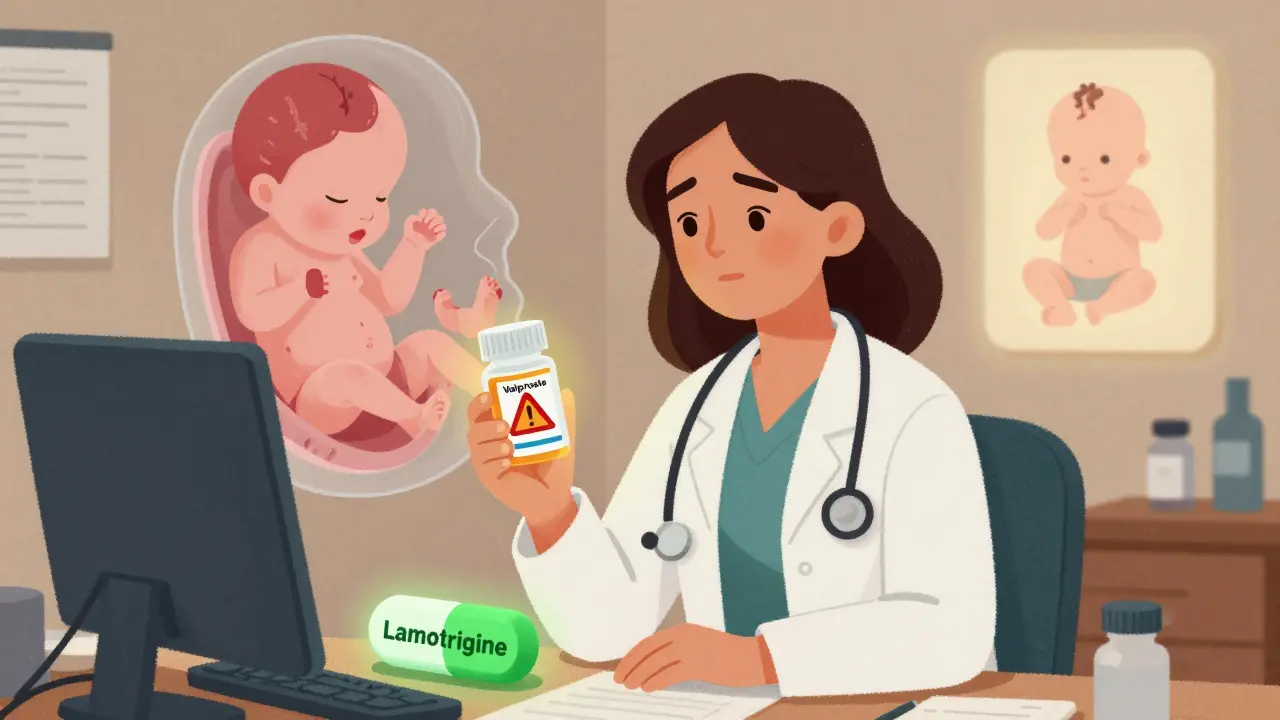
When you’re taking medicine to control seizures, the last thing you want to worry about is whether it might harm a baby you’re planning to have. But the truth is, some seizure medications carry real risks during pregnancy - not just for the baby, but for the mother too. And if you’re using birth control at the same time, things get even more complicated. It’s not about scaring you. It’s about giving you clear, real facts so you can make smarter choices - with your doctor.
Some seizure meds are far riskier than others
Not all antiseizure medications (ASMs) are created equal when it comes to pregnancy. Back in the 1960s and 70s, doctors didn’t have good data. Many women with epilepsy were told not to have kids at all. That changed as treatments improved, but some of the older drugs turned out to be dangerous.
Take sodium valproate a commonly prescribed antiseizure medication that has been linked to severe birth defects and developmental disorders in children exposed during pregnancy. It’s one of the most effective drugs for stopping seizures. But it’s also one of the riskiest for unborn babies. About 1 in 10 babies exposed to valproate in the womb develop major physical birth defects - things like heart problems, cleft lip or palate, or spinal cord issues. The risk goes up the higher the dose. And it’s not just physical. These children are more than twice as likely to be diagnosed with autism or ADHD later in life, according to research from Indiana University published in Neurology in 2020.
Other high-risk drugs include carbamazepine an antiseizure medication that increases the risk of physical birth abnormalities, especially at higher doses, phenobarbital a barbiturate used for seizure control with known teratogenic effects during pregnancy, phenytoin a long-standing antiseizure drug associated with increased rates of congenital malformations, and topiramate an antiseizure medication that can increase the risk of cleft lip/palate and low birth weight. The UK’s Medicines and Healthcare products Regulatory Agency (MHRA) confirms these four carry clear risks.
But here’s the good news: newer medications like lamotrigine an antiseizure medication with a favorable safety profile during pregnancy and levetiracetam an antiseizure medication with minimal risk of birth defects and no known major teratogenic effects are much safer. Studies from Stanford in 2021 followed 298 children exposed to these drugs before birth. At age two, their language skills were just as strong as children whose mothers didn’t take any seizure meds. The risk of major birth defects with these two is close to the general population rate - around 2-3%.
What kinds of birth defects can happen?
It’s not just one thing. Different drugs are linked to different problems:
- Heart defects - like holes in the heart or abnormal blood flow. Seen in 1-2% of babies exposed to high-risk ASMs.
- Cleft lip or palate - more common with topiramate and valproate.
- Spinal cord problems - such as spina bifida, especially with valproate.
- Microcephaly - a smaller-than-normal head size, seen in about 0.5-1% of valproate-exposed babies.
- Slow growth - babies may be born smaller or gain weight slowly after birth.
- Urinary tract issues - kidney or bladder abnormalities reported in some cases.
And while these sound scary, remember: more than 90% of babies born to mothers with epilepsy are healthy. The key isn’t avoiding medication - it’s choosing the right one.
Drug interactions can make things worse
If you’re using hormonal birth control - pills, patches, or rings - you might not realize your seizure meds are fighting each other. Some ASMs make birth control less effective. That means you could get pregnant even if you’re taking your pill every day.
Drugs like carbamazepine, phenytoin, phenobarbital, oxcarbazepine, and high-dose topiramate speed up how your body breaks down hormones. That lowers the amount of birth control in your system.
And it goes both ways. Hormonal birth control can make some seizure meds less effective. That’s especially true for lamotrigine, valproate, zonisamide, and rufinamide. If your seizure control slips, you’re at risk for dangerous tonic-clonic seizures - which can cause miscarriage or injury to both you and the baby.
So if you’re on birth control and an ASM, talk to your doctor. You might need a higher-dose pill, a non-hormonal IUD, or even a different seizure medication. Don’t assume your pharmacy or your pill pack has it covered.
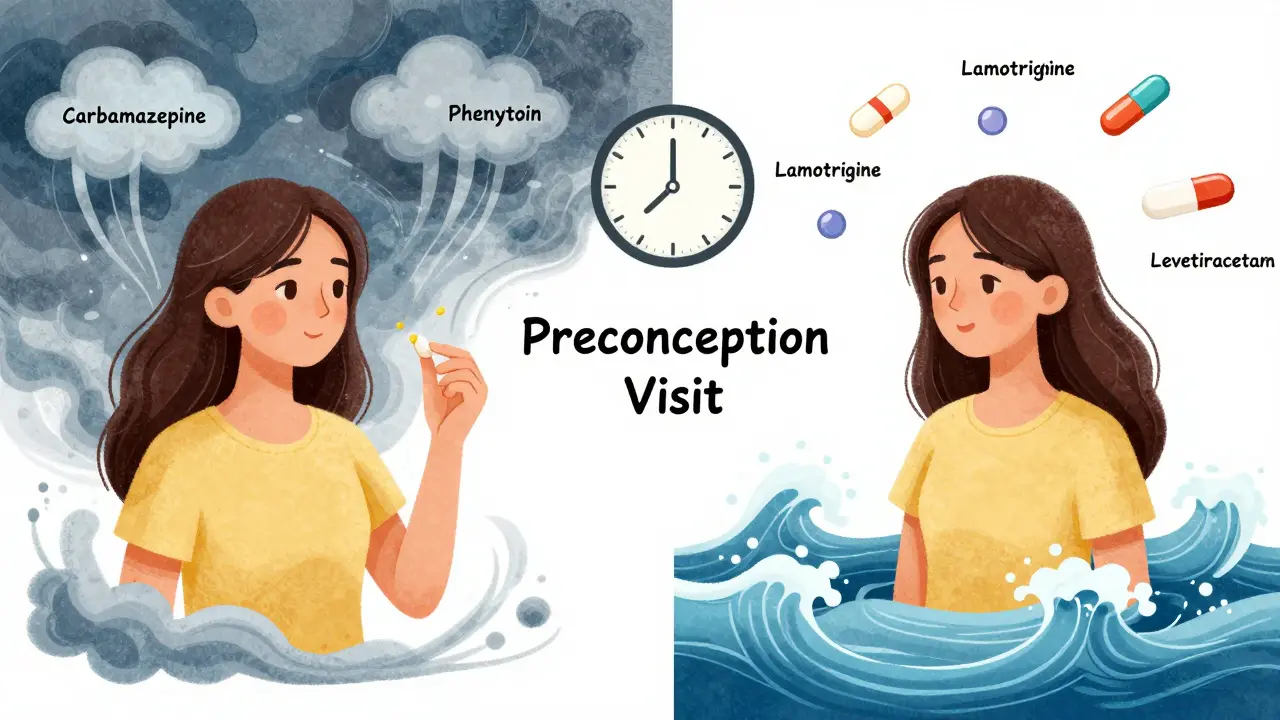
Why you shouldn’t stop your meds on your own
It’s tempting. If you’re worried about birth defects, you might think, “I’ll just quit my meds.” But that’s dangerous. Uncontrolled seizures are a major threat. A single tonic-clonic seizure during pregnancy can cause oxygen loss, falls, trauma, or even miscarriage. The American Epilepsy Society says clearly: no ASM is as dangerous to a pregnant person or their baby as uncontrolled seizures.
That’s why experts call it an “excruciating double bind.” You need the medicine to stay safe. But the medicine might hurt the baby. The answer isn’t choosing one over the other - it’s choosing the right one.
Preconception counseling isn’t optional - it’s essential
If you’re a woman of childbearing age and take seizure meds, you need to talk to your neurologist before you even try to get pregnant. This isn’t a one-time chat. It’s part of your ongoing care.
Here’s what should happen:
- Review your current medication. If you’re on valproate, switching to lamotrigine or levetiracetam should be seriously considered - even if your seizures are well controlled.
- Use the lowest effective dose. Higher doses = higher risk. Your doctor should aim for the minimum amount that keeps you seizure-free.
- Check your birth control. If you’re on hormonal methods, ask if your ASM is making them less effective. Switch to an IUD or implant if needed.
- Start taking folic acid. At least 0.4 mg daily, and sometimes up to 5 mg if you’re on high-risk meds. Folic acid lowers the risk of neural tube defects.
- Plan your timeline. Don’t wait until you miss a period. Get your meds adjusted before conception.
A 2023 study in Neurology found that women with lower income or fewer healthcare resources were more likely to be on high-risk drugs during pregnancy. That’s not because they made bad choices - it’s because they didn’t get the right advice. Access to specialists matters.
The big picture: things are getting better
There’s real progress. Between 1997 and 2011, the rate of major birth defects linked to seizure meds dropped by 39%. Why? Better prescribing. More awareness. More women getting preconception care.
Stanford’s 2021 study showed that children exposed to newer ASMs like lamotrigine and levetiracetam had normal language development. That’s huge. It means you can have a healthy baby and still manage your epilepsy.
But we’re not done. Eleven other ASMs still don’t have enough data to say whether they’re safe in pregnancy. And too many women are still being prescribed valproate without knowing the risks.
What you can do right now
- If you’re on valproate, phenobarbital, phenytoin, carbamazepine, or topiramate - ask your doctor if you can switch.
- If you’re on lamotrigine or levetiracetam - you’re already on a safer path. Keep taking it.
- If you’re on birth control - tell your neurologist what you’re using. Ask if your seizure meds interfere.
- If you’re planning pregnancy - schedule a preconception visit. Don’t wait.
- If you’re not planning pregnancy - use reliable contraception. Talk to your doctor about what’s safest with your meds.
You don’t have to choose between being seizure-free and being a parent. With the right care, you can be both.
Can I get pregnant if I’m taking seizure medication?
Yes, you can. Most women with epilepsy have healthy pregnancies and babies. But the risk of birth defects depends on which medication you’re taking. Valproate and phenobarbital carry higher risks, while lamotrigine and levetiracetam are considered much safer. The key is planning ahead and working with your doctor to switch to the safest option before you conceive.
Do all seizure medications cause birth defects?
No. While some older medications like valproate, phenytoin, and phenobarbital are linked to higher rates of birth defects, newer drugs like lamotrigine and levetiracetam have risks close to the general population - around 2-3%. Many women take these safer drugs and have healthy children. The risk isn’t about having epilepsy - it’s about which drug you’re on.
Can birth control pills still work if I’m on seizure meds?
Sometimes, but not always. Medications like carbamazepine, phenytoin, and high-dose topiramate can make hormonal birth control much less effective. This means you could get pregnant even if you take your pill every day. If you’re on one of these drugs, talk to your doctor about switching to a non-hormonal method like an IUD or implant. These aren’t affected by seizure meds.
What should I do if I’m already pregnant and on valproate?
Don’t stop taking it on your own. Stopping suddenly can trigger dangerous seizures. Contact your neurologist immediately. They’ll assess your seizure control and may slowly switch you to a safer medication like lamotrigine - but only under medical supervision. Your baby’s safety depends on keeping your seizures under control.
Is it safe to breastfeed while taking seizure meds?
Yes, for most medications. Lamotrigine and levetiracetam pass into breast milk in very small amounts and are generally considered safe. Valproate is also considered acceptable for breastfeeding, though monitoring your baby’s liver function is recommended. Always check with your doctor - the benefits of breastfeeding usually outweigh the tiny risks from medication exposure.
Why is folic acid important before and during pregnancy?
Folic acid helps prevent neural tube defects, like spina bifida, which are more common in babies exposed to certain seizure medications. Taking at least 0.4 mg daily before conception and during early pregnancy reduces this risk. If you’re on high-risk meds like valproate, your doctor may recommend 5 mg daily. Start taking it at least three months before trying to conceive.
Are there any new seizure meds that are safer than others?
Yes. Lamotrigine and levetiracetam are now considered the safest options for pregnancy. Studies show no increase in major birth defects compared to the general population. Newer drugs like cenobamate and perampanel are still being studied, but early data suggests lower risks than valproate. Your doctor can help you choose based on your seizure type and history.
How often should I see my neurologist if I’m planning pregnancy?
Start with a preconception visit at least 3-6 months before trying to conceive. After that, monthly checkups are ideal during pregnancy. Your medication levels may change as your body adjusts to pregnancy - especially with drugs like lamotrigine, which can be cleared faster. Regular blood tests and dose adjustments are often needed.
If you’re thinking about having a baby and take seizure meds, you’re not alone. Thousands of women do it every year. With the right care, the risks are manageable. The goal isn’t to avoid pregnancy - it’s to make sure you and your baby both stay safe.


Betty Kirby, February 15, 2026
Let me get this straight: women with epilepsy are being told to risk their lives to have kids because some doctor somewhere decided valproate was fine 20 years ago. We’ve known about the birth defect risks since the 90s. Why are we still having this conversation? This isn’t about choice. It’s about systemic neglect wrapped in medical jargon. If your doctor hasn’t brought up switching to lamotrigine or levetiracetam by now, find a new one. Period.
Erica Banatao Darilag, February 17, 2026
I just wanted to say thank you for writing this with such clarity. As someone who’s been on lamotrigine for over a decade and just became a mother last year, I can tell you the peace of mind is immeasurable. My daughter is now two, hitting every milestone, and I didn’t have to sacrifice my health to have her. It’s not perfect, but it’s possible. Please, if you’re reading this and thinking about pregnancy - talk to your neurologist. It’s worth the effort.
Josiah Demara, February 19, 2026
Oh wow. Another feel-good post that ignores the real issue: most women on these meds can’t even afford a neurologist, let alone switch to expensive newer drugs. You talk about lamotrigine like it’s a magic pill, but it costs $800 a month without insurance. Meanwhile, valproate is $12. So yeah, ‘just switch’ - unless you’re on Medicaid in Alabama or working two minimum wage jobs. This isn’t medical advice. It’s privileged fantasy dressed up as public service.
Charlotte Dacre, February 19, 2026
So let me get this straight - the medical establishment spent decades telling women with epilepsy not to have kids, then suddenly we’re all supposed to be thrilled about ‘safer’ meds? How about we stop treating women like biology experiments and start giving us real options? Like, I don’t know, free access to specialists? Or maybe not prescribing valproate like it’s aspirin? Just a thought.
Esha Pathak, February 20, 2026
Life is a paradox, isn’t it? We are told to control our minds, yet our bodies betray us. The seizure is not the enemy - the fear is. The fear of being seen as broken. The fear of being told you’re unfit. But here’s the truth: your worth is not measured in synaptic firings or fetal ultrasounds. You are not your diagnosis. You are not your medication. You are the quiet storm that still sings. And if you choose to bring life into this world, even with all its risks - that is not weakness. That is courage, written in neurotransmitters and silent nights.
Mike Hammer, February 22, 2026
Been on levetiracetam since 2018. Got pregnant last year. No issues. Baby’s 6 months old, laughs like a hyena, sleeps through the night. My doc said ‘this is what we’ve been waiting for.’ Honestly? I didn’t even know half this stuff until I got pregnant. I thought birth control and meds just… worked. Turns out, they don’t always. If you’re on anything but lamotrigine or levetiracetam and thinking about kids - don’t wait. Talk to someone. Even if it’s just a nurse. Anything’s better than guessing.
Kapil Verma, February 23, 2026
How can you even consider having children when your brain is this unstable? This isn’t just about birth defects - it’s about responsibility. You’re not just risking your own life, you’re risking the life of a child who didn’t ask to be born into this chaos. If you can’t control your seizures, you shouldn’t be a parent. End of story. Stop romanticizing this as ‘empowerment.’ It’s negligence with a hashtag.
Michael Page, February 23, 2026
There’s something deeply ironic about a post that spends 12 paragraphs detailing the dangers of medication during pregnancy, then ends with ‘you can be both seizure-free and a parent.’ As if the answer is simply… yes. But the real question isn’t whether it’s possible. It’s whether society will ever make it safe. For the woman in rural India with no access to a neurologist. For the single mom on Medicaid. For the one who can’t afford the 3-month preconception visit. We talk about risks like they’re math problems. They’re not. They’re lives.
Mandeep Singh, February 24, 2026
Look, I’ve been on valproate for 15 years. My seizures are controlled. I’m 32. I want kids. So what? You think I don’t know the risks? Of course I do. I read every study. I cried over the data. But here’s the thing - my neurologist says I’m low-risk because my dose is low and my seizures are infrequent. And yes, I’m on an IUD. And yes, I’m taking 5mg folic acid. So don’t act like every woman on valproate is a ticking time bomb. We’re not. We’re trying. We’re doing the work. And if you’re going to judge us, at least know what you’re talking about.
Also, why are we still using 1970s data to dictate 2024 decisions? If lamotrigine is so safe, why isn’t it the first-line treatment for every woman of childbearing age? Because the system is broken. Not us.
Kaye Alcaraz, February 24, 2026
This is a critical conversation and your clarity is deeply appreciated. The data is clear. The path forward is known. What is missing is consistent, accessible, nonjudgmental care. Every woman deserves a preconception consultation. Every woman deserves to know her options. This should not be a privilege tied to income, geography, or insurance. We must advocate for policy change - not just individual action. Let’s turn awareness into access.
Sarah Barrett, February 26, 2026
It’s remarkable how much progress has been made in just two decades. In 1997, many women were told to avoid pregnancy entirely. Today, we have data, guidelines, and safer options. The fact that lamotrigine and levetiracetam now carry risks comparable to the general population is nothing short of a medical triumph. The challenge now is not whether it’s possible - it’s whether we will ensure equitable access to these solutions. Knowledge is power, but access is justice.
Daniel Dover, February 27, 2026
Switched from valproate to lamotrigine last year. Got pregnant this spring. Baby’s healthy. No seizures. No drama. Just a quiet, normal life. The hardest part? Getting my old doctor to listen. The easy part? Taking the pill every day.