
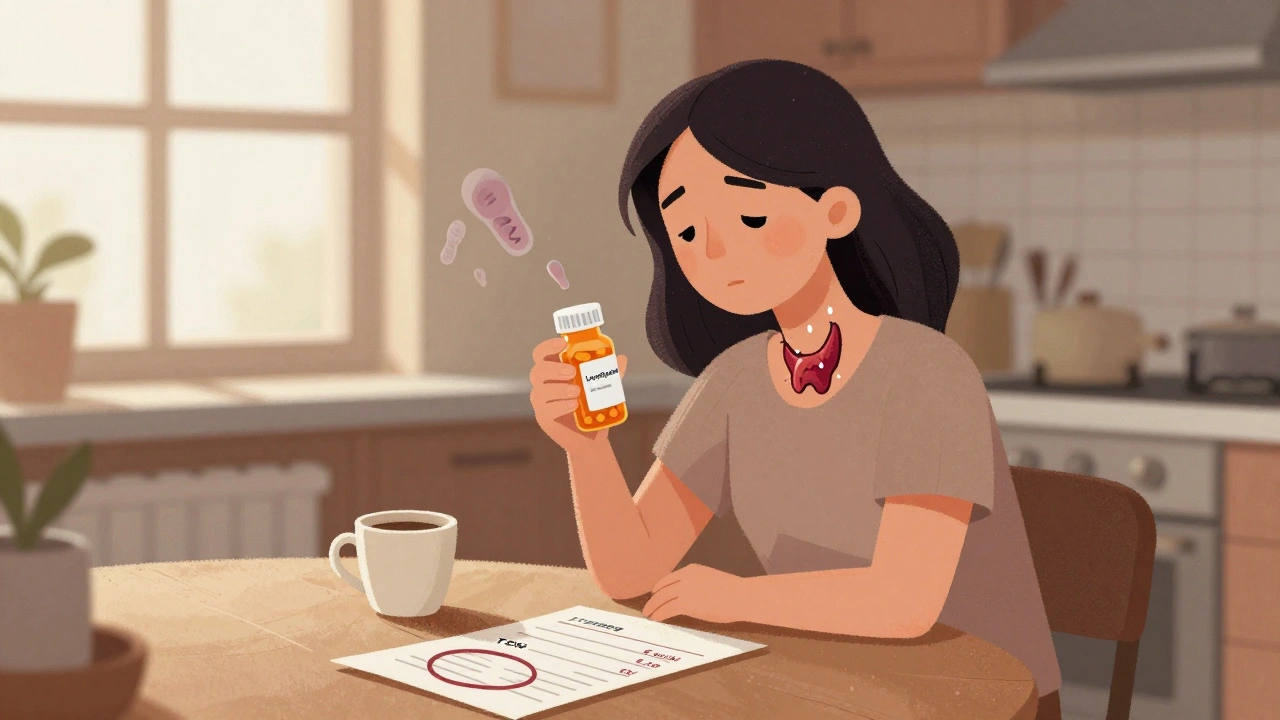
Hashimoto’s thyroiditis isn’t just a lab result. For millions of people, especially women, it’s a quiet, persistent drain on energy, mood, and daily life. It’s when your immune system turns against your thyroid, slowly shutting down its ability to make hormones. The result? Hypothyroidism - a condition where your body runs on low fuel. And the key to managing it isn’t just taking a pill. It’s understanding how to use TSH - thyroid-stimulating hormone - as your guide through treatment.
What Hashimoto’s Thyroiditis Really Does to Your Body
Hashimoto’s isn’t an infection you catch. It’s an autoimmune glitch. Your body mistakes thyroid cells for invaders and sends antibodies to attack them. Over time, the thyroid gets scarred, shrinks, and produces less T4 and T3 - the hormones that control your metabolism, heart rate, body temperature, and even your mood.
It’s the most common cause of hypothyroidism in places where people get enough iodine, like the U.S. and the U.K. About 90% of hypothyroid cases trace back to Hashimoto’s. Women are five to ten times more likely to develop it than men. It often shows up between ages 30 and 50, but it can strike at any age.
Many people don’t realize they have it until symptoms pile up: constant tiredness, weight gain that won’t budge, dry skin, hair thinning, depression, brain fog, and feeling cold even in a warm room. Sometimes, the first clue is a blood test done for another reason - like checking cholesterol or investigating infertility.
How Diagnosis Works: TSH, T4, and Antibodies
Doctors don’t guess. They test. The first step is always measuring TSH - the hormone your pituitary gland releases to tell your thyroid to work harder. If your thyroid is failing, your pituitary screams louder. So a high TSH is the earliest red flag.
If TSH is above 4.5 mIU/L, the next step is checking free T4 (FT4) and thyroid peroxidase antibodies (TPOAb). A high TSH with low or low-normal T4 confirms primary hypothyroidism. Elevated TPOAb - usually above 35 IU/mL - confirms the autoimmune cause. That’s Hashimoto’s.
But here’s something most people don’t know: you don’t need to keep checking those antibodies after diagnosis. The American Thyroid Association says repeating antibody tests doesn’t help manage your treatment. Once you know it’s Hashimoto’s, the focus shifts entirely to hormone levels - not immune activity.
Levothyroxine: The Standard Treatment
The treatment is simple in theory: replace what your thyroid can’t make. Levothyroxine (LT4), a synthetic form of T4, is the gold standard. Brands like Synthroid are common, but generics work just as well if you stick with the same batch.
Dosing isn’t one-size-fits-all. For most adults, doctors start with 1.4 to 1.8 micrograms per kilogram of body weight. That usually means 25 to 50 mcg per day for someone with mild or early hypothyroidism. If you’re older, have heart disease, or are significantly overweight, they might start even lower - maybe 12.5 mcg - to avoid stressing your heart.
It’s not a quick fix. Levothyroxine takes time to build up in your system. That’s why you can’t expect to feel better the next day. The body needs weeks to adjust. And that’s why timing your blood tests matters.
Why TSH Is the Only Test You Really Need for Monitoring
After you start levothyroxine, the goal isn’t just to get your TSH into the normal range. It’s to find your personal sweet spot - the level where you feel your best.
Major guidelines from the American Thyroid Association, the Cleveland Clinic, and the American Association of Clinical Endocrinologists all agree: for primary hypothyroidism, TSH alone is enough to guide treatment. You don’t need to check T4 or T3 every few months. Those tests are useful at diagnosis, but once you’re on stable therapy, TSH tells the full story.
Why? Because TSH is the body’s most sensitive early warning system. It reacts faster and more precisely than T4 levels do. If your dose is too low, TSH rises before T4 drops. If it’s too high, TSH falls before you get symptoms of over-replacement like anxiety or heart palpitations.
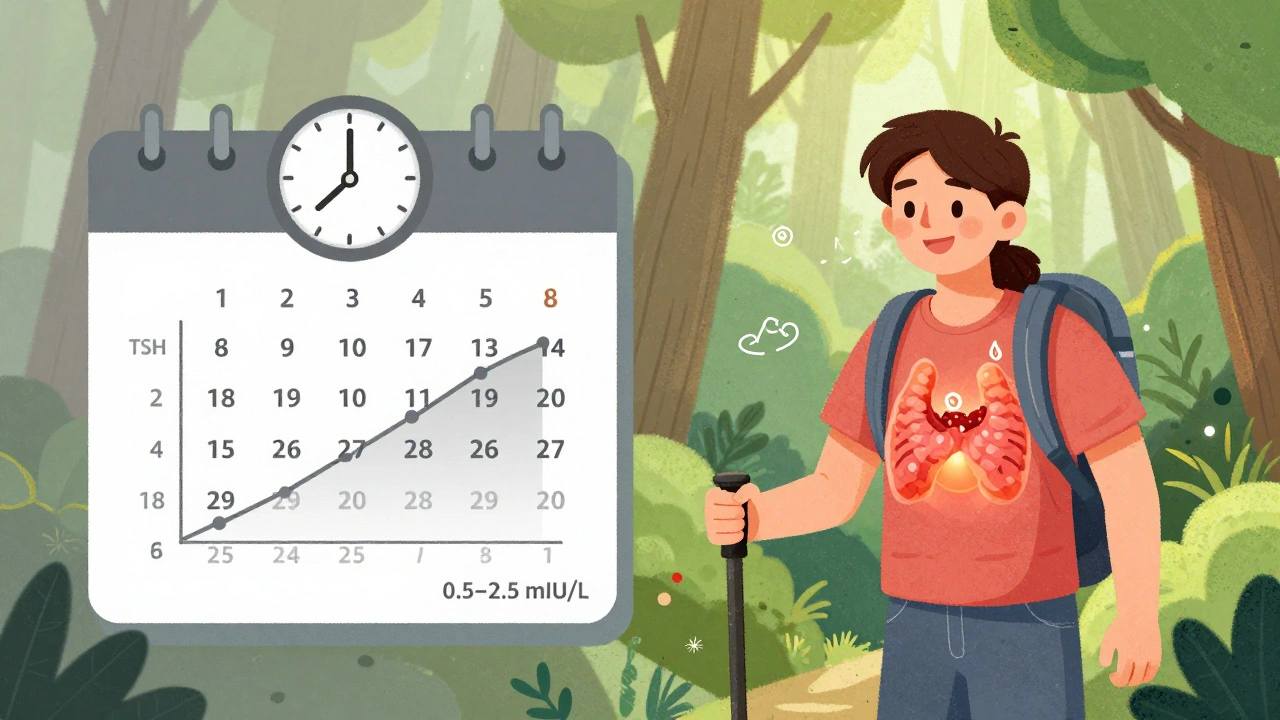
Most labs use a normal TSH range of 0.4 to 4.0 mIU/L. But that’s just a population average. Your ideal level might be lower - say, between 0.5 and 2.5 mIU/L - especially if you still feel fatigued or sluggish. Some people feel better with TSH at the lower end of normal. That’s not unusual. It’s not wrong. It’s personalized care.
When and How Often to Test TSH
Timing your blood tests is critical. Test too soon after a dose change, and you’ll get misleading results. Levothyroxine has a long half-life - about 7 days. It takes 6 to 8 weeks for your pituitary gland to fully respond and stabilize TSH levels.
So here’s the real-world schedule:
- First test: 6 to 8 weeks after starting levothyroxine or changing your dose
- Next test: Another 6 to 8 weeks after any adjustment
- Once stable: Once a year
Some clinics test at 4 to 6 weeks, especially early on. But if you’re still adjusting, don’t rush. Waiting the full 6 to 8 weeks gives your body time to settle. Testing more often doesn’t speed things up - it just adds stress and cost.
For pregnant women with Hashimoto’s, the rules change. TSH needs to be checked every 4 weeks until week 20 of pregnancy. The target TSH drops to 0.1-2.5 mIU/L in the first trimester. Untreated or poorly controlled Hashimoto’s during pregnancy increases the risk of miscarriage, preterm birth, and developmental issues in the baby.
What Can Throw Off Your TSH Results
Even with perfect dosing, your TSH can look weird if you’re not careful about how you take your medication or what else you’re on.
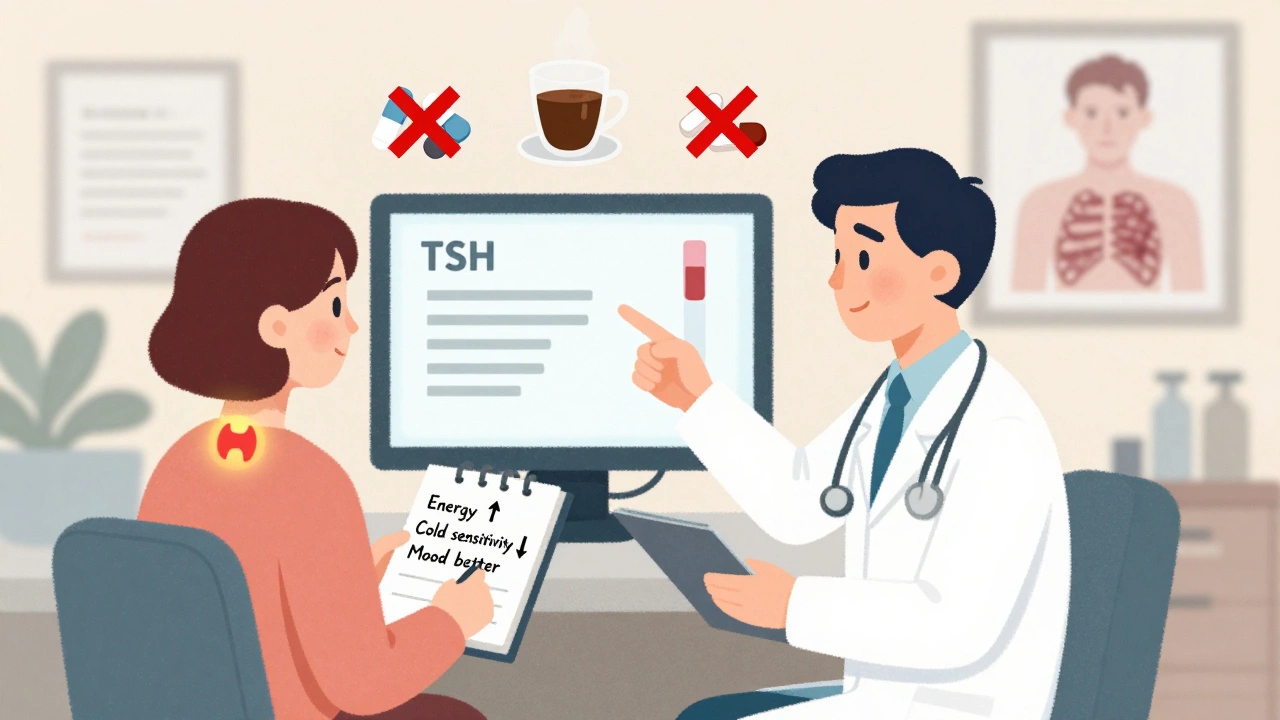
- Timing matters: Take levothyroxine on an empty stomach, at least 30 to 60 minutes before breakfast. Coffee, calcium, iron, and antacids can block absorption.
- Medications interfere: Proton pump inhibitors (like omeprazole), estrogen pills, and some cholesterol drugs can affect how well your body absorbs levothyroxine.
- Weight changes: If you gain or lose more than 10% of your body weight, your dose likely needs adjusting.
- Brand switching: The FDA tightened manufacturing standards in 2018 to reduce batch-to-batch variation, but some people still report feeling different when switching from brand to generic. Stick with one version if it works.
Don’t skip meals or take supplements right after your pill. Even a small delay can cut absorption by 30% or more. Consistency is everything.
When TSH Is Normal But You Still Feel Terrible
This is the most frustrating part for patients. You’ve been tested. Your TSH is in range. Your doctor says you’re fine. But you’re still exhausted, bloated, and down.
You’re not imagining it. Studies show that some people with Hashimoto’s - especially those with a genetic variation in the DIO2 gene - respond better when TSH is kept in the lower half of the normal range (0.4-2.0 mIU/L). Their bodies may not convert T4 to T3 efficiently, so even a “normal” TSH doesn’t mean their tissues are getting enough active hormone.
If you’re symptomatic despite normal TSH, talk to your doctor about adjusting your target. Some endocrinologists will aim for TSH between 0.5 and 2.5, especially if you’ve had Hashimoto’s for years. Don’t accept “you’re fine” if you don’t feel fine.
Don’t rush to T3 supplements. Despite what you might read online, the Cochrane Review found no strong evidence that adding T3 (like Cytomel) helps most people. It can even cause heart rhythm problems. Stick with T4 unless you’re under the care of a specialist who’s monitoring you closely.
What’s Changing in Hashimoto’s Management
Things are evolving. In 2021, the FDA approved the first home TSH test - ThyroChek. It’s not for everyone yet. Accuracy drops at very low TSH levels, and it’s not covered by insurance. But it’s a sign of where things are headed: more control, less waiting.
Research is also looking at whether diet, stress, or gut health play a role in autoimmune flare-ups. While no diet cures Hashimoto’s, some patients report feeling better reducing gluten or dairy. That’s individual. Don’t believe claims that “clean eating” will reverse it. But if cutting out a food makes you feel better, and your doctor agrees it’s safe, go for it.
The big takeaway? Hashimoto’s isn’t a death sentence. It’s a manageable condition. With the right dose of levothyroxine and smart TSH monitoring, most people live full, active lives. The key is patience, consistency, and knowing when to push back if you’re not feeling like yourself.
What to Do Next
If you’ve been diagnosed with Hashimoto’s:
- Take your levothyroxine the same way every day - on an empty stomach, before breakfast
- Wait 6 to 8 weeks after any dose change before testing TSH
- Ask for your TSH result every time you get tested - don’t just accept “you’re fine”
- Track your symptoms: energy, mood, weight, temperature sensitivity
- Let your doctor know if you start or stop any new medications
- Don’t test antibodies repeatedly - it won’t change your treatment
If you’re still tired, anxious, or gaining weight despite normal labs - speak up. Your TSH target might need fine-tuning. You’re not broken. You just need a better fit.
Can Hashimoto’s thyroiditis be cured?
No, Hashimoto’s thyroiditis cannot be cured. It’s a lifelong autoimmune condition. But it can be effectively managed with daily levothyroxine medication and regular TSH monitoring. Once properly dosed, most people experience no symptoms and live normal, healthy lives.
Why is TSH the best marker for monitoring Hashimoto’s?
TSH is the most sensitive indicator of thyroid hormone levels in the body. It’s produced by the pituitary gland and responds quickly to small changes in T4 and T3. When thyroid hormone drops, TSH rises - often before symptoms appear. This makes it the most reliable tool for adjusting levothyroxine doses without needing to test T4 or T3 repeatedly.
How long does it take for levothyroxine to start working?
You might notice small improvements in energy or mood within 2 to 3 weeks, but full effects take 6 to 8 weeks. That’s because levothyroxine has a long half-life, and your pituitary gland needs time to adjust its TSH output. Testing too early gives misleading results. Patience is part of the treatment.
Should I avoid gluten if I have Hashimoto’s?
There’s no strong evidence that a gluten-free diet cures or reverses Hashimoto’s. But some people with the condition also have celiac disease or non-celiac gluten sensitivity. If you notice symptoms improve after cutting out gluten, it’s worth trying under medical supervision. Don’t eliminate it without testing first - you could miss diagnosing celiac disease.
Can I stop taking levothyroxine if I feel better?
No. Stopping levothyroxine will cause your TSH to rise again, and your symptoms will return. Hashimoto’s damages your thyroid permanently. You need ongoing hormone replacement. Feeling better means your dose is working - not that you’re cured. Never stop without consulting your doctor.
Is it safe to take levothyroxine with other medications?
Some medications interfere with levothyroxine absorption. Iron, calcium, antacids, proton pump inhibitors, and certain cholesterol drugs can reduce its effectiveness. Take levothyroxine at least 4 hours before or after these. Always tell your doctor what else you’re taking - even supplements.
Why do some people need a lower TSH target than others?
Everyone’s body responds differently. Some people, especially those with specific genetic variations like the DIO2 polymorphism, convert T4 to active T3 less efficiently. For them, a TSH in the lower half of the normal range (0.4-2.0 mIU/L) often leads to better symptom control. Treatment isn’t just about numbers - it’s about how you feel.


Christian Landry, December 8, 2025
this post is a lifesaver. i've been on levothyroxine for 3 years and still thought i was doing something wrong when i felt tired. turns out i was testing too early lol. 6-8 weeks? got it. 🙌
Katherine Rodgers, December 10, 2025
so let me get this straight... you're telling me my 2.8 TSH is 'fine' but i'm still a zombie? yeah right. my doctor says 'it's in range' like that's a magic spell. 🤡
Katie Harrison, December 10, 2025
I've been told my TSH is 'normal'... but I still can't get out of bed before noon. I've asked for a lower target. They said 'you're not diabetic.' I'm not. I'm just exhausted. This post gets it.
Lauren Dare, December 11, 2025
Let's be real: if your doctor is still using the 0.4–4.5 range as gospel, they're practicing medicine from 2005. TSH is a tool, not a prison sentence. Personalization isn't 'alternative'-it's science.
Lola Bchoudi, December 12, 2025
If you're still tired despite 'normal' labs, track your symptoms for 2 weeks. Write down energy, sleep quality, mood swings, body temp. Bring it to your endo. Data > anecdotes. You're not crazy-you're just under-optimized.
Taya Rtichsheva, December 12, 2025
took my pill with coffee one morning and my tsh spiked to 8.5 next test... i thought i was broken. turns out i was just dumb. now i take it with water at 5am. life changed
Guylaine Lapointe, December 14, 2025
I don't know why people still believe in gluten-free cures. I tried it. I cried. I ate a bagel. I felt better. Then I checked my TPO antibodies. Still high. The pill works. Stop chasing fairy tales.
Gilbert Lacasandile, December 14, 2025
I've been on the same dose for 5 years. Got my TSH checked last year-2.1. Felt great. Then I moved, switched pharmacies, got a different generic. Felt like crap again. Took me 3 months to figure out why. Never switch brands unless you have to.
Sarah Gray, December 15, 2025
The fact that people still think T3 supplementation is a 'solution' is alarming. Cochrane Review says no. End of story. If you're googling 'natural thyroid cures' while on levothyroxine, you're not healing-you're gambling with your heart.
Mona Schmidt, December 17, 2025
I appreciate the emphasis on consistency. Taking levothyroxine at the same time, on an empty stomach, avoiding calcium and iron-these aren't 'hacks.' They're pharmacological necessities. The body doesn't care about your schedule; it cares about absorption. Respect the science.
Morgan Tait, December 17, 2025
I think the real issue is that the FDA doesn't regulate the fillers in generics. I swear my body reacts to cornstarch. I'm convinced there's a glyphosate conspiracy in the thyroid med supply chain. Also, I don't trust labs. I bought a home test. It says I'm 37% more hypothyroid than the hospital says. I'm not crazy. I'm just awake.
Darcie Streeter-Oxland, December 17, 2025
So let me summarize: you're telling me to ignore my antibodies, trust a single hormone, and ignore my intuition because 'guidelines' say so? And you're the expert? I've been on this for 12 years. My TSH is 1.8. I still can't tolerate cold. I'm not a lab rat.
Delaine Kiara, December 18, 2025
I'm 42, female, diagnosed at 35, and I've been on levothyroxine since. My TSH is 0.7. I feel like a new person. I run marathons. I sleep through the night. I didn't need a miracle. I needed someone to listen. Thank you for writing this. I'm not alone.