

FAERS Side Effect Risk Calculator
Understand FAERS Data Better
FAERS reports don't tell you how likely a side effect is - they only show how many people reported it. This calculator helps you understand the relationship between reported cases and estimated users to get a better sense of risk.
When you’re trying to find out if a medication might cause serious side effects, the FAERS database is one of the most powerful tools available. But it’s not a simple lookup. If you type in a drug name and take the first numbers you see as proof of danger, you’re going to get it wrong. The FDA’s Adverse Event Reporting System doesn’t tell you how often side effects happen - it tells you what people have reported. And that’s a big difference.
What FAERS Actually Shows You
FAERS collects reports of adverse events - things like liver damage, heart palpitations, or sudden dizziness - after a drug hits the market. These reports come from doctors, pharmacists, patients, and drug makers. Pharmaceutical companies are legally required to send in reports of serious or unexpected reactions within 15 days. Patients and providers can file reports too, though they often go through the manufacturer first. About 75% of all reports in FAERS come from drug companies.
But here’s the catch: FAERS doesn’t verify these reports. A report doesn’t mean the drug caused the problem. Maybe the patient had another illness. Maybe they took five other medications. Maybe the reaction was unrelated. FAERS doesn’t know. It just records what was reported.
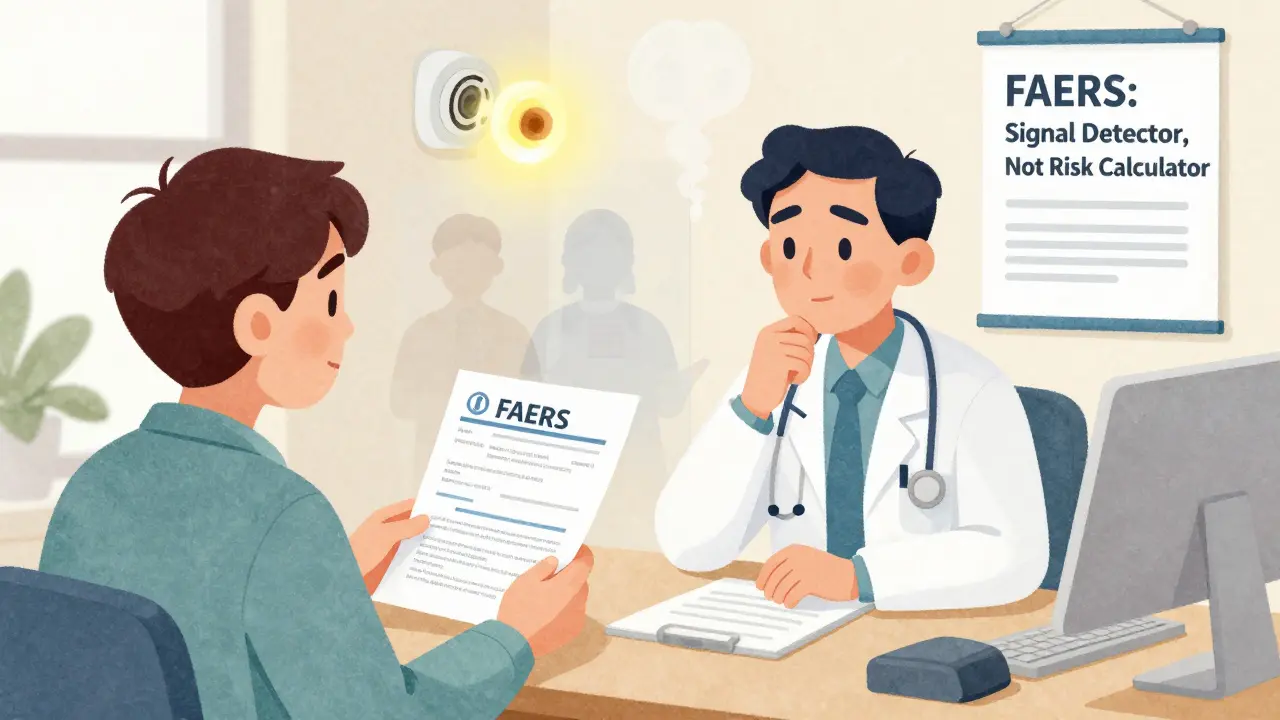
Think of it like a smoke alarm. It goes off when it senses smoke - but it doesn’t tell you if it’s toast burning or a house on fire. FAERS is designed to sound the alarm, not solve the fire.
The Real-Time Update Changed Everything
Before August 2024, FAERS updated every three months. That meant if a new safety issue popped up in June, it wouldn’t show up publicly until September. That delay could cost lives. In 2024, the FDA switched to real-time updates. Now, reports show up within days of being submitted. This isn’t just a technical upgrade - it’s a shift in how public health surveillance works.
Why does this matter to you? If you’re tracking a drug that was recently approved, or one that’s been in the news for a possible side effect, real-time data means you’re seeing the latest signals - not outdated trends. But it also means the numbers are still messy. Early reports can be noisy. A single hospital might submit 50 similar cases all at once, making it look like there’s a spike. It’s not necessarily a trend - yet.
How to Search the FAERS Public Dashboard
The easiest way to start is with the FAERS Public Dashboard. It’s free, no login needed, and built for non-experts.
- Type the drug name in the blue search bar. Use the generic name - not the brand. For example, search metformin, not Glucophage.
- After hitting search, you’ll see a graph showing reports by year. This is just the total volume.
- Click the dropdown menu on the right labeled "Cases by" and select "Reaction".
- You’ll now see a list of side effects reported with that drug, ranked by frequency. The most common ones appear at the top.
Important: The dashboard only lets you search up to five drugs at once. If you’re comparing drugs - say, two diabetes pills - you’ll need to run separate searches and compare the results manually.
Also, don’t forget to check for alternate names. A drug like esomeprazole is sold as Nexium, esomeprazole magnesium, and esomeprazole sodium. If you only search one name, you’re missing half the data.

What the Numbers Don’t Tell You
Let’s say you see 1,200 reports of liver injury with Drug X. That sounds alarming. But how many people took Drug X? If 10 million people used it, that’s 0.012%. If only 10,000 people used it, that’s 12% - a huge red flag. FAERS doesn’t give you the denominator. That’s the biggest flaw.
Another issue: reporting bias. If a drug gets pulled from the market, people start reporting every headache as a side effect. If a drug is new, doctors are more likely to report anything unusual. Older drugs get fewer reports - not because they’re safer, but because everyone’s used to them.
And then there’s underreporting. Studies estimate only 1% to 10% of actual adverse events get reported. Most patients never file a report. Most doctors don’t either. So the absence of reports doesn’t mean safety.
Advanced Tools: VisDrugs and PharmaPendium
If you’re looking beyond basic curiosity - say, you’re a researcher, a pharmacist, or someone managing a patient’s medication history - you need more than the dashboard.
VisDrugs is a free tool built by researchers to make sense of FAERS data. It turns raw numbers into visual charts. You can compare two drugs side by side. It shows you which side effects are more common with one drug than another using forest plots and odds ratios. It even breaks down reports by age and gender. If you’re trying to decide between two blood pressure meds, this tool helps you see which one has more reports of cough, dizziness, or kidney issues - and whether those differences are statistically meaningful.
PharmaPendium (by Elsevier) is another option. It’s not free, but many hospitals and universities have access. It lets you use logic operators like AND, OR, NOT. You can search for all reports of heart failure in patients over 65 taking Drug A or Drug B. You can filter by reporter type - did a doctor report it, or a patient? You can even see if the reaction was fatal or led to hospitalization.
These tools don’t fix FAERS’ flaws - but they help you see patterns instead of noise.
What to Do With This Information
FAERS isn’t for deciding whether to take a drug. It’s for asking better questions.
If you’re a patient and you see a scary side effect listed, don’t panic. Talk to your doctor. Say: "I saw this reaction reported with my medication. How common is it really? Are there alternatives with fewer reports?"
If you’re a caregiver for an elderly parent on multiple drugs, use FAERS to spot potential interactions. If your mom takes warfarin and a new antibiotic, check both drugs in FAERS. Look for reports of bleeding or abnormal liver tests. Then ask the pharmacist: "Is this combo known to cause problems?"
If you’re a healthcare provider, use FAERS to spot signals in your own practice. If three patients in your clinic report sudden muscle pain after starting a new statin, check FAERS. If dozens of others have reported the same thing, it’s time to reconsider prescribing it.
Don’t Confuse FAERS With MAUDE
Many people search FAERS for medical device problems - like a faulty pacemaker or a broken hip implant. That’s the wrong database. For devices, use MAUDE - the Manufacturer and User Facility Device Experience database. Devices have different naming conventions. One company might sell the same implant under three different model numbers. Searching "knee replacement" in FAERS will give you nothing. In MAUDE, you need the exact model name.
If you don’t know the device name, check your medical records. Your surgeon’s office or hospital should have a copy of the implant card. That’s your best starting point.
Bottom Line: FAERS Is a Signal Detector, Not a Risk Calculator
FAERS is not a tool to prove a drug is dangerous. It’s a tool to find out if something might be dangerous. The real value isn’t in the numbers - it’s in the questions it sparks.
Use it to:
- Spot unusual patterns in side effects
- Compare safety profiles of similar drugs
- Ask informed questions of your healthcare team
- Understand why the FDA might add a warning to a label
Never use it to make a final decision about your health. Use it to start a conversation - with your doctor, your pharmacist, or your own research. The FDA doesn’t expect the public to interpret FAERS alone. They built it to help professionals find signals. And if you’re smart about how you use it, you can too.
Can I trust the number of side effects listed in FAERS?
No. The number of reports doesn’t tell you how likely a side effect is. It only tells you how many people reported it. Many factors affect reporting - like how new the drug is, whether it’s been in the news, or if a hospital reports a cluster of cases. FAERS data is for spotting trends, not calculating risk.
Why does FAERS only let me search five drugs at once?
The FAERS Public Dashboard is designed for simplicity. Searching more than five drugs at once would overwhelm the interface and make results harder to interpret. For complex comparisons - like analyzing 10 antidepressants - use advanced tools like VisDrugs or PharmaPendium, which allow bulk queries and statistical comparisons.
Are side effects in FAERS confirmed by the FDA?
No. The FDA does not verify or confirm any individual report in FAERS. Reports come from healthcare providers, patients, and drug companies without independent investigation. The FDA uses FAERS to find patterns across thousands of reports - not to validate single cases.
Can I use FAERS to find out if my medication caused my health problem?
No. FAERS cannot prove causation. Many factors can cause a health issue - other medications, underlying conditions, lifestyle, genetics. FAERS only records what was reported. If you suspect a drug caused your reaction, talk to your doctor and consider filing a report through MedWatch. That’s how the system improves.
Is FAERS data available for download?
Yes. The FDA releases quarterly raw data files for researchers and analysts. These files are large and require programming skills (like SQL or Python) to process. Most people should use the Public Dashboard or VisDrugs instead. The raw data is meant for experts who can account for reporting biases and missing denominators.
What’s the difference between FAERS and MedWatch?
FAERS is the database that stores all the reports. MedWatch is the system used to submit them. If you want to report a side effect, you use MedWatch - either online, by phone, or by form. Those reports then go into FAERS. So MedWatch is the input; FAERS is the archive.
Next Steps If You’re Investigating a Drug
If you’re researching a drug because you or someone you care about had a bad reaction:
- Find the exact generic name of the drug.
- Search the FAERS Public Dashboard and note the top 3 reported side effects.
- Check VisDrugs to see how those side effects compare to similar drugs.
- Look up the drug’s FDA label - it lists warnings based on FAERS signals and clinical trials.
- Talk to your doctor or pharmacist. Bring your findings. Ask: "Is this something I should be worried about, or is it rare?"
- If you haven’t already, file a report through MedWatch. Your input helps improve the system.
FAERS won’t give you all the answers. But if you know how to read between the lines, it can give you the right questions to ask.


gary ysturiz, January 12, 2026
FAERS is like a crowd-sourced warning system - not a verdict. I use it to spot weird patterns, then talk to my pharmacist. Never take the numbers at face value.
Jessica Bnouzalim, January 13, 2026
OMG, YES!! I saw 300 reports of heart palpitations for my new blood pressure med… panicked for a week… then found out 2 million people take it!! Like, 0.015%?? Chill, body, chill.
laura manning, January 15, 2026
The statistical methodology underlying FAERS is fundamentally flawed due to reporting bias, selection bias, and the absence of a denominator population. To interpret adverse event frequencies as risk metrics is a profound epistemological error. The FDA explicitly disclaims causal inference from FAERS data, yet public misinterpretation persists at alarming rates.
Bryan Wolfe, January 17, 2026
Love this breakdown. Seriously, so many people see a scary side effect and quit their meds without talking to anyone. You’re right - FAERS is a starting point, not an ending. If you’re worried, bring the data to your doc and say, ‘Hey, what do you think?’ That’s how you stay safe without falling into fear.
Sumit Sharma, January 19, 2026
FAERS is garbage if you don’t know how to filter. The dashboard is for laypeople. Real analysis requires Python, SQL, and understanding of disproportionality metrics like ROR and PRR. If you’re not calculating reporting odds ratios, you’re just noise. Stop treating this like a Yelp review.
Jay Powers, January 20, 2026
Been using FAERS for 10 years as a nurse and I still get tripped up by brand vs generic names. Always double check the spelling. And don’t forget - if you see a spike, check if a hospital just had a cluster. One nursing home reporting 40 cases of dizziness doesn’t mean the drug is evil.
Lawrence Jung, January 21, 2026
The system is designed to be misunderstood. That’s the point. The FDA wants you to be anxious. Anxiety drives compliance. Compliance drives profits. FAERS isn’t transparency - it’s controlled fear. The real question is: who benefits from your confusion?
Alice Elanora Shepherd, January 22, 2026
Excellent summary. I’d add: always cross-reference with the FDA’s drug safety communications. FAERS signals often trigger formal warnings - those are published and annotated. Also, check the drug’s prescribing information - the ‘Warnings and Precautions’ section is usually grounded in FAERS trends, not anecdotal reports.
Christina Widodo, January 23, 2026
Wait - so if I see 500 reports of liver damage for a drug, but only 10k people took it, that’s bad? But if 10 million took it, it’s fine? So the same side effect is okay because more people used it? That feels wrong…
Prachi Chauhan, January 24, 2026
Think of FAERS like a radio static - you hear the noise, but the real message is hidden underneath. You need to tune out the hype, look at the patterns over time, and compare with other drugs. Also - most people don’t report. So if nothing shows up? Doesn’t mean it’s safe. Just means nobody talked.
Katherine Carlock, January 25, 2026
My grandma’s on 7 meds. I use FAERS to check for combos that might cause falls or confusion. Found out her new antibiotic + blood thinner combo had 200+ bleeding reports. We switched it. Saved her a hospital trip. This tool is a lifesaver if you’re smart about it.
Lauren Warner, January 25, 2026
People still think FAERS is a risk calculator? This is why medicine is broken. You don’t understand statistics, you don’t understand pharmacovigilance, and you’re not qualified to interpret this data. Stop posting half-baked takes. Go back to WebMD.
Bryan Wolfe, January 26, 2026
Lauren - I get it. You want people to be careful. But the whole point of this post is to help non-experts use FAERS wisely - not to shut them down. If we scare people away from checking data because they’re ‘not qualified’, we’re doing more harm than good. Let’s teach, not shame.