
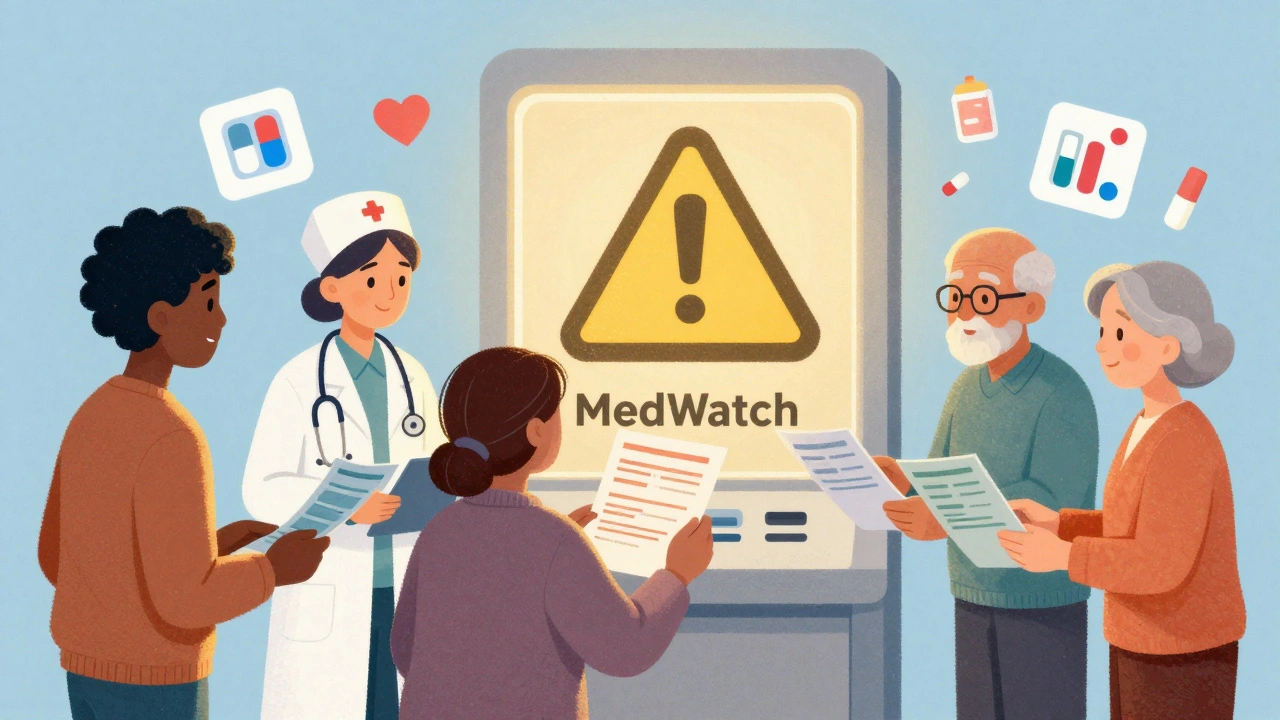
The U.S. Food and Drug Administration doesn’t just approve drugs and medical devices-it keeps watching them long after they’re on the market. That’s where MedWatch comes in. It’s the FDA’s main system for collecting reports about harmful side effects, product failures, and other safety issues tied to medicines, medical devices, vaccines, and even cosmetics. Think of it as a national early-warning system powered by doctors, patients, and manufacturers all sending in alerts when something goes wrong.
What Exactly Is MedWatch?
MedWatch, officially called the FDA Safety Information and Adverse Event Reporting Program, started in 1993. It wasn’t created to replace clinical trials-it was built to catch problems those trials missed. Clinical studies involve thousands of people over months or a few years. But once a drug is used by millions, rare side effects, long-term risks, or interactions with other medications can show up. That’s where MedWatch steps in. It’s not just a database. It’s a two-way street. The FDA uses MedWatch to collect reports, but it also uses it to send out safety alerts. If a new risk emerges-like a blood clot linked to a certain birth control pill or a pacemaker battery failing early-the FDA pushes out updates through email, its website, and direct notices to healthcare providers.Who Reports to MedWatch?
There are two types of reporters: those who have to report, and those who can report. Manufacturers, importers, and hospitals that use medical devices are legally required to report serious problems. If a device causes death or serious injury, they have 30 days to file a report-and just five workdays if it’s life-threatening. These reports go into the MAUDE database, which is part of MedWatch’s larger system. But here’s the key: anyone can report. Doctors, nurses, pharmacists, and even patients can submit a report using Form FDA 3500. In 2022, 42% of all reports came from consumers-not professionals. That’s huge. It means everyday people are helping the FDA spot problems that might otherwise go unnoticed.How Do You File a Report?
Filing a report is free and can be done in several ways:- Online at www.fda.gov/medwatch (the most common method)
- By phone: 1-800-FDA-1088
- By fax: 1-800-FDA-0178
- By mail to FDA HF-510, 5600 Fishers Lane, Rockville, MD 20857
- Patient’s age and sex
- Name of the drug, device, or product
- Exact description of the adverse event
- When symptoms started after using the product
- Any other medications or conditions the patient had
- What was done to treat the problem
- Outcome: Did the patient recover, get worse, or die?

What Happens After You Submit?
All reports go into the FDA Adverse Event Reporting System (FAERS), a database with over 28 million entries. That’s not just a pile of paperwork-it’s a goldmine for data mining. The FDA uses algorithms like Proportional Reporting Ratio (PRR) and Bayesian Confidence Propagation Neural Network (BCPNN) to spot unusual patterns. For example, if 50 people report sudden liver failure after taking a new diabetes drug, but only 2 reported it with older drugs, that’s a red flag. The agency reviews about 5,000 potential signals each year. If a signal looks real, the FDA investigates. That might mean:- Updating the drug label with new warnings
- Requiring a Risk Evaluation and Mitigation Strategy (REMS)
- Issuing a public safety alert
- Requesting a recall
Why Is MedWatch Important?
Without MedWatch, the FDA would be flying blind after approval. Drugs and devices are tested in controlled environments. Real-world use is messy. People take multiple meds. They have different genetics. They’re older, sicker, or pregnant. Dr. Janet Woodcock, former FDA Commissioner, said MedWatch reports contributed to 37% of all FDA safety communications between 2015 and 2020. That’s not small. It means nearly four out of ten safety updates came from real people-not lab tests or clinical trials. It’s also the only system in the U.S. that lets patients report directly. In Europe, reports go through national agencies first. In Canada, it’s mostly provider-only. MedWatch gives the public a direct line to the regulator.The Big Problem: Underreporting
Here’s the catch: only 1% to 10% of actual adverse events are ever reported. That’s not because people don’t care-it’s because reporting is hard. A 2021 American Medical Association study found it takes doctors 15 to 20 minutes to file a single report. For busy clinics, that’s a lot of time. Even with EHR integrations (like Epic Systems), it still takes 8 to 12 minutes for some providers. Patients face even bigger hurdles. A 2022 National Consumers League survey showed 68% of people who tried to report got stuck on medical jargon. Terms like “arrhythmia,” “hepatotoxicity,” or “anaphylaxis” are confusing. Many gave up. Dr. Joel Lexchin, a critic of the system, calls the low reporting rate a “structural flaw.” If only a fraction of problems are reported, even the best algorithms can’t catch everything.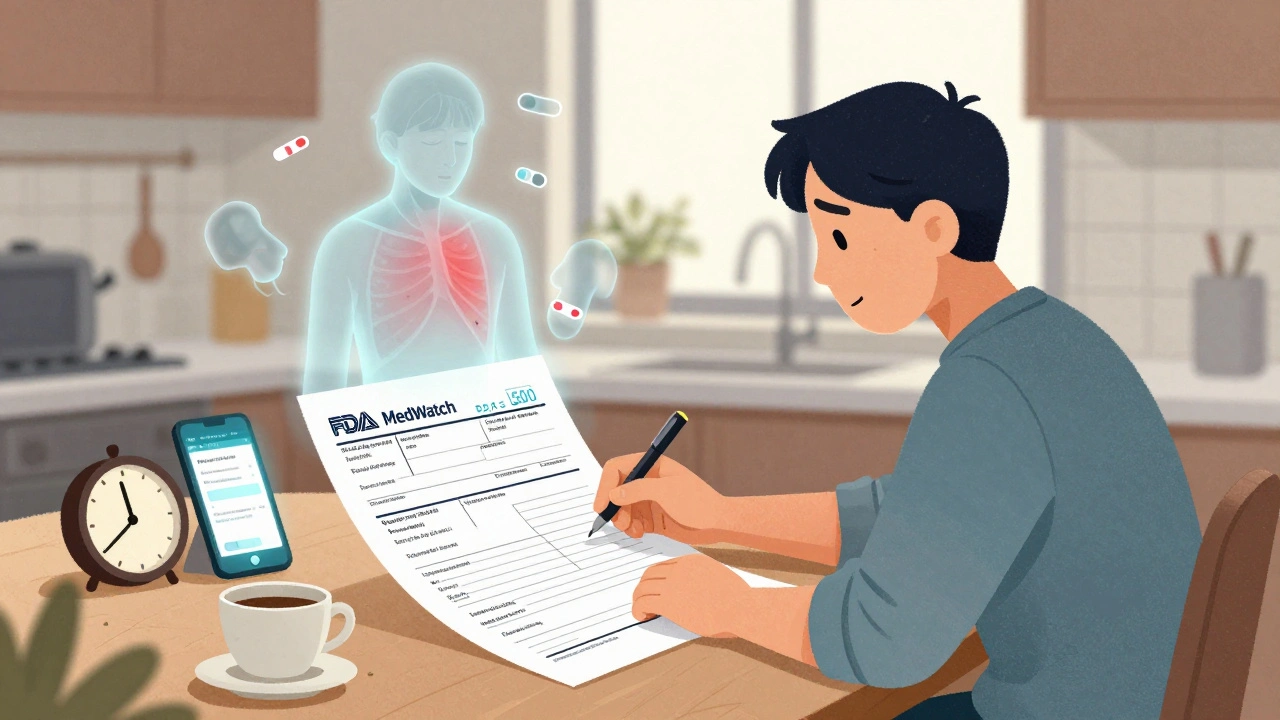
What’s Changing in MedWatch?
The FDA knows the system needs help. In September 2023, it launched MedWatch Direct, a new API tool that lets electronic health records automatically send reports. If your doctor’s system flags a possible reaction, it can auto-fill a report with patient data, saving time and improving accuracy. By mid-2024, the FDA plans to use AI to scan clinical notes for signs of adverse events. Right now, a nurse writes “patient had chest pain after starting new blood thinner.” The AI will pull that out, classify it, and route it to the right team. By late 2024, they’re testing blockchain to verify reports and prevent duplicates. And they’re hiring more analysts-though with only 120 staff handling 1.2 million reports a year, the workload is still overwhelming.What You Can Do
If you or someone you know had a bad reaction to a drug or device, report it. You don’t need to be a doctor. You don’t need to prove causation. Just tell the truth: what happened, when, and how it affected you. If you’re a healthcare provider, make reporting part of your routine. Even one report a year can help. Use the FDA’s online decision tree tool-it cuts down wrong reports by 38%. And if you’re confused? Call the MedWatch hotline: 1-800-FDA-1088. The average wait time is under a minute. MedWatch isn’t perfect. But it’s the best tool we have to protect people after a product leaves the lab. And it only works if people use it.Is MedWatch only for prescription drugs?
No. MedWatch accepts reports for prescription drugs, over-the-counter medicines, vaccines, medical devices like pacemakers and insulin pumps, biologics like monoclonal antibodies, combination products (like drug-coated stents), and even cosmetics and hemp-derived products. If it’s regulated by the FDA and you had a bad reaction, you can report it.
Do I need to prove the product caused the problem to report it?
No. The FDA doesn’t require you to prove causation. If you suspect a product might have played a role-even if you’re not sure-report it. The system is designed to catch patterns, not assign blame. A report saying “I started taking X and got dizzy” is valuable, even if you also take other meds.
How long does it take for the FDA to act on a report?
There’s no fixed timeline. Some reports trigger action within days if they point to a clear, urgent danger-like a batch of contaminated pills. Others sit in the database for months or years until enough similar reports pile up to form a signal. The system looks for trends, not isolated events. A single report rarely leads to a recall, but 50 similar ones might.
Can I report a problem with a supplement or herbal product?
Yes. Even though dietary supplements aren’t approved by the FDA before sale, they’re still regulated. If you had a bad reaction to a supplement-like liver damage from a weight-loss pill or heart palpitations from a pre-workout-you can and should report it. The FDA uses these reports to identify dangerous ingredients and issue warnings.
Are MedWatch reports anonymous?
You can choose to remain anonymous when submitting a report. However, if you provide your contact info, the FDA may follow up for more details, which can improve the quality of the report. Your personal information is protected under privacy laws and is not made public.
What’s the difference between MedWatch and MAUDE?
MedWatch is the overall program for reporting safety issues with all FDA-regulated products. MAUDE (Manufacturer and User Facility Device Experience) is a specific database within MedWatch that holds only reports about medical devices. So all device reports go into MAUDE, but MedWatch also includes drug, biologic, and cosmetic reports.
Can I see the reports others have filed?
Yes. The FDA makes de-identified MedWatch data publicly available through the FAERS database. You can search it online to see what others have reported about a specific drug or device. This is useful if you’re researching side effects or considering a new medication.


Aman deep, December 10, 2025
Man, i had no idea regular folks like me could actually help the FDA catch bad stuff. Last year my grandma had a crazy reaction to her blood pressure med-she got this weird rash and kept fainting. We didn’t know what to do, but i filed a report just cause i thought ‘hey, maybe this helps someone else.’ didn’t even know if it mattered. turns out it did. thanks for making this clear.
Sylvia Frenzel, December 12, 2025
This system is a joke. The FDA’s always late to the party. We’ve had the same problems with these drugs for years and they only act after people die. Why do we even bother reporting? It’s just paperwork for bureaucrats who don’t care.
Paul Dixon, December 12, 2025
Big fan of MedWatch honestly. I’m a nurse and i used to think reporting was a waste of time until i saw how a single report on a bad batch of insulin pumps led to a recall. It’s slow, yeah, but it works. And the new AI stuff they’re rolling out? That’s gonna be a game changer. Keep it up, FDA.
matthew dendle, December 14, 2025
So let me get this straight… you want me to spend 20 mins typing out my aunt’s migraine after some vitamin D pill… so some suit in DC can ‘analyze trends’? Bro. You’re telling me we need a blockchain to stop duplicate reports? The system’s broken. Just ban the bad stuff before it hits shelves. Duh.
Doris Lee, December 15, 2025
If you had a bad reaction, just report it. No fancy words needed. ‘I felt weird after taking this’ counts. Seriously. Your voice matters. Even if it’s just one line. Someone’s gonna see it and it might save a life. You got this.
Michaux Hyatt, December 16, 2025
One thing people don’t realize-MedWatch isn’t just for drugs. I reported a faulty CPAP machine last year. It was a $300 device that started overheating. FDA flagged it, contacted the maker, and within weeks they issued a recall. That’s real power. Don’t underestimate what you can do.
Raj Rsvpraj, December 17, 2025
Of course, the Americans have this ‘democratic’ reporting system… but in India, we have discipline. We don’t need ‘patients’ reporting-they don’t even know what ‘hepatotoxicity’ means. The system is chaotic. We trust our doctors. We don’t need crowdsourced chaos. This is why your healthcare is so inefficient.
Jack Appleby, December 18, 2025
Let’s be precise: MedWatch’s FAERS database uses PRR and BCPNN algorithms, yes-but the signal-to-noise ratio is abysmal. Over 70% of reports lack sufficient temporal alignment or confounder control. And let’s not forget the selection bias: patients who report are disproportionately those with higher health literacy. The system is statistically compromised. It’s not ‘goldmine,’ it’s a noisy, unnormalized dataset with systemic skew. If you’re going to cite ProPublica, cite the actual regression analyses.
Frank Nouwens, December 19, 2025
While the utility of MedWatch is undeniable, one must acknowledge the structural limitations inherent in a voluntary reporting framework. The underreporting phenomenon, as documented by the AMA, suggests a fundamental mismatch between procedural burden and public engagement. That said, the integration of AI-driven clinical note extraction represents a paradigmatic shift toward proactive surveillance. The future lies in automation-not advocacy.