
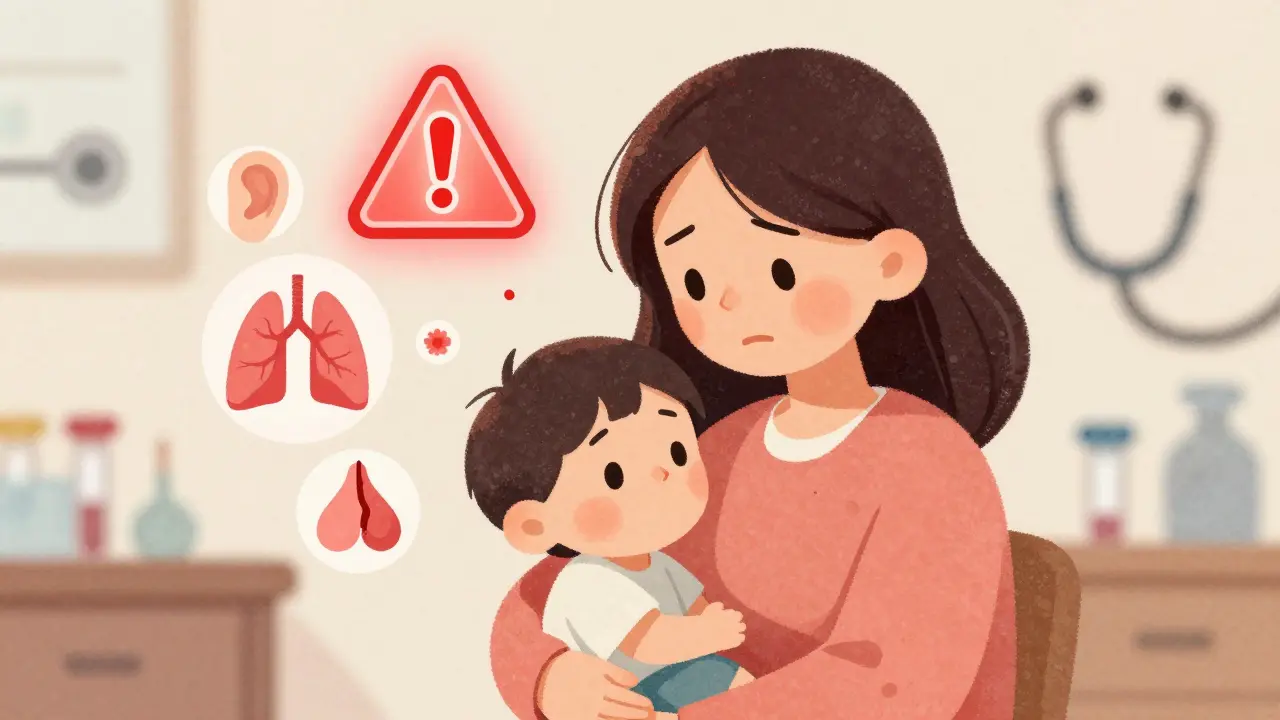
When your child keeps getting sick - ear infections, pneumonia, sinusitis - it’s easy to shrug it off as just part of growing up. But what if it’s not normal? What if those infections are a warning sign that something deeper is wrong with their immune system?
Recurrent infections aren’t just annoying. They can be the first and sometimes only clue to a primary immunodeficiency - a hidden flaw in the body’s ability to fight off germs. Left unchecked, these conditions can lead to permanent lung damage, chronic sinus disease, or even life-threatening complications. The good news? Early detection changes everything.
When Is a Recurrent Infection a Red Flag?
Healthy kids get sick. A preschooler might have 6 to 12 colds a year. That’s normal. But when infections start piling up in a pattern that doesn’t fit, it’s time to look closer.
The American Academy of Allergy, Asthma & Immunology and the European Society for Immunodeficiencies agree on these key red flags:
- Four or more ear infections in one year
- Two or more serious sinus infections in one year
- Two or more pneumonias within 12 months
- Persistent oral thrush after age 1
- Deep skin or organ abscesses that keep coming back
- Infections that don’t clear up after two months of standard antibiotics
- Need for intravenous antibiotics to treat infections
- Two or more deep-seated infections like septicemia or meningitis
- Failure to gain weight or grow normally
- Family history of primary immunodeficiency
These aren’t arbitrary numbers. They’re based on decades of clinical data showing what separates normal childhood illness from something more serious. For example, oral thrush (a fungal infection in the mouth) after age 1 is a strong indicator - it’s 89% specific for antibody deficiency. That means if a child has it, there’s a very high chance their immune system isn’t making the right antibodies to fight off fungi.
And it’s not just kids. Adults with undiagnosed immunodeficiency often get the same infections - but they’re told it’s just allergies, asthma, or bronchitis. One pediatrician in Ohio saw three patients with Common Variable Immunodeficiency (CVID) misdiagnosed as chronic bronchitis because their IgG levels were just above the adult cutoff - but far below what’s normal for an 8-year-old.
What Do These Infections Tell You About the Immune System?
Not all infections mean the same thing. The type of germ, the location, and how hard it is to treat give clues about what part of the immune system is broken.
Recurrent ear and sinus infections? Often point to low antibody levels - especially IgG or IgA. These antibodies help the body recognize and neutralize bacteria like Streptococcus and Haemophilus. Without them, these bugs keep coming back.
Pneumonia caused by unusual organisms like Pneumocystis jirovecii or fungi like Aspergillus? That’s a red flag for T-cell problems. These germs rarely hurt healthy people. They’re called opportunistic - meaning they only strike when the immune system is down.
Deep abscesses in the liver, lungs, or skin? Could signal a defect in neutrophils - the white blood cells that swarm and eat bacteria. In some cases, it’s a rare condition like chronic granulomatous disease, where neutrophils can’t kill the germs they swallow.
And then there’s the physical exam. No tonsils? No lymph nodes? That’s a classic sign of severe combined immunodeficiency (SCID). In one study, 78% of SCID patients had absent lymphoid tissue. Skin telangiectasias (tiny red blood vessels)? That’s ataxia-telangiectasia. These aren’t random findings - they’re diagnostic fingerprints.
The Workup: How Doctors Diagnose Immunodeficiency
If red flags are present, the next step isn’t more antibiotics. It’s a structured immune workup. This isn’t a single test. It’s a step-by-step process.
Step 1: Complete Blood Count (CBC) with Differential
This checks your white blood cell numbers. In children over 1, a lymphocyte count below 1,500 cells/μL raises concern for T-cell deficiency. In babies under 1, anything under 3,000 is suspicious. It’s simple, cheap, and often the first clue.
Step 2: Immunoglobulin Levels (IgG, IgA, IgM)
These aren’t one-size-fits-all. IgG in a 3-month-old is normal at 243 mg/dL. At 6 months, it’s 558 mg/dL. By age 5, it should be 700-1,600 mg/dL - adult levels. Many doctors miss this. A child with IgG at 420 mg/dL might be told they’re fine because it’s above 400. But for an 8-year-old, that’s dangerously low. Age-adjusted ranges matter.
Step 3: Lymphocyte Subset Analysis (Flow Cytometry)
This counts the different types of immune cells: CD3+ T cells, CD4+ helper cells, CD8+ killer cells, CD19+ B cells, CD56+ NK cells. A CD3 count below 1,000 cells/μL in a child over 2 is abnormal. It tells you if the problem is with T cells, B cells, or both.
Step 4: Vaccine Response Testing
This is the gold standard. You give a vaccine - like tetanus or pneumococcal - and check antibody levels 4 to 6 weeks later. If the body doesn’t respond, it’s not just low antibodies - it’s a functional failure. For tetanus, a protective level is ≥0.1 IU/mL. For pneumococcus, it’s ≥1.3 μg/mL. No response? That’s diagnostic for antibody deficiency, even if IgG looks borderline.
Step 5: Genetic Testing
Newer tests like next-generation sequencing panels (e.g., StrataID Immune) screen 484 immune-related genes. They find the exact mutation in 35% of suspected cases - twice as many as older methods. In 2023, the FDA approved these for clinical use. They’re not always the first test, but they’re becoming essential for confirming rare conditions.
Don’t Jump to Treatment - Rule Out Other Causes First
Before you start immunoglobulin infusions or steroids, you must rule out other reasons for recurrent infections.
Up to 43% of cases in children are due to anatomical problems - not immune defects. Cystic fibrosis accounts for 12%. Chronic sinusitis from deviated septums or nasal polyps? That’s 31%. A foreign body stuck in the airway? It happens in 18% of kids with recurrent pneumonia.
And here’s something most don’t realize: up to 30% of patients diagnosed with CVID actually have a secondary cause - like lupus, lymphoma, or medications (including long-term steroids or biologics). Treating the immune system when the real problem is cancer or an autoimmune disease can be dangerous.
The American College of Physicians warns: 22% of patients get IVIG (immunoglobulin replacement) without proof of poor vaccine response. That’s unnecessary, expensive, and carries risks like kidney damage and blood clots.
What Happens If You Wait Too Long?
Delay isn’t just inconvenient - it’s deadly.
For SCID - the most severe form - survival jumps from 69% to 94% if diagnosed before 3.5 months of age. That’s because early bone marrow transplant or gene therapy can reset the immune system before infections cause irreversible damage. After that window? The damage is done. Lungs scar. Liver fails. Survival drops.
For CVID, the average time to diagnosis used to be 9.2 years. That’s nearly a decade of lung infections, bronchiectasis, and antibiotic overuse. In centers using the 10-warning-signs checklist, that dropped to 2.1 years. Early diagnosis means fewer hospital stays, less lung damage, and better quality of life.
And it’s not just about survival. Children with untreated immunodeficiencies often miss school, fall behind in growth, and live in fear of the next infection. Parents lose sleep. Families burn through sick days. The emotional toll is massive.
What Can You Do?
If you’re a parent and your child fits the red flags - don’t wait. Don’t accept ‘it’s just a phase.’ Ask for a referral to an immunologist. Bring a list of infections: dates, types, treatments, how long they lasted.
If you’re a doctor: Use the 10-warning-signs checklist. Don’t rely on IgG alone. Check age-adjusted norms. Order vaccine responses. Rule out cystic fibrosis with a sweat test. Look for physical signs - tonsils, lymph nodes, skin changes.
There are tools to help. The Jeffrey Modell Foundation’s 10 Warning Signs campaign is active in 86 countries. It’s translated into 22 languages. It’s free. It’s simple. Use it.
And remember: you don’t need a fancy lab to start. A CBC, basic immunoglobulins, and a vaccine response test can be done in most clinics. You don’t need to be a specialist to suspect this. You just need to know the signs.
What’s Next?
The future is faster diagnosis. The NIH is launching a 5,000-patient study to build AI tools that predict immunodeficiency from routine blood tests. By 2029, whole exome sequencing may be the first test for suspected cases - cutting diagnosis time from years to weeks.
But right now, the biggest barrier isn’t technology. It’s awareness. In low- and middle-income countries, 78% lack access to basic immunoglobulin testing. Even in the UK and US, many primary care providers still don’t know how to interpret age-adjusted IgG levels.
So if you’ve seen a child with six ear infections this year - or a teenager with pneumonia every winter - don’t assume it’s normal. Ask the question: Could this be an immune problem? The answer could save a life.


Hilary Miller, January 21, 2026
My nephew had 7 ear infections by age 2. Pediatrician said 'it's just kids.' Turned out his IgG was 380. We got him on IVIG. He's 8 now and hasn't missed a day of school since.
Stop normalizing suffering.
Jasmine Bryant, January 22, 2026
Wait so if a kid has 4 ear infections in a year but their IgG is 600 and they responded to pneumococcal vaccine... is that still a red flag? I'm confused because my cousin's kid had that and they just got tubes. No immune workup.
Brenda King, January 24, 2026
This is the most important post I've read all year.
My daughter had thrush at 18 months. We were told it was from antibiotics. Two years later we found out she had CVID.
Doctors need to stop dismissing this. Please share this with every pediatrician you know.
Liberty C, January 24, 2026
Oh sweet mercy. Another medical virtue signaling op-ed.
Let me guess-next you’ll be telling us to test every toddler for SCID because ‘what if?’
People are getting IVIG for no reason because you’re terrified of a 2% false negative. Meanwhile, the healthcare system is collapsing under the weight of your performative vigilance.
Neil Ellis, January 25, 2026
I’m a nurse in rural Kansas and I see this all the time.
Parents come in with a folder full of infection records. Doctors glance at IgG, say 'it's fine,' send them home.
Then six months later, they’re in the ICU with pneumonia from Pneumocystis.
We need to stop treating immunology like a guessing game. This checklist? It’s a lifeline.
shivani acharya, January 25, 2026
Funny how this post ignores the fact that Big Pharma is pushing immunoglobulin infusions like candy.
Remember when vaccines were the 'cause' of everything? Now it’s 'your kid’s immune system is broken'-and guess what? There’s a $20k/year treatment for it.
My cousin’s kid got diagnosed with 'CVID' after 5 colds. Now he’s on lifelong infusions. His dad works at a lab that sells the stuff. Coincidence? I think not.
arun mehta, January 25, 2026
In India, we have kids with recurrent pneumonia and no access to IgG testing.
My brother’s daughter had 3 pneumonias by age 3. We took her to 3 hospitals. One said 'malnutrition.' Another said 'air pollution.' None said 'immune deficiency.'
She’s 7 now. Still coughing.
Thank you for writing this. We need this knowledge in the Global South too 🙏
Sarvesh CK, January 26, 2026
There’s a profound philosophical tension here: medicine as a system of suspicion versus medicine as a system of trust.
We are conditioned to believe that more testing = better outcomes. But what if we’re pathologizing normal childhood?
What if the body’s resilience, its capacity to adapt and recover through repeated exposure, is being undermined by premature intervention?
Perhaps the real red flag isn’t the infections-but our panic to fix them.
Kenji Gaerlan, January 26, 2026
i think u r overreacting. my cousin had 10 ear infeckshuns and he turned out fine. now he’s a pro basketball player. stop scaremongering.
Keith Helm, January 27, 2026
I must respectfully challenge the assertion that age-adjusted immunoglobulin levels are universally understood by primary care providers. In a recent audit of 127 pediatric clinics in the Midwest, only 19% consistently referenced pediatric reference ranges for IgG.
This is not a knowledge gap-it is a systemic failure in clinical education.
Daphne Mallari - Tolentino, January 28, 2026
The notion that a child with four ear infections requires an immunology consult is not only scientifically unsound-it is a gross misapplication of evidence-based medicine.
The AAP’s guidelines explicitly state that recurrent otitis media is overwhelmingly attributable to Eustachian tube dysfunction in children under five.
To conflate this with primary immunodeficiency is to risk iatrogenic harm through unnecessary, costly, and potentially dangerous interventions.
This post is not advocacy. It is alarmism dressed as education.
Oren Prettyman, January 29, 2026
Let’s be honest. This entire piece is a beautifully wrapped sales pitch for immunoglobulin replacement therapy.
Yes, some kids have real immunodeficiencies. But the vast majority of recurrent infections are viral, self-limiting, and unrelated to antibody levels.
Why is it that every time someone writes about pediatric infections, the solution is always 'test, infuse, sequence genes'? Why not 'wait, watch, and let nature take its course'?
Because profit margins.
And now parents are terrified of their own children getting sick. Brilliant marketing.
Margaret Khaemba, January 31, 2026
I’m a mom of twins. One had 5 ear infections, the other had zero.
We did the CBC, IgG, vaccine response. Turned out the one with infections had a mild IgA deficiency-no treatment needed.
Just knowing made me stop blaming myself.
Thanks for making this so clear. I shared it with my whole mom group.
Malik Ronquillo, January 31, 2026
Ive seen this too many times.
Kid gets sick. Parent panics. Doctor says 'its normal.'
Then kid gets sicker. Then they find out its CVID.
By then the lungs are ruined.
WHY ISN’T THIS COMMON KNOWLEDGE??
Chiraghuddin Qureshi, February 1, 2026
In India, we say 'beta bimar hai, thik ho jayega'-the child is sick, he’ll get better.
But what if he doesn’t?
Thank you for this. I’m printing this out and giving it to every auntie and uncle who says 'just give him kadha and he’ll be fine.' 🙏🔥