
Ever wondered why some pills are labeled "XR" while others just say the drug name? Or why your doctor told you that one pill a day does the work of three? It comes down to how your body absorbs the medicine. Choosing between extended-release is a pharmaceutical delivery system designed to release a drug slowly into the bloodstream over a prolonged period and immediate-release versions isn't just about convenience; it's about how the chemistry interacts with your biology. Getting the timing wrong or mishandling these pills can lead to anything from a complete lack of symptom control to dangerous toxicity.
The Core Difference: Speed vs. Stability
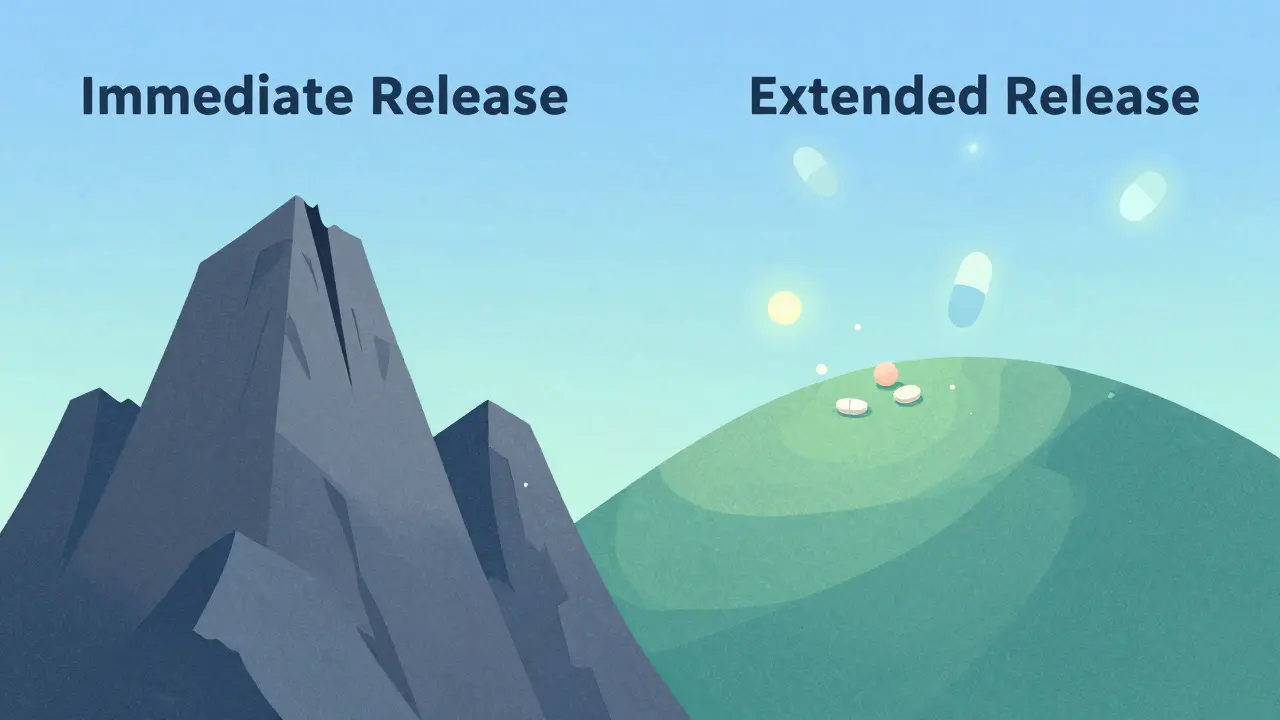
When you take an immediate-release (IR) medication, the goal is speed. These drugs are designed to dissolve almost instantly in your stomach. Within 15 to 30 minutes, the active ingredients are hitting your system, usually peaking in your bloodstream within 90 minutes. This is perfect for acute needs-like stopping a sudden migraine or managing breakthrough pain-but it comes with a trade-off: the "crash." Because the drug leaves your system quickly, you often face a peak-to-trough ratio of about 3:1, meaning your levels swing wildly from high to low.
Extended-release (ER) formulations-which you'll also see labeled as XR, SR, CR, or DR-play the long game. Instead of a sudden spike, they maintain a steady level of medication in your blood, typically for 12 to 24 hours. This keeps you within the therapeutic window (the sweet spot between "not enough to work" and "too much to be safe") for much longer. In an optimized ER product, that peak-to-trough ratio drops to about 1.5:1. You don't get that jagged ride of highs and lows; instead, you get a smooth, consistent flow of medication.
How ER Technology Actually Works
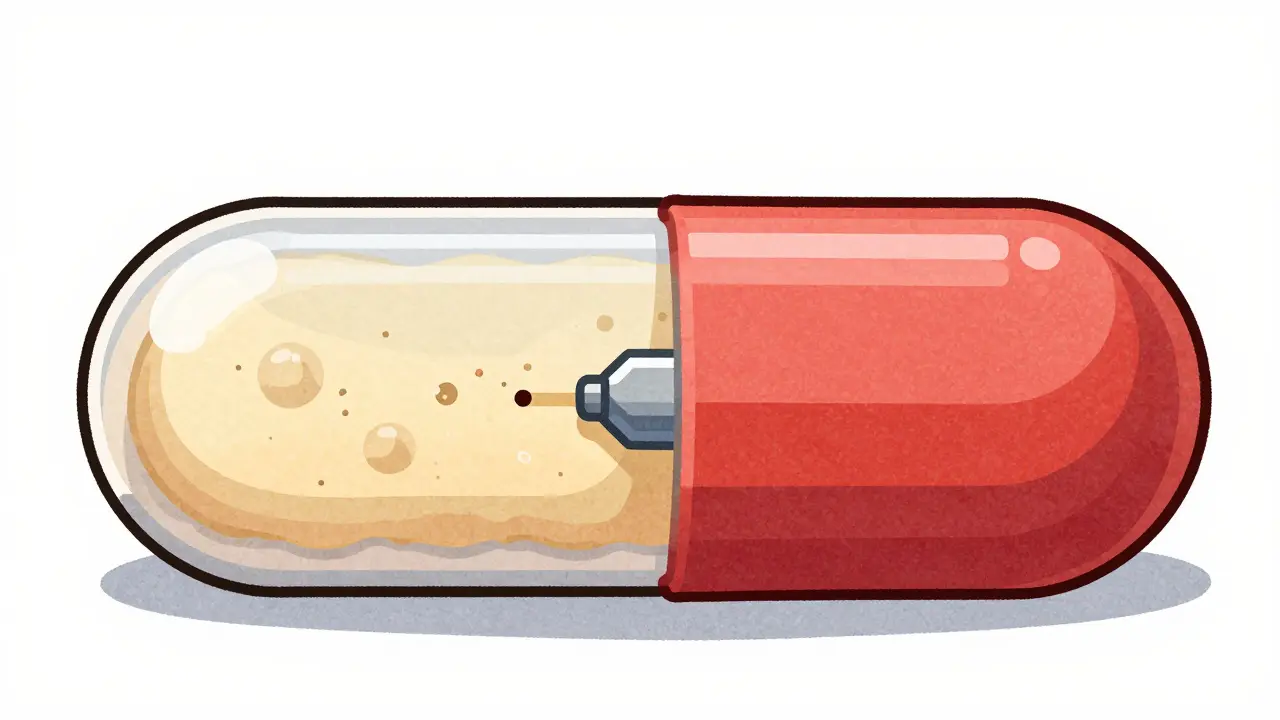
It might seem like magic, but ER pills are actually tiny pieces of engineering. They don't just "dissolve slower"; they use specific mechanisms to gate the drug's release. Some use a hydrophilic matrix, like the one found in Metformin ER, where the pill creates a gel-like barrier that the drug must slowly seep through. Others use osmotic pumps-think of the OROS technology in Concerta-which use osmotic pressure to push the medication out of a laser-drilled hole at a constant rate.
There are also multilayer tablets where different layers dissolve at different speeds, or microencapsulation, where the drug is coated in tiny spheres of varying thicknesses. This is why you'll notice that ER pills are often larger or have a distinct coating. They aren't just holding the medicine; they are managing the clock.
| Feature | Immediate-Release (IR) | Extended-Release (ER/XR/SR) |
|---|---|---|
| Onset of Action | 15-90 Minutes | 2-4 Hours |
| Duration of Effect | 4-8 Hours | 12-24 Hours |
| Dosing Frequency | 3-4 times daily | 1-2 times daily |
| Plasma Concentration | High peaks, sharp drops | Steady, stable levels |
| Best Use Case | Acute symptoms / Titration | Chronic maintenance |
The High Cost of a "Quick Fix": Risks and Dangers
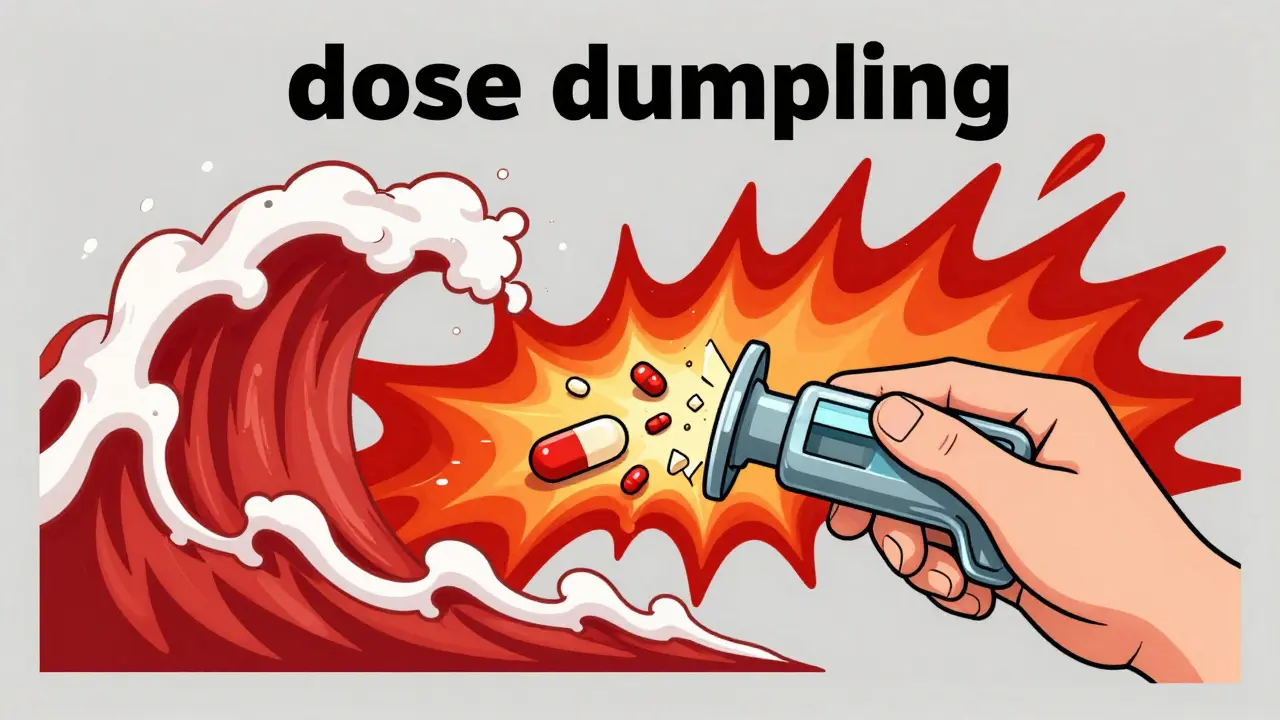
The most dangerous mistake a person can make with ER medication is treating it like an IR pill. Specifically, 92% of ER formulations cannot be split, crushed, or chewed. Why? Because doing so destroys the delivery mechanism. If you crush a 24-hour pill, you aren't just making it work faster-you are dumping a full day's worth of medication into your bloodstream all at once. This is known as "dose dumping," and it can be fatal, especially with opioids or high-dose antidepressants.
Consider bupropion. In its ER form, it maintains a safe plasma concentration over 24 hours. However, if you were to take a single 300mg dose in IR form, the concentration could spike well above the 350 ng/mL threshold, significantly increasing the risk of seizures. This is why ER versions are often prescribed at dosages that would be toxic if delivered instantly.
Overdose situations are also much more complex with ER drugs. Because the medication continues to leak into the system for 24 to 48 hours, hospital stays for ER overdoses are often two to three times longer than for IR versions. Doctors can't simply wait for the drug to clear the system; they have to manage a constant influx of the toxin.
Real-World Performance: Adherence and Lifestyle
From a practical standpoint, ER medications are a game-changer for consistency. A study tracking 15,000 hypertension patients found that 78% of ER users stayed adherent to their meds, compared to only 56% of IR users. It's simple math: it's much easier to remember one pill in the morning than it is to remember four different doses throughout a busy workday.
In the world of ADHD, Adderall XR is often preferred by professionals and students because it prevents the "2 p.m. crash." While an IR version might wear off by lunchtime, leaving the user exhausted and unable to focus, the XR version provides a smooth ride for 10 to 12 hours. However, many people use a hybrid approach-using the ER for a stable baseline and keeping a small amount of IR for a high-stakes event, like a presentation, where an immediate boost in focus is required.
But ER isn't always the answer. If you are in a titration phase-where your doctor is slowly increasing your dose to find the right fit-IR is often better. It allows the doctor to see exactly how you react to a specific dose and adjust it quickly without waiting days for the drug to reach a "steady state" in your blood.
Timing Pitfalls to Avoid
One of the biggest issues with ER medications is the "expectation gap." Because ER drugs take 2 to 4 hours to reach therapeutic levels, some patients feel the medication isn't working and take another dose. This is an incredibly dangerous path that can lead to unintentional overdosing. You have to trust the slow ramp-up.
Another factor is your gut health. Certain delayed-release (DR) medications only activate when they hit a specific pH level-for example, some only trigger when they reach the terminal ileum where the pH is greater than 7. If you have a condition like gastroparesis (delayed stomach emptying), these ER pills might sit in your stomach too long or move too slowly, causing peak concentrations to be 30% to 50% higher than normal. Always tell your doctor if you have chronic digestive issues.
Can I crush an ER pill if I have trouble swallowing?
Generally, no. Crushing, chewing, or splitting an extended-release tablet destroys the time-release mechanism, which can lead to "dose dumping"-where the entire dose is released at once. This can cause severe toxicity or overdose. If you have trouble swallowing, ask your pharmacist for a liquid version or a different formulation.
Why does my ER medication take longer to work than the IR version?
IR medications dissolve quickly in gastric fluids, usually peaking in 30-90 minutes. ER medications use matrices or pumps to slowly release the drug. This means it takes 2-4 hours to reach a therapeutic level, and it can take 7-10 days of consistent use to reach a "steady state" in your bloodstream.
Are ER medications more expensive?
Yes, typically. Due to the advanced engineering required for controlled delivery, ER versions often command a price premium of 15-25% over their immediate-release equivalents.
What happens if I miss a dose of an ER medication?
Because ER meds stay in your system longer, a single missed dose may be less disruptive than missing an IR dose. However, you should never double up on the next dose to "make up" for the missed one, as this could push your plasma levels into the toxic range. Always follow your specific prescription guidelines.
Do all XR/ER pills work the same way?
No. Some use hydrophilic matrices (gel-forming), some use osmotic pumps (pressure-based), and others use microencapsulation (coated beads). The delivery method can affect how the drug interacts with your stomach pH and how it is absorbed.
Next Steps for Patients
If you're currently on an ER medication, double-check your pill bottle for warnings against splitting or crushing. If you find yourself feeling the "crash" late in the day, don't just take more; talk to your doctor about whether a different release profile or a supplemental IR dose is appropriate for your lifestyle.
For those starting a new ER regimen, give your body at least a full week to adjust. Remember that you won't feel the full effect on day one. Keep a simple log of when you take your dose and when you feel the peak effect; this data is incredibly helpful for your doctor to fine-tune your dosage during your next visit.


Jasmin Stowers, April 13, 2026
this is actually super helpful info
Scott Lofquist, April 15, 2026
Actually, most people just ignore the labels anyway because they think they know better than the pharmacist 🙄. It is honestly a miracle more people don't end up in the ER every single day given how reckless some folks are with their pills 💊. Everyone loves to act like they are a doctor after reading one blog post 🙄
mimi clouet, April 16, 2026
I always tell my friends that the OROS system is basically like a tiny little machine in your stomach! 🌟 It's so cool how the laser-drilled hole works to keep everything steady. Just remember to never chew them or you'll ruin the magic! ✨
Kenzie Evans, April 16, 2026
This is basic stuff. Anyone with half a brain knows not to crush an XR pill. I can't believe we're treating this like groundbreaking news. The part about gastroparesis is the only thing that's even remotely useful here and even that's common knowledge in any medical circle worth its salt.
S.A. Reid, April 18, 2026
One must wonder if these "engineered" delivery systems are merely tools for the pharmaceutical industrial complex to ensure a more rigid dependency upon their products. The precision of the osmotic pump is indeed impressive, yet I suspect the true goal is a level of plasma stability that makes the patient more docile and easier to monitor through the systemic architecture of modern medicine.
Brooke Mowat, April 18, 2026
It's like a dance between the molecule and the body, a slow waltz instead of a frantic sprint!! 💃 I love how the chemistry creates a little sanctuary in the gut to let the medicine seep out slowely... it's almost poetic how we've hacked our own biology to find some peace in the chaos of chronic illness. Just imagine the vibez of a steady stream of help floating through your veins all day long!
Milo Tolley, April 19, 2026
The pharmacokinetic profile of the peak-to-trough ratio is absolutely catastrophic!!! 😱 I can't believe the volatility of IR medications!!! It's a complete systemic rollercoaster of hemodynamic instability!!!
Billy Wood, April 19, 2026
Stay consistent!! One pill a day is the way!! Get that routine locked in!!
Sam Dyer, April 20, 2026
American pharma is the only reason we have this tech, period. While other countries are still playing catch-up with basic tablets, we've got laser-drilled holes and osmotic pumps. It's a total masterclass in engineering. Some of you idiots probably think you can just crush them and get a "super dose" lol. Don't be a moron, just follow the label 🇺🇸
Olivia Lo, April 22, 2026
The distinction between the therapeutic window and toxic concentrations is a critical pharmacological nuance. From a holistic perspective, it's important to remember that while the steady-state concentration reduces the crash, the individual's metabolic rate still plays a significant role in how they perceive the efficacy of an ER formulation. We should approach these delivery systems with a balanced understanding of both the chemical engineering and the biological variability.
Princess Busaco, April 24, 2026
I find it absolutely tragic that people are so dependent on these little pellets to function in a society that is fundamentally broken to begin with. I mean, sure, the XR version stops the 2 p.m. crash, but is that really the solution to a life devoid of natural focus and spirit? I've spent years studying the energetic alignment of the mind and body, and frankly, relying on a hydrophilic matrix to manage your mood is just a shortcut that ignores the deeper spiritual void we are all feeling. Why settle for a pharmaceutical sweet spot when you could be pursuing a higher state of consciousness that doesn't require a prescription from a doctor who spends five minutes looking at your chart?
David Snyder, April 25, 2026
It's really great to see a breakdown like this. It makes it so much easier for people to feel confident in their treatment when they actually understand how the medicine works. Glad this is out there to help folks stay safe!
Ikram Khan, April 26, 2026
Wow, the part about dose dumping is actually terrifying!! 😱 I had no idea that crushing a pill could be that dangerous. It's like a ticking time bomb in your stomach! Thanks for the warning!
Becca Suttmiller, April 27, 2026
I appreciate the reminder about the expectation gap. It's easy to get impatient when you're not feeling an immediate effect, but knowing it takes a week to reach a steady state helps with the patience.
Mark Dueben, April 28, 2026
If anyone is struggling with the pill size of the ER versions, please remember that you can always talk to your doctor about alternatives. There's no need to risk dose dumping by trying to make it easier to swallow on your own.