
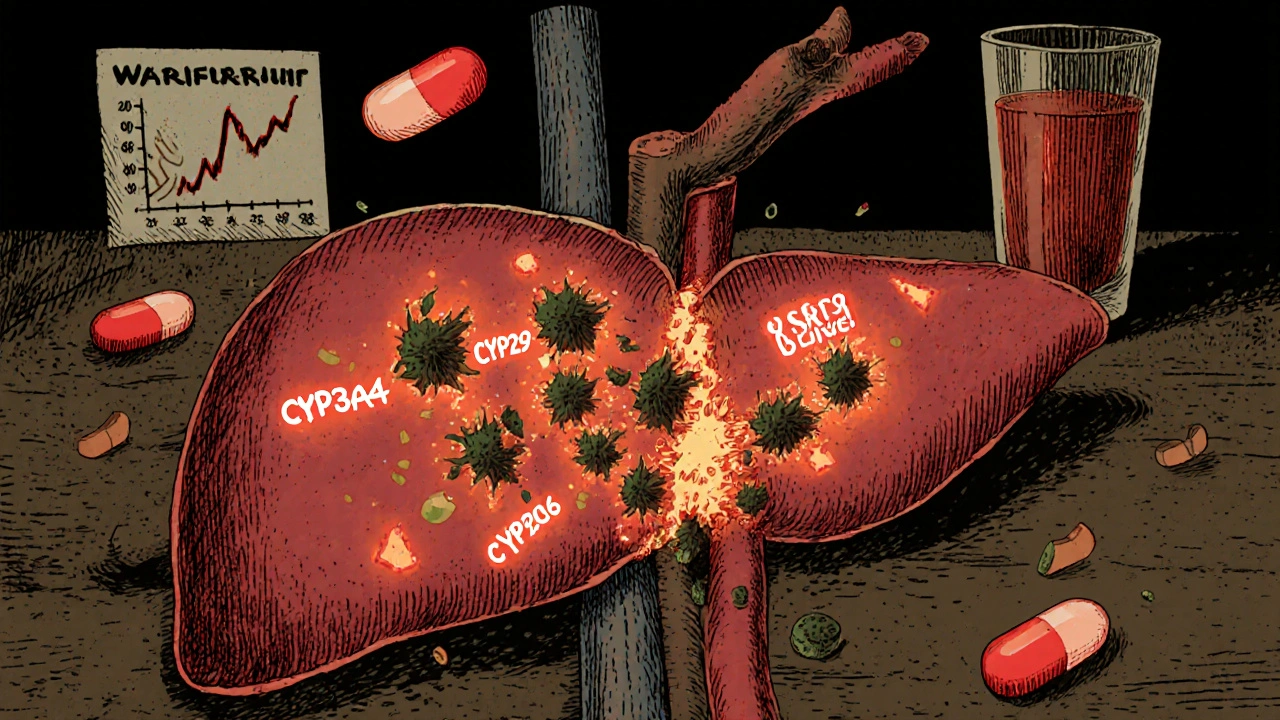
Every morning, millions of people drink a glass of grapefruit juice to start their day-thinking it’s healthy, natural, and harmless. But if you’re taking warfarin or an SSRI, that glass could be quietly changing how your medicine works. It’s not a myth. It’s not a warning you can ignore by just taking your pill two hours later. This is about your liver enzymes, your blood clotting, and your mental health-and it’s happening right now, whether you know it or not.
What Is CYP450, and Why Should You Care?
Your body uses a family of enzymes called cytochrome P450 (CYP450) to break down most of the drugs you take. Think of them as tiny factory workers inside your liver and gut. Some of these enzymes-CYP3A4, CYP2C9, and CYP2D6-are especially important. They handle about 75% of all prescription medications, including blood thinners like warfarin and antidepressants like sertraline and fluoxetine. The problem isn’t that these drugs are dangerous. It’s that grapefruit can shut them down-permanently-for days.Grapefruit Isn’t Just Juice. It’s a Chemical Weapon.
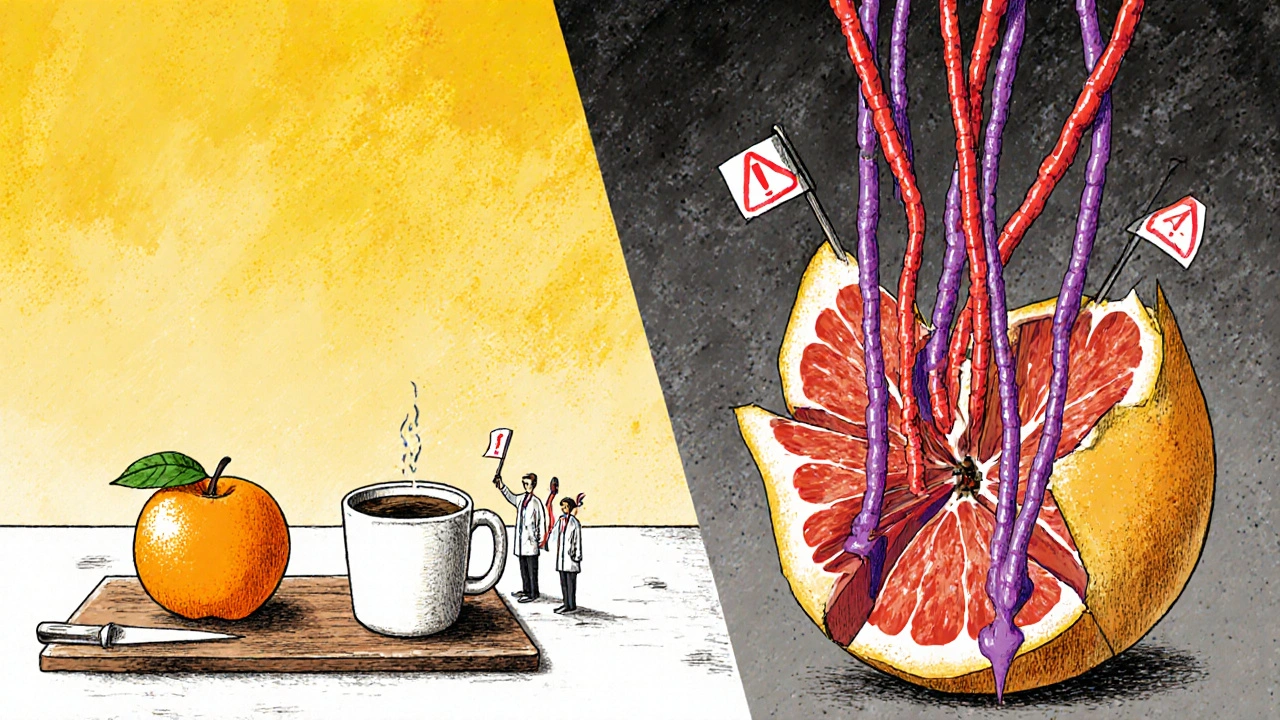
Grapefruit doesn’t just block these enzymes. It destroys them. The culprits are chemicals called furanocoumarins-mainly bergamottin and DHB. These aren’t found in oranges or tangerines. Only grapefruit, and some of its close relatives like pomelos and Seville oranges, have them in high enough doses to matter. Once you drink grapefruit juice, those chemicals go straight to your gut. There, they latch onto CYP3A4 enzymes and break them apart. Your body doesn’t just pause them. It kills them. And it takes 24 to 72 hours for your gut to make new ones. That means even if you take your warfarin at 8 a.m. and your grapefruit juice at 5 p.m., you’re still at risk. A 1998 study showed that bergamottin can inhibit not just CYP3A4, but also CYP2C9 and CYP2D6-the same enzymes that handle warfarin and many SSRIs. That’s why the interaction isn’t always obvious. It’s not just one enzyme. It’s a cascade.Warfarin and Grapefruit: A Quiet Danger
Warfarin is one of the most dangerous drugs to mix with grapefruit-not because it’s powerful, but because it’s precise. A tiny change in your blood levels can mean the difference between a clot and a bleed. Your INR (a blood test that measures clotting time) must stay in a narrow range. Too low? You risk a stroke. Too high? You risk internal bleeding. Warfarin is mostly broken down by CYP2C9 (80-90%), and a smaller amount by CYP3A4. Grapefruit inhibits both. That’s why, even though early studies were mixed, we now know the risk is real. A 2021 guideline from the Clinical Pharmacogenetics Implementation Consortium (CPIC) says: if you have a CYP2C9*2 or *3 gene variant, you’re extra sensitive. These variants are common in people of European descent. If you’re on warfarin and have this variant, grapefruit can push your INR up by 15-25%. That’s enough to send you to the ER. Real-world data backs this up. A Drugs.com analysis of over 1,200 warfarin users found nearly 9% actively avoid grapefruit. And in Reddit’s r/pharmacy, 32% of users who accidentally drank grapefruit juice reported abnormal INR readings within days. The fix? Simple: don’t eat or drink grapefruit at all. Not even once a week. Not even if you take your pill in the morning. It’s not worth the gamble.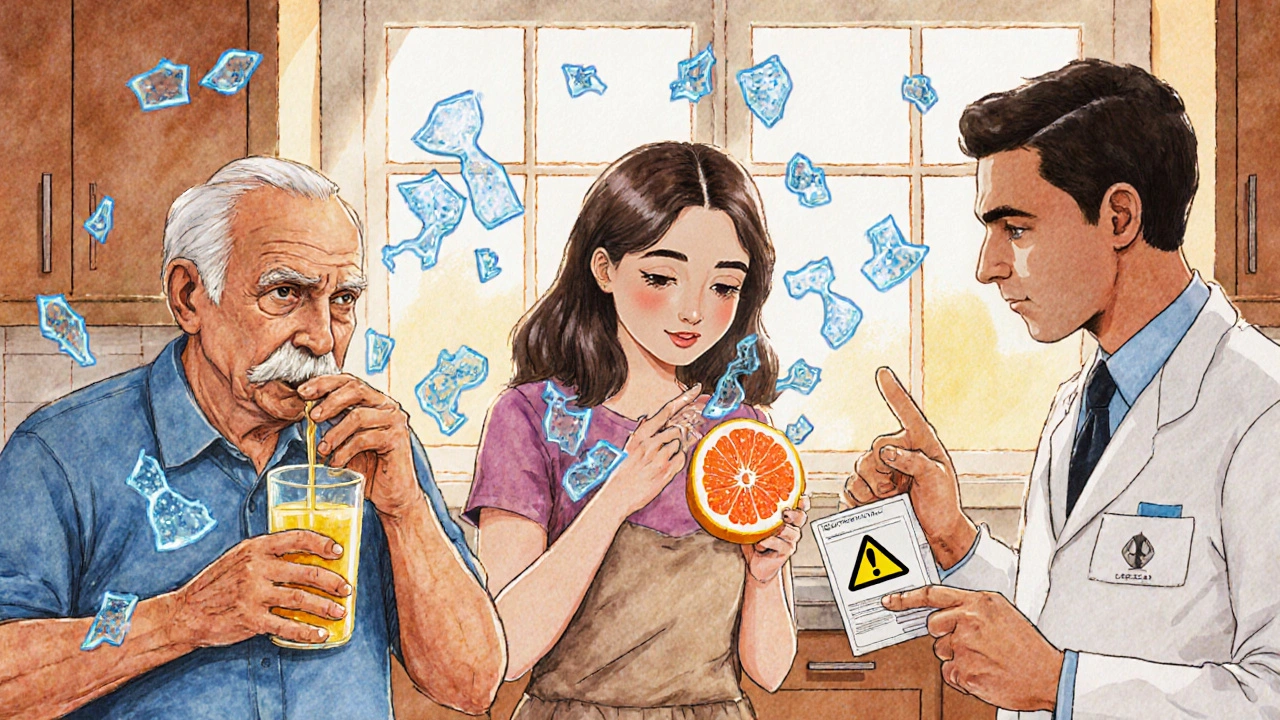
SSRIs and Grapefruit: The Myth vs. The Reality
Now let’s talk about SSRIs. These antidepressants are some of the most prescribed drugs in the world. But not all of them react the same way to grapefruit. Fluoxetine and paroxetine? They’re mainly broken down by CYP2D6. Grapefruit has a weak effect on this enzyme. So, for most people, the risk is low. But here’s the catch: fluoxetine and paroxetine are also strong inhibitors of CYP2D6 themselves. That means they’re already slowing down your metabolism. Add grapefruit? You’re stacking the deck. Sertraline? That’s the one to watch. It’s broken down by CYP2C9, CYP2C19, and CYP3A4. All three are affected by grapefruit. A 2015 case series showed that people who drank grapefruit juice daily for weeks saw their sertraline levels jump by 27-39%. That’s not a small change. It can mean more nausea, dizziness, drowsiness-even serotonin syndrome in rare cases. Citalopram and escitalopram? They’re metabolized by CYP2C19 and CYP3A4. A 2024 study in Clinical Pharmacology & Therapeutics tested 24 healthy volunteers and found no significant change in escitalopram levels after grapefruit juice. That’s good news. But citalopram? Still a gray area. The American Psychiatric Association’s 2022 guidelines say: avoid grapefruit only if you’re on sertraline-and even then, only if you’re older, have liver issues, or are taking other meds that affect CYP3A4. Most people don’t know this. On medical student forums, 64% believe all SSRIs interact with grapefruit. They’re wrong. But the confusion is dangerous. It makes people ignore real risks or overreact to harmless ones.Who’s at Risk? And What Should You Do?
You’re at higher risk if:- You’re over 65
- You take multiple medications
- You have liver disease
- You have a CYP2C9 gene variant (common in 10-15% of Caucasians)
- You’re on sertraline or warfarin
- If you’re on warfarin: avoid grapefruit completely. No exceptions. Even a single glass can change your INR.
- If you’re on sertraline: talk to your doctor. If you’re healthy and young, the risk is low-but don’t drink grapefruit juice daily.
- If you’re on fluoxetine, paroxetine, citalopram, or escitalopram: occasional grapefruit is probably fine. But don’t make it a habit.
- Always check your medication leaflet. If it says “avoid grapefruit,” take it seriously.
- Ask your pharmacist. They can check for interactions you didn’t even know about.
Why Don’t Doctors Always Warn You?
It’s not that they don’t care. It’s that the system is broken. Only 18% of warfarin prescriptions in the U.S. include a grapefruit warning. For SSRIs? Just 8%. Why? Because drug labels haven’t caught up with the science. The FDA lists only three SSRIs (sertraline, trazodone, vilazodone) as having serious grapefruit interactions. That leaves citalopram, fluoxetine, and others in a gray zone. Plus, most doctors assume patients will read the label. But studies show 70% of patients never read the medication guide. And if they do, they might not understand terms like “CYP3A4 inhibition.” Pharmacists spend an average of 3.2 minutes per patient explaining this. But in a 10-minute appointment? That time gets lost.What’s Changing? And What’s Next?
The FDA is pushing for better labeling. Their 2024 draft guidance requires new drugs to include detailed CYP inhibition data. That means future medications will come with clearer warnings. Also, grapefruit itself is changing. New varieties like Oroblanco and Sweetie have up to 300% more furanocoumarins than traditional ones. So even if you’ve had grapefruit for years without problems, a different fruit could be dangerous now. And the numbers are rising. Since 2019, grapefruit consumption in the U.S. has gone up 17%. Meanwhile, the number of people on warfarin and SSRIs keeps climbing. By 2030, the European Medicines Agency predicts a 22% increase in grapefruit-related adverse events-if nothing changes. The solution isn’t just better labels. It’s better education. It’s asking your pharmacist. It’s knowing your own meds. It’s realizing that “natural” doesn’t mean “safe.”Final Takeaway
You don’t need to give up fruit. You just need to know which ones to avoid. Oranges? Fine. Apples? Fine. Grapefruit? Not if you’re on warfarin. Maybe not if you’re on sertraline. Probably okay if you’re on escitalopram-but don’t test it. Medication safety isn’t about fear. It’s about awareness. It’s about asking one simple question before you drink that juice: “Could this change how my medicine works?” If the answer isn’t clear, don’t guess. Ask your doctor. Or your pharmacist. They’re there to help.Can I drink grapefruit juice if I take warfarin?
No. Even small amounts of grapefruit juice can raise your INR and increase your risk of bleeding. The effect lasts up to 72 hours, so timing doesn’t help. Avoid grapefruit entirely if you’re on warfarin.
Do all SSRIs interact with grapefruit?
No. Sertraline is the only SSRI with a clear, documented risk due to its metabolism by CYP3A4. Fluoxetine and paroxetine are metabolized by CYP2D6, which grapefruit affects weakly. Escitalopram and citalopram have mixed data, but recent studies suggest low risk. Always check your specific medication.
How long does grapefruit affect CYP450 enzymes?
The inhibition lasts 24 to 72 hours. Grapefruit doesn’t just block the enzyme-it destroys it. Your body must make new enzymes in your gut, which takes days. One glass can affect your meds for days.
Is it safe to eat grapefruit if I take an SSRI like escitalopram?
Based on a 2024 clinical study, escitalopram levels don’t significantly increase with grapefruit juice in healthy adults. Occasional consumption is likely safe. But daily use isn’t recommended, especially if you’re older or take other medications.
Can I switch to orange juice instead?
Yes. Regular sweet oranges (like Valencia or navel) don’t contain furanocoumarins and are safe. But avoid Seville oranges, pomelos, and tangelos-they’re closely related to grapefruit and can cause the same interactions.
Should I get tested for CYP2C9 gene variants?
If you’re on warfarin and have had unexplained INR swings, genetic testing for CYP2C9*2 or *3 variants can help. It costs $250-$400 and can clarify your risk. But even without testing, avoiding grapefruit is the safest choice.


Robert Bashaw, November 29, 2025
Grapefruit is basically the Voldemort of fruit-don’t say its name around your meds. I drank a glass thinking it was ‘healthy’ and ended up in the ER with an INR of 6.3. My doctor looked at me like I’d just set my liver on fire with a match. Turns out, I didn’t even know CYP450 was a thing. Now I call it ‘the juice that kills enzymes.’ And yeah, I’m still mad.
Also, if you’re on sertraline and still drinking it? You’re not brave. You’re just lucky.
PS: My cat now stares at my grapefruit like it’s a demon. She’s smarter than half the people in this thread.
PPS: If you think ‘natural’ means ‘safe,’ go hug a cactus. It’s less likely to kill you.
PPPS: I now drink orange juice like it’s my emotional support beverage. And I’m not ashamed.
PPPPS: Someone get this man a medal. This post saved my life.
PPPPPS: Why do we still have grapefruit in stores? Someone needs to ban it.
PPPPPPS: I’m not even mad anymore. I’m just… disappointed in humanity.
PPPPPPPS: My pharmacist gave me a sticker that says ‘NO GRAPEFRUIT.’ I put it on my fridge. It’s my new life motto.
PPPPPPPPS: If you’re reading this and you still drink grapefruit juice while on warfarin… I’m not judging. I’m just preparing your obituary.
PPPPPPPPPS: I’m going to start a support group. ‘Grapefruit Survivors Anonymous.’ First rule: You do not talk about grapefruit.
PPPPPPPPPPS: I now have a fruit chart on my fridge. Oranges? Green. Grapefruit? Red. Blood? Red. Same color. Coincidence? I think not.
PPPPPPPPPPPS: I’m not a doctor. But I play one on Reddit. And I say: DON’T. DO. IT.
Brandy Johnson, December 1, 2025
It is regrettable that the American public continues to exhibit such a profound disregard for pharmacological science. The ingestion of grapefruit products in conjunction with CYP450-metabolized pharmaceuticals constitutes a clinically significant deviation from evidence-based practice. The FDA’s current labeling protocols are woefully inadequate, and the absence of mandatory patient education in retail pharmacy settings represents a systemic failure of public health infrastructure. One cannot reasonably expect laypersons to possess expertise in enzymatic pharmacokinetics. The onus must therefore fall upon regulatory bodies to enforce unambiguous, standardized contraindications across all pharmaceutical packaging and digital prescribing platforms. This is not a matter of personal choice-it is a matter of national safety.
Peter Axelberg, December 3, 2025
Let me tell you something about grapefruit. I used to drink it every morning like it was liquid sunshine. I thought it was helping me lose weight, boost my immune system, maybe even make me more attractive to people. Spoiler: it didn’t. It just made my blood thinner than a bad Netflix documentary.
I didn’t even know what CYP450 meant until I had to sit in a hospital room for three days while they tried to get my INR down from 7.8 to something that didn’t scream ‘bleed out.’ My doctor looked at me like I’d just confessed to stealing the Mona Lisa. And honestly? I kind of did.
Turns out, grapefruit doesn’t just ‘interfere’ with your meds. It murders the enzymes that are supposed to keep your body from turning into a human sieve. And it doesn’t care if you took your pill three hours before or after. It’s like a silent assassin with a citrusy aftertaste.
Now I drink orange juice. Not because I’m scared. Because I’m smarter. And I’ve got a new rule: if it’s not an orange, apple, or banana, I don’t touch it with my meds.
Also, I started asking my pharmacist every time I get a new script. Turns out, they’re not just there to hand you pills and say ‘take twice daily.’ They’re like the secret superheroes of medicine.
And if you’re still drinking grapefruit juice because ‘it’s natural’? Natural doesn’t mean safe. Poison ivy is natural. Tetanus is natural. Your body is not a chemistry lab you can experiment on.
So yeah. Don’t be the guy who turns his warfarin into a Russian roulette game. Just… don’t.
Also, I started putting ‘NO GRAPEFRUIT’ on my coffee mug. It’s my new personality trait.
Monica Lindsey, December 3, 2025
Warfarin + grapefruit = death waiting to happen. End of story.
Anyone who ignores this is either ignorant or suicidal.
And yes, your ‘occasional’ glass counts.
jamie sigler, December 5, 2025
I just read this whole thing and now I’m paranoid about everything I’ve ever eaten.
Do I have to stop drinking coffee too?
Is water safe?
What if I breathe near a grapefruit?
I think I need to move to a cabin in the woods.
Bernie Terrien, December 6, 2025
Grapefruit doesn’t just inhibit enzymes-it assassinates them. CYP3A4 doesn’t get a warning label. It gets a bullet. And you’re the one holding the gun.
And no, ‘I only drink it once a week’ doesn’t matter. Your liver doesn’t care about your schedule. It cares about survival.
Also, if you’re on sertraline and think you’re fine because ‘the study said it’s okay’-you’re the reason we need better public health education.
Just don’t. Please.
Jennifer Wang, December 6, 2025
As a clinical pharmacist with over 18 years of experience, I can confirm that the interaction between grapefruit and CYP450-metabolized medications is not theoretical-it is well-documented, reproducible, and clinically significant. The inhibition of CYP3A4, CYP2C9, and CYP2D6 by furanocoumarins leads to elevated plasma concentrations of substrates such as warfarin and sertraline, increasing the risk of toxicity. The duration of effect, lasting up to 72 hours, renders timing of ingestion irrelevant. Patient education must be proactive, not reactive. I routinely counsel patients on this interaction, and I recommend complete avoidance of grapefruit and its derivatives in patients on these medications. Alternative citrus fruits, such as oranges and tangerines, are safe and should be encouraged. Documentation of this counseling in the medical record is essential for continuity of care and liability mitigation.
stephen idiado, December 7, 2025
Western medicine is a scam. Grapefruit is a natural anticoagulant. Your body was designed to process it. The CYP450 system is an artificial construct of pharmaceutical capitalism. You’re being manipulated into fear. Take your warfarin. Drink your juice. Let the body heal itself. The FDA is owned by Big Pharma. You’ve been lied to.
Subhash Singh, December 9, 2025
This is an exceptionally well-researched and meticulously structured exposition on a critical pharmacokinetic interaction. The integration of clinical guidelines from CPIC and APA, along with reference to recent peer-reviewed studies from Clinical Pharmacology & Therapeutics, demonstrates commendable scholarly rigor. I would, however, be interested in further clarification regarding the differential impact of furanocoumarin concentrations across grapefruit cultivars-particularly in light of the increasing prevalence of high-furanocoumarin hybrids such as Oroblanco. Are there any studies quantifying the dose-response relationship between furanocoumarin intake and CYP enzyme inhibition in humans? Additionally, is there any data on the impact of grapefruit peel or pulp versus juice? Thank you for this invaluable contribution to public pharmacological literacy.
Geoff Heredia, December 11, 2025
Did you know the FDA knows about this? They’ve known since 1998. But they won’t ban grapefruit because the juice industry lobbies them. Big Pharma doesn’t want you to know that natural foods can outmaneuver their patents. This is all part of the Great Medication Control Scheme. They want you dependent on pills. Grapefruit is the rebellion. But they’ve turned it into a villain. The real danger isn’t the juice-it’s the system that wants you afraid of food.
Also, I heard the WHO is secretly testing grapefruit as a cure for cancer. They’re hiding it because it’s too cheap. That’s why they made you think it’s dangerous.
Check your pills. Are they made in the USA? If yes, you’re being poisoned.
Tina Dinh, December 12, 2025
OMG THIS POST CHANGED MY LIFE 💥
I was drinking grapefruit juice with my sertraline and I didn’t even know 😱
Now I’m drinking orange juice and doing yoga and crying happy tears 🍊🧘♀️💖
Thank you for saving me from myself 🙏
Also, I told my mom. She’s 72 and on warfarin. She’s never touching grapefruit again. We’re having a juice party with apples and pears! 🍎🍐
PS: I made a poster. It says ‘GRAPEFRUIT = BAD. ORANGES = GOOD.’ I taped it to my fridge. My cat approves. 🐱
Andrew Keh, December 13, 2025
This is a very clear and important explanation. I’ve been on warfarin for five years and never knew grapefruit was a problem. I’ve been drinking it every morning. I’m glad I read this before something bad happened.
I’m switching to orange juice today. Simple change. Big difference.
Thanks for taking the time to write this out so well. It’s not often you get information like this that’s both accurate and easy to understand.
Peter Lubem Ause, December 14, 2025
Let me tell you something, my friend. This post? It’s not just information-it’s a lifeline. I’ve seen too many people in my community, especially the elderly, believe that because something is natural, it’s harmless. Grapefruit? It’s beautiful. It’s sweet. It’s refreshing. But when you’re on medication, it becomes a silent saboteur. I’ve had a cousin who almost bled out because he thought ‘a little won’t hurt.’ He didn’t. It hurt him. Badly.
But here’s the good news: awareness changes everything. Once you know, you act. And once you act, you protect. That’s what this post does. It doesn’t scare you. It empowers you. You don’t have to give up fruit. You just have to choose wisely. Oranges? Perfect. Apples? Excellent. Grapefruit? Not if you’re on warfarin. Not if you’re on sertraline. Not if you’re on anything that your body needs to process carefully.
And to those who say, ‘I’ve been drinking it for years’-you’re not invincible. You’re just lucky so far. Luck isn’t a strategy. Knowledge is.
So thank you. For writing this. For caring enough to explain it. And for giving people like me the courage to speak up to our parents, our neighbors, our friends. Because sometimes, the most powerful thing you can do is say: ‘Don’t do it. Not this time.’
And if you’re reading this and you’re still holding that glass of grapefruit juice? Put it down. Walk away. And drink something safe. Your future self will thank you.
Robert Bashaw, December 16, 2025
And now I’m the guy who brings orange juice to family dinners. My aunt asked why I don’t drink grapefruit anymore. I said, ‘Because I’m not trying to become a statistic.’ She laughed. Then she asked me to print out this post for her husband. He’s on warfarin. Now he’s got a sticky note on his fridge. We’re all doing better.