

Getting a cancer diagnosis is never easy, but the real stress often comes from the waiting game that follows. You need to know exactly where the disease is, how far it has spread, and whether treatment is working. This is where Oncologic Imaging is the use of medical imaging techniques to detect, stage, and monitor cancer. It’s not just about taking pictures; it’s about mapping the battlefield so doctors can fight smarter. The three main tools in this arsenal are PET-CT, MRI, and the newer hybrid PET-MRI. Each has strengths, weaknesses, and specific jobs they do best.
Key Takeaways
- PET-CT remains the standard workhorse for most cancers because it combines metabolic activity with anatomical detail quickly and cost-effectively.
- MRI offers superior soft-tissue contrast without radiation, making it ideal for brain, liver, and pelvic cancers.
- PET-MRI is the high-end hybrid option, reducing radiation by half and improving accuracy for complex cases like brain tumors and pediatric cancers, but it costs more and takes longer.
- Staging accuracy depends heavily on the tumor type; no single scan is perfect for every scenario.
- Choosing the right scan involves balancing diagnostic precision, patient safety (radiation exposure), and practical factors like time and cost.
Why Staging Accuracy Matters More Than Ever
Staging tells us the extent of cancer. Is it localized? Has it jumped to lymph nodes or distant organs? A small error here can mean the difference between surgery and chemotherapy, or curative intent versus palliative care. According to the 2023 ASCO guidelines, imaging selection must now align with tumor molecular subtypes, not just anatomy. For example, breast cancer response to neoadjuvant chemotherapy varies wildly by subtype, and imaging must reflect that biological reality.
The global oncology imaging market hit $18.7 billion in 2022, growing at 5.2% annually through 2030. Why? Because better images lead to better decisions. But more data isn’t always better if it’s noisy or misleading. That’s why understanding what each modality actually sees-and what it misses-is crucial for patients and clinicians alike.
PET-CT: The Reliable Workhorse
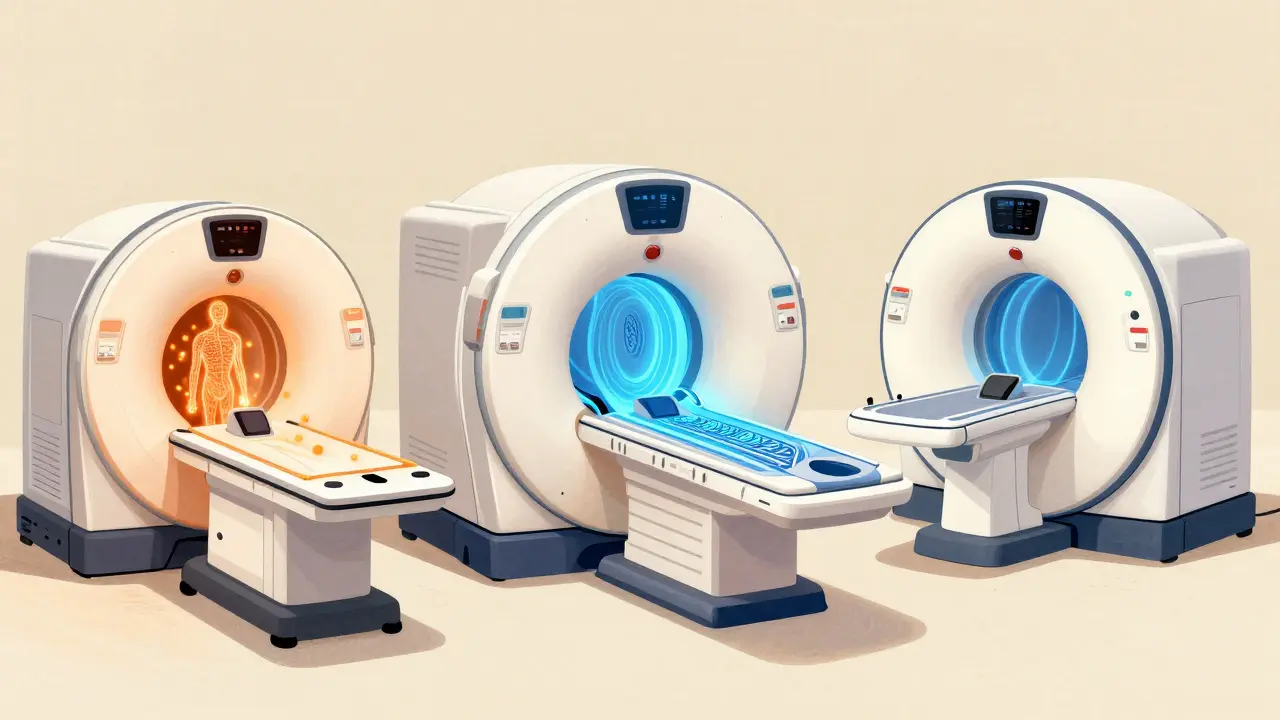
PET-CT is a hybrid imaging technique combining Positron Emission Tomography and Computed Tomography to show both metabolic activity and anatomical structure. Introduced commercially in 2001 by David W. Townsend and Ronald Nutt, it quickly became the gold standard for initial staging in many cancers.
Here’s how it works: you’re injected with a radioactive tracer, usually 18F-FDG (fluorodeoxyglucose), which accumulates in cells with high glucose metabolism-like cancer cells. The PET part detects this activity, while the CT provides a detailed anatomical map. Modern systems like the Siemens Biograph Vision Quadra offer a 106 cm axial field of view and 17.5 cps/kBq sensitivity, meaning they catch even tiny hotspots.
Pros:
- Fast acquisition: 15-20 minutes per patient.
- Broad availability: 45% of global installations are in North America.
- Cost-effective: $1,600-$2,300 per exam in the US (2023 pricing).
- High specificity for early response assessment in breast cancer (94% vs. 83% for MRI in pre-cycle 3 evaluations).
Cons:
- Radiation exposure: 10-25 mSv per scan, equivalent to 3-8 years of natural background radiation.
- Lower soft-tissue contrast compared to MRI.
- Can miss slow-growing or low-metabolism tumors (e.g., some prostate or neuroendocrine cancers).
Dr. Richard L. Wahl of Johns Hopkins calls PET-CT “the workhorse” for good reason. It’s fast, widely available, and reliable for most solid tumors. But it’s not perfect.
MRI: The Soft-Tissue Specialist
MRI is Magnetic Resonance Imaging, a non-invasive technique using strong magnetic fields and radio waves to produce detailed images of organs and tissues. Developed by Paul Lauterbur and Peter Mansfield (Nobel Prize, 2003), MRI has been used in oncology since the 1980s.
MRI doesn’t use ionizing radiation. Instead, it exploits the magnetic properties of hydrogen atoms in water and fat. 3T systems deliver spatial resolution down to 0.5-1.0 mm for anatomical imaging and 2-3 mm for functional techniques like diffusion-weighted imaging (DWI). This makes MRI unbeatable for soft-tissue differentiation.
Pros:
- No radiation risk-ideal for young patients, pregnant women (with caution), and those needing repeated scans.
- Superior contrast for brain, liver, pelvis, and musculoskeletal tumors.
- Functional imaging (DWI, perfusion) adds biological insight beyond anatomy.
Cons:
- Longer scan times: 30-60 minutes, increasing motion artifact risk.
- Contraindications: metallic implants, pacemakers, claustrophobia.
- Higher infrastructure cost: RF-shielded rooms ($150k-$250k) and specialized training.
- Less effective for lung cancer due to air-tissue interfaces.
In prostate cancer, conventional MRI detected tumors with 75% accuracy versus 62% for PSMA PET/CT in one 2022 study (though debated). In liver metastases, MRI’s ability to distinguish benign cysts from malignant lesions is unmatched.
PET-MRI: The Precision Hybrid
PET-MRI is a combined imaging system that integrates PET and MRI in a single device, offering metabolic and high-resolution soft-tissue data simultaneously. First cleared by the FDA in 2011 (Siemens Biograph mMR), PET-MRI represents the cutting edge of oncologic imaging.
By merging PET’s metabolic sensitivity with MRI’s soft-tissue clarity, PET-MRI reduces radiation exposure by ~50% compared to PET-CT. It’s particularly valuable for central nervous system (CNS) tumors, where differentiating recurrence from radiation necrosis is critical. MRI alone achieves 70-80% accuracy here; PET-MRI pushes that to 85-90%.
Pros:
- Half the radiation of PET-CT.
- Superior diagnostic confidence for liver, pelvic, and CNS malignancies.
- Single-session convenience for frail or pediatric patients.
- Advanced attenuation correction algorithms (e.g., Dixon-based) improve image quality.
Cons:
- High cost: $3.0-$4.2 million per system; $2,500-$3,500 per exam.
- Longer acquisition: 45-60 minutes, requiring strict patient cooperation.
- Workflow challenges: 73% of radiologists cite longer scan times as a major hurdle.
- Limited availability: 78% of installations are in academic centers with residency programs.
Dr. Hedvig Hricak of Memorial Sloan Kettering emphasizes personalization: “No single imaging method is optimal for all cancer scenarios.” PET-MRI shines in specific niches but isn’t a universal replacement.
| Feature | PET-CT | MRI | PET-MRI |
|---|---|---|---|
| Radiation Dose | 10-25 mSv | None | ~5-12 mSv (50% less than PET-CT) |
| Scan Time | 15-20 min | 30-60 min | 45-60 min |
| Spatial Resolution | PET: 4-5 mm; CT: 0.5-0.625 mm | 0.5-1.0 mm (anatomical); 2-3 mm (functional) | Combined high-resolution metabolic + anatomical |
| Best For | Initial staging, lung, lymphoma, breast response | Brain, liver, pelvis, musculoskeletal tumors | CNS tumors, pediatric cancers, complex recurrences |
| Cost per Exam (US, 2023) | $1,600-$2,300 | $1,000-$2,500 | $2,500-$3,500 |
| Availability | Widespread (45% NA, 30% EU) | Common in hospitals | Limited (mostly academic centers) |
When to Choose Which Modality
Let’s get practical. Your doctor won’t pick a scan based on trends-they’ll match the tool to the job. Here’s a decision framework:
- Initial Staging of Solid Tumors: Start with PET-CT. It’s fast, covers the whole body, and catches distant metastases efficiently. Exceptions: brain tumors (use MRI first) and prostate cancer (PSMA PET or multiparametric MRI).
- Brain or Spinal Cord Tumors: MRI is king. Add PET only if recurrence vs. necrosis is unclear. PET-MRI is ideal if available.
- Liver Metastases: MRI with DWI outperforms CT for small lesions. PET-CT helps assess metabolic activity. PET-MRI combines both advantages.
- Pelvic Cancers (Prostate, Cervix, Rectum): MRI defines local extent; PET-CT checks for distant spread. PET-MRI streamlines this into one session.
- Pediatric Cancers: Minimize radiation. Prefer MRI or PET-MRI. Reserve PET-CT for cases where metabolic data is critical and MRI is contraindicated.
- Treatment Response Monitoring: For breast cancer undergoing neoadjuvant chemo, PET-CT shows early metabolic changes before size reduction. MRI tracks structural changes. PET-MRI offers both.
A 2023 RadioGraphics study found FDG PET/MRI changed management decisions in 49% of pancreatic cancer patients-highlighting its value in ambiguous cases.
Real-World Challenges and Expert Insights
Technology looks great on paper, but clinics face real hurdles. A 2022 Academic Radiology survey of 127 radiologists revealed that while 68% trusted PET-MRI for liver lesion characterization, 73% struggled with workflow bottlenecks due to longer scan times.
Dr. Sarah Chen of Massachusetts General Hospital noted on the ACR forum: “The single-session convenience of PET-MRI is valuable for frail patients, but we’ve encountered difficulties with motion artifacts during the longer scans, particularly in abdominal imaging.”
Training matters too. PET-CT interpretation requires 6-12 months post-residency training. PET-MRI demands an additional 3-6 months focused on hybrid imaging physics and artifact recognition. Technologists report needing at least 40 extra hours of instruction compared to PET-CT operation.
Reimbursement is another headache. Dr. Barry Siegel of Washington University pointed out in JAMA Oncology that PET-MRI’s 50% higher cost requires careful patient selection. Insurance coverage varies, and many centers still rely on research grants or out-of-pocket payments for PET-MRI.
What’s Next? AI and Personalized Imaging
The future isn’t just better hardware-it’s smarter software. At the 2023 RSNA meeting, 27 presentations focused on AI-enhanced quantitative biomarkers. Imagine an algorithm that predicts chemo response from baseline PET/MRI radiomics, sparing patients ineffective treatments.
Siemens Healthineers’ BioMatrix 600 PET/MRI (FDA-cleared Jan 2024) boasts a 102 cm bore and 6-minute whole-body acquisition, tackling speed issues. Meanwhile, novel tracers like 68Ga-PSMA-11 (FDA-approved 2020) paired with multiparametric MRI are revolutionizing prostate cancer detection.
The NCI-sponsored PREDICT trial (NCT04535920) is testing AI-assisted imaging for personalized response prediction. Early results suggest radiomic signatures can stratify responders vs. non-responders with >80% accuracy.
By 2035, Frost & Sullivan projects PET-MRI will capture 25-30% of the academic center market, driven by dose reduction mandates and precision oncology demands. But PET-CT won’t disappear-it’ll remain the backbone for routine staging.
Is PET-CT or MRI better for cancer staging?
It depends on the cancer type. PET-CT is generally preferred for initial staging of most solid tumors (lung, lymphoma, breast) due to its speed and whole-body coverage. MRI is superior for brain, liver, and pelvic cancers because of its soft-tissue contrast. Neither is universally “better”-they answer different questions.
How much radiation does a PET-CT scan expose me to?
A standard adult PET-CT delivers 10-25 mSv, roughly equivalent to 3-8 years of natural background radiation. While this increases lifetime cancer risk slightly, the benefit of accurate staging outweighs the risk in most cases. PET-MRI cuts this exposure by about 50%.
Can PET-MRI replace PET-CT entirely?
Not yet. PET-MRI excels in specific areas like brain tumors, pediatric cancers, and complex recurrences, but it’s slower, more expensive, and less available. PET-CT remains the workhorse for routine staging due to broader accessibility and faster throughput.
Why do I need multiple types of scans for cancer?
Different scans reveal different aspects of the disease. CT shows anatomy, PET shows metabolism, and MRI shows soft-tissue detail. Combining them gives a complete picture-like using both a map and a compass. Guidelines now recommend tailoring imaging to tumor biology and clinical questions.
Are there risks to having an MRI scan?
MRI uses no ionizing radiation, so there’s no cancer risk from the scan itself. However, the strong magnetic field poses dangers for people with certain metallic implants (pacemakers, cochlear implants). Claustrophobia is also common, though open-bore MRIs and sedation options help.
How long does it take to get results from these scans?
Most centers provide preliminary reports within 24-48 hours. Final radiologist interpretations may take 3-5 business days. Urgent cases (e.g., suspected spinal cord compression) can be expedited. Always ask your care team about expected timelines.
Will insurance cover PET-MRI if my doctor recommends it?
Coverage varies by insurer and region. Many US plans cover PET-MRI for approved indications (brain tumors, pediatric cancers), but prior authorization is often required. Check with your provider and hospital billing department beforehand. Out-of-pocket costs can range from $500 to $2,000 depending on deductibles.