
Every year, hundreds of thousands of patients in U.S. hospitals suffer harm because of medication errors-errors that could have been prevented. These aren’t rare mistakes. They happen in plain sight: a nurse gives the wrong dose, a doctor prescribes a drug that interacts dangerously with another, or a patient leaves the hospital with a confusing list of pills they don’t understand. Medication safety isn’t just about following rules. It’s about building systems so strong that even when people make mistakes, the system catches them before harm happens.
What Counts as a Medication Error?
A medication error isn’t just giving the wrong pill. It’s any preventable mistake in the process-from prescribing to administering to monitoring. The American Society of Health-System Pharmacists defines it as any event that could lead to inappropriate use or patient harm. That includes wrong dose, wrong drug, wrong patient, wrong route, or even giving a drug at the wrong time. One of the most dangerous errors? Giving methotrexate daily instead of weekly. That single mistake can kill a patient within days. In fact, the Institute of Medicine found that medication errors contribute to about 7,000 deaths a year in U.S. hospitals alone.The ISMP Targeted Best Practices: What Works
The Institute for Safe Medication Practices (ISMP) released its Targeted Medication Safety Best Practices for Hospitals in 2020, and it’s become the gold standard. These aren’t suggestions-they’re hard-hitting, evidence-based rules built from real error reports. One of the most powerful? The hard stop for methotrexate. Electronic systems now block daily dosing unless the prescriber confirms it’s for cancer treatment. Since this rule was adopted, an estimated 1,200 serious errors have been prevented each year. That’s not theory-it’s life saved. Other key practices include banning glacial acetic acid from hospital floors (it looks like water and has killed patients when accidentally injected), requiring double-checks for high-alert drugs like insulin and opioids, and eliminating vials with look-alike labels. These aren’t just paperwork-they’re physical, digital, and procedural barriers built into daily workflows.High-Alert Medications: The Big Risks
Not all drugs are created equal. High-alert medications carry a higher risk of serious harm if misused. The ISMP list includes insulin, opioids, anticoagulants, chemotherapy agents, and intravenous potassium chloride. These drugs demand extra layers of protection. For example, insulin should be stored separately from other medications, labeled clearly, and dosed using standardized concentrations. Nurses must perform independent double-checks before giving them. Automated dose-range checking in electronic systems flags doses that fall outside safe limits. In one hospital, implementing these steps cut insulin-related errors by 65% in just six months. But systems aren’t perfect. A nurse on Reddit described how inconsistent use of safety checks led to a neuromuscular blocking agent being given without proper monitoring-resulting in patient harm. That’s the problem: if even one step is skipped, the safety net fails. That’s why culture matters as much as technology.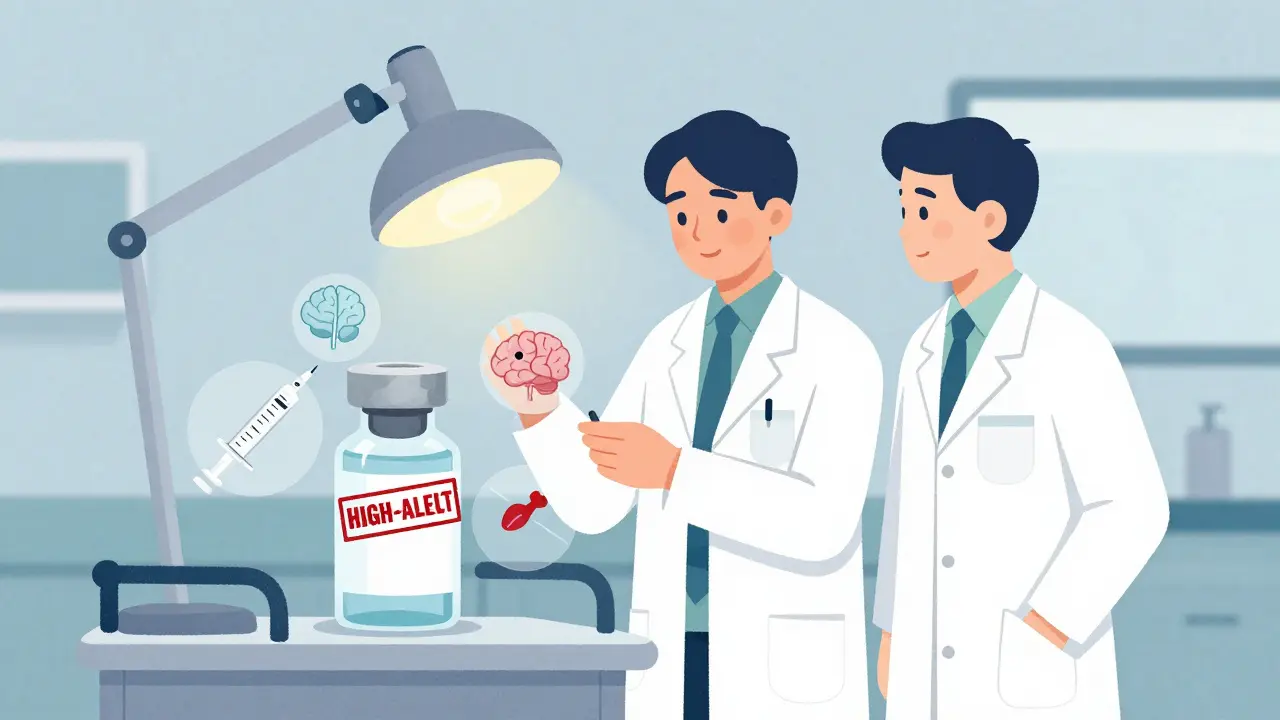
Technology That Saves Lives
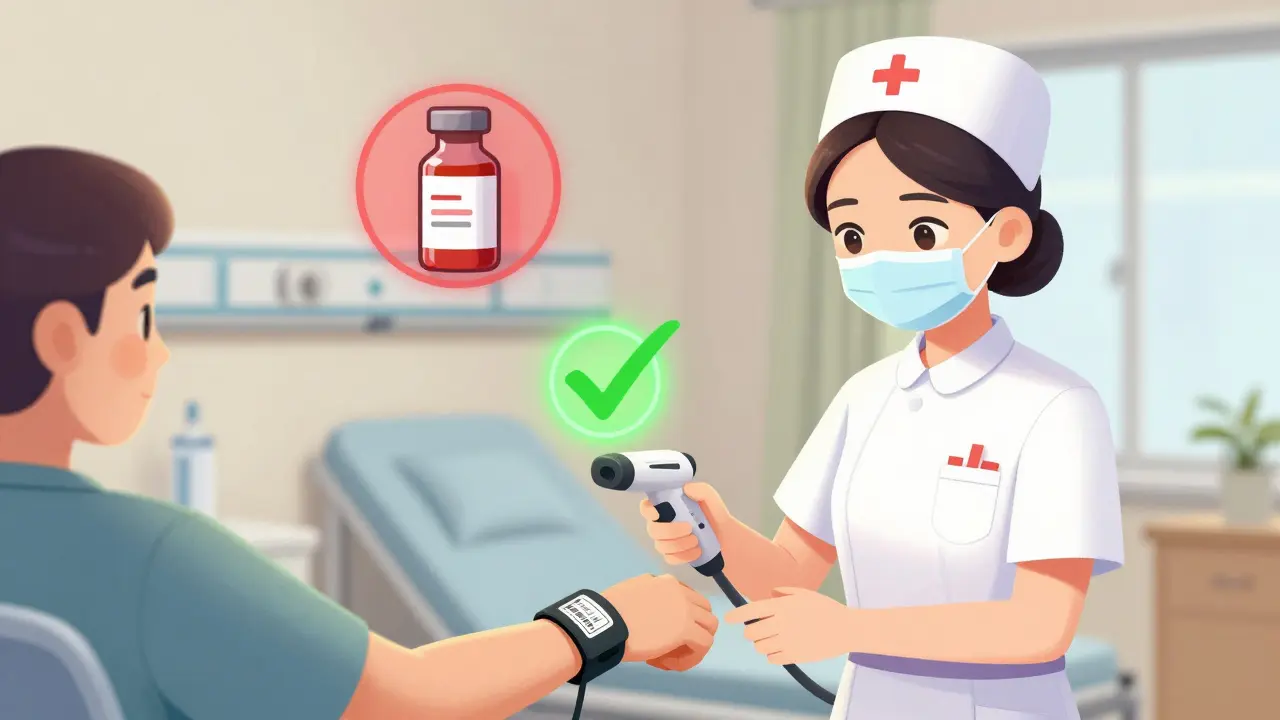
Barcode medication administration (BCMA) systems scan the patient’s wristband and the drug’s barcode before every dose. If the system doesn’t match, it won’t allow the medication to be given. Hospitals with full BCMA adoption see 55% fewer serious medication errors than those without it, according to the Agency for Healthcare Research and Quality. Electronic health records with clinical decision support also flag drug interactions, allergies, and kidney function issues before a prescription is finalized. But tech alone isn’t enough. A 2021 survey found that 63% of hospitals struggled to build hard stops in their EHR systems because vendors didn’t support the flexibility needed. Many hospitals still rely on pharmacists manually reviewing high-risk orders until the system catches up. That’s a workaround-but it’s better than nothing.Medication Reconciliation: The Missing Link
Patients often come into hospitals on multiple medications. They leave with a new list. The gap between those two lists is where errors thrive. Medication reconciliation-comparing what the patient was taking before admission with what’s ordered now-is required by the Joint Commission. Yet many hospitals still do it poorly. A patient on warfarin might get switched to a new blood thinner without checking their INR levels. An elderly patient on five drugs at home might have three of them accidentally discontinued in the hospital, then restarted incorrectly after discharge. The fix? Pharmacists must actively interview patients or caregivers at admission, discharge, and transfer. They need access to community pharmacy records. And discharge instructions must be clear, written in plain language, and verified with the patient. A 2022 survey by the National Council on Aging found that 68% of seniors felt safer when hospitals used the “Right Patient Check”-verifying name, birth date, and wristband before giving any drug.Why Some Hospitals Struggle
Not every hospital can afford the latest tech. Community hospitals with fewer than 100 beds are far less likely to have barcode systems or automated alerts than big academic centers. Only 42% of small hospitals fully implement all ISMP best practices, compared to 78% of large ones. Staff shortages make double-checks harder. Burnout leads to shortcuts. A nurse manager in a rural hospital said requiring both written and verbal methotrexate discharge instructions created delays during staffing crises. That’s the tension: safety protocols are necessary, but they can’t ignore reality. Implementation takes time-12 to 18 months for full rollout. Training staff takes 8 to 12 hours per person. And it’s not just pharmacists and nurses. Doctors, IT teams, administrators, and even housekeeping (who might accidentally move a dangerous drug to the wrong cart) all need to be involved.
The Cost of Not Acting
Medication errors cost U.S. hospitals an estimated $21 billion a year. That’s not just direct costs-like treating harm or extended stays-but lost productivity, legal fees, and reputational damage. CMS now ties hospital payments to safety performance. The Joint Commission can threaten accreditation if safety standards aren’t met. Meanwhile, the global medication safety market is growing at 8.2% annually, hitting $4.7 billion in 2023. Hospitals that invest early don’t just save lives-they save money.What’s Coming Next
The future of medication safety is smarter, not just more rules. AI is already being piloted to detect patterns in real time-flagging a pattern of delayed insulin doses or repeated wrong-route orders before harm occurs. By 2025, Gartner predicts 75% of U.S. hospitals will use AI for this. The FDA is requiring clearer labeling on high-concentration electrolytes by the end of 2024. And ISMP is expanding its best practices to outpatient clinics, where medication errors have risen 40% since 2019. Pilot programs at Mayo Clinic and Johns Hopkins are now asking patients to report their own medication concerns directly into safety systems. Early results show a 32% increase in error detection when patients are part of the process. That’s huge. Patients aren’t just recipients of care-they’re the last line of defense.What You Can Do
Whether you’re a nurse, pharmacist, doctor, or patient, you play a role. Ask: “Is this the right drug? Right dose? Right patient? Right time?” Don’t assume someone else checked. Speak up if something feels off-even if you’re not sure. Use plain language when explaining meds to patients. Bring a list of all your medications to every appointment. Double-check your discharge instructions. If something doesn’t make sense, ask again. Medication safety isn’t about perfection. It’s about building layers so that when one fails, another catches it. It’s about systems that work even when people are tired, rushed, or distracted. It’s about recognizing that behind every error is a person-and that no one should leave a hospital sicker than when they arrived.What is the most common cause of medication errors in hospitals?
The most common cause is miscommunication between staff, especially during handoffs and transitions of care. This includes unclear handwriting on paper orders, incomplete medication reconciliation, and failure to verify patient identity before administering drugs. Electronic systems help, but if staff skip verification steps or override alerts without proper justification, errors still happen.
Which medications are considered high-alert and why?
High-alert medications include insulin, opioids, anticoagulants like heparin, chemotherapy drugs such as methotrexate, and concentrated electrolytes like potassium chloride. These drugs can cause serious harm or death if given incorrectly-even in small doses. For example, a single wrong dose of insulin can lead to coma, while an overdose of an opioid can stop breathing. Because of this, they require extra safeguards like double-checks, standardized concentrations, and automated alerts in electronic systems.
How do barcode scanning systems reduce medication errors?
Barcode scanning ensures the right patient gets the right drug, in the right dose, at the right time. Before giving a medication, a nurse scans the patient’s wristband and the drug’s barcode. If the system doesn’t match the order, it blocks administration. Studies show hospitals using full barcode systems reduce serious medication errors by 55%. It’s not foolproof-staff can still scan the wrong barcode-but it adds a critical digital checkpoint that catches many human mistakes.
What is medication reconciliation and why is it important?
Medication reconciliation is the process of comparing a patient’s current home medications with what’s ordered in the hospital. It’s done at admission, transfer, and discharge. Without it, patients often get duplicate drugs, have important ones stopped accidentally, or are discharged with conflicting instructions. For example, a patient on warfarin might be switched to a new blood thinner without checking their blood levels. This mismatch leads to bleeding or clotting risks. Pharmacists play a key role in this process by interviewing patients and checking pharmacy records.
Can patients help prevent medication errors?
Absolutely. Patients are the last line of defense. They should bring a complete list of all medications-including over-the-counter drugs and supplements-to every appointment. Ask questions: “What is this for?” “Is this new?” “What side effects should I watch for?” At discharge, review the new medication list with a nurse or pharmacist. If something doesn’t match what they were taking before, speak up. Studies show patients who actively engage in their care are 32% more likely to catch errors before they cause harm.


Robyn Hays, December 27, 2025
Man, I’ve seen nurses bypass barcode scans just to keep up with the pace - and it’s terrifying. One time, a patient got morphine instead of methotrexate because the barcode was smudged and the nurse just tapped ‘override’ like it was a Netflix skip. No one got hurt, but I swear, that moment changed how I see safety protocols. It’s not about blame - it’s about designing systems that don’t let us be careless.
Liz Tanner, December 28, 2025
Medication reconciliation is the quiet hero of hospital safety. I work in oncology, and I’ve watched patients come in on ten meds, leave on five, and come back two weeks later with a full-blown crisis because no one checked if their blood pressure pill was still needed. Simple? Yes. Easy? Never. But when pharmacists actually sit down with patients and ask, ‘What do you take every morning?’ - that’s when the magic happens.
Kishor Raibole, December 28, 2025
It is imperative to acknowledge that the implementation of technological safeguards, while commendable, does not inherently mitigate the fundamental deficiencies in human vigilance. The reliance upon electronic systems constitutes a perilous abdication of professional responsibility. In the absence of rigorous cognitive engagement by clinical personnel, even the most sophisticated algorithm remains an ineffectual artifact.
John Barron, December 30, 2025
Let’s be real - 70% of these ‘best practices’ are just bureaucratic theater. I’ve worked in three hospitals. None of them actually follow the double-check rules unless HR is watching. And don’t get me started on BCMA - half the time, the barcode scanner is broken, and the nurse just scans a random barcode and says ‘all good.’ 😒 We’re treating safety like a PowerPoint slide, not a living system. #MedSafetyIsACircus
Anna Weitz, January 1, 2026
Systems can't fix human nature we're all tired we're all rushed we're all just trying to get through the shift and the system knows it and still asks us to be perfect
Todd Scott, January 1, 2026
For context, in India, many rural clinics still rely on handwritten scripts and verbal handoffs - and yet, they have lower medication error rates than some U.S. hospitals. Why? Because there’s no illusion of automation. Everyone knows the system is fragile, so they double-check each other constantly. There’s no ‘I trusted the computer’ mentality. Maybe we’ve over-engineered safety and under-trained trust. The human network, not the software, is the real safety net.
Andrew Gurung, January 1, 2026
Oh please. You think methotrexate hard stops are the solution? I’ve seen residents ignore them because the system didn’t have the right ICD code for their ‘off-label’ use. And now they blame the system? The real problem is lazy clinicians who think tech will do their thinking for them. If you can’t memorize the top 10 high-alert drugs, you shouldn’t be holding a stethoscope. 😒
Paula Alencar, January 2, 2026
I cried the day my hospital finally implemented barcode scanning. Not because it was fancy - because for the first time, I didn’t feel like I was gambling with someone’s life every time I walked into a room. I’ve seen patients die from a single wrong dose. And I’ve seen the same nurse, same unit, same shift, make the same mistake three times. No one talked about it. No one owned it. Until the system said ‘NO.’ That’s not technology. That’s mercy.
Nikki Thames, January 4, 2026
Patients asking questions? That’s just shifting responsibility. The burden of safety should rest squarely on trained professionals, not on a confused 78-year-old who just got out of surgery and can’t remember if they took their blood thinner. This ‘patient empowerment’ narrative is dangerously naive. We don’t ask patients to fix broken elevators - why should they fix broken medicine?
Chris Garcia, January 6, 2026
In Lagos, we use color-coded pill bottles and community health volunteers who walk with patients to the pharmacy after discharge. No barcode. No EHR. Just trust, repetition, and a grandmother who remembers your meds better than your doctor does. Safety isn’t about tech - it’s about connection. Maybe the West has forgotten that healing isn’t a checklist - it’s a relationship.
James Bowers, January 7, 2026
The data is clear: hospitals that implement all ISMP guidelines reduce adverse events by 68%. Any facility failing to comply is negligent. This is not a suggestion. It is a professional obligation. Failure to adhere constitutes malpractice by omission.
Will Neitzer, January 9, 2026
I’ve been a nurse for 22 years. I’ve seen the shift from paper charts to AI-driven alerts. The most powerful tool? Not the scanner. Not the hard stop. It’s the nurse who pauses and says, ‘Wait - this doesn’t feel right.’ That moment of doubt? That’s the heartbeat of safety. We’ve trained people to trust machines. We need to retrain them to trust their gut. And then - we need to listen.
Janice Holmes, January 10, 2026
Let’s be honest - methotrexate errors are the poster child because they’re dramatic. But the real silent killer? Polypharmacy in the elderly. Five drugs. Three pharmacies. No coordination. And then they end up in the ER with a TIA because someone didn’t check for that one anticholinergic interaction. We’re doing all this fancy tech… but we’re still letting grandma’s meds be a game of telephone.
Liz MENDOZA, January 10, 2026
My mom almost died because her discharge meds didn’t match what she was taking at home. No one asked her what pills she was on. No one called her pharmacy. She got home, took her usual dose, and collapsed. I spent three days in the hospital with her while they tried to fix it. That’s not a system failure - that’s a heart failure. We need to treat patients like people, not data points.
Caitlin Foster, January 11, 2026
So… we’re spending billions on AI to catch errors… but we still let nurses work 16-hour shifts? 😂 The real solution? Pay people enough to not be exhausted. Hire enough staff so they don’t have to override alerts just to get to lunch. Fix the burnout - then the tech will actually work. Until then? We’re just putting lipstick on a pig.