

Imagine a patient rushing into your clinic gasping for air. Is it their heart failing, or just a bad case of COPD? The answer often lies in a single blood test that can save hours of uncertainty and thousands of dollars in unnecessary imaging. That test is NT-proBNP, a stable fragment of the B-type natriuretic peptide prohormone released by the heart when ventricles are stretched under pressure. While many clinicians know it exists, few master exactly *when* to order it versus when to skip it.
This guide cuts through the noise. We will look at the specific clinical scenarios where blood level testing changes management, how to interpret those numbers without getting tripped up by age or kidney function, and why this marker has become the gold standard in emergency and outpatient cardiology. Whether you are a resident learning the ropes or an experienced practitioner refining your workflow, understanding these nuances prevents both missed diagnoses and over-testing.
Why NT-proBNP Over Standard BNP?
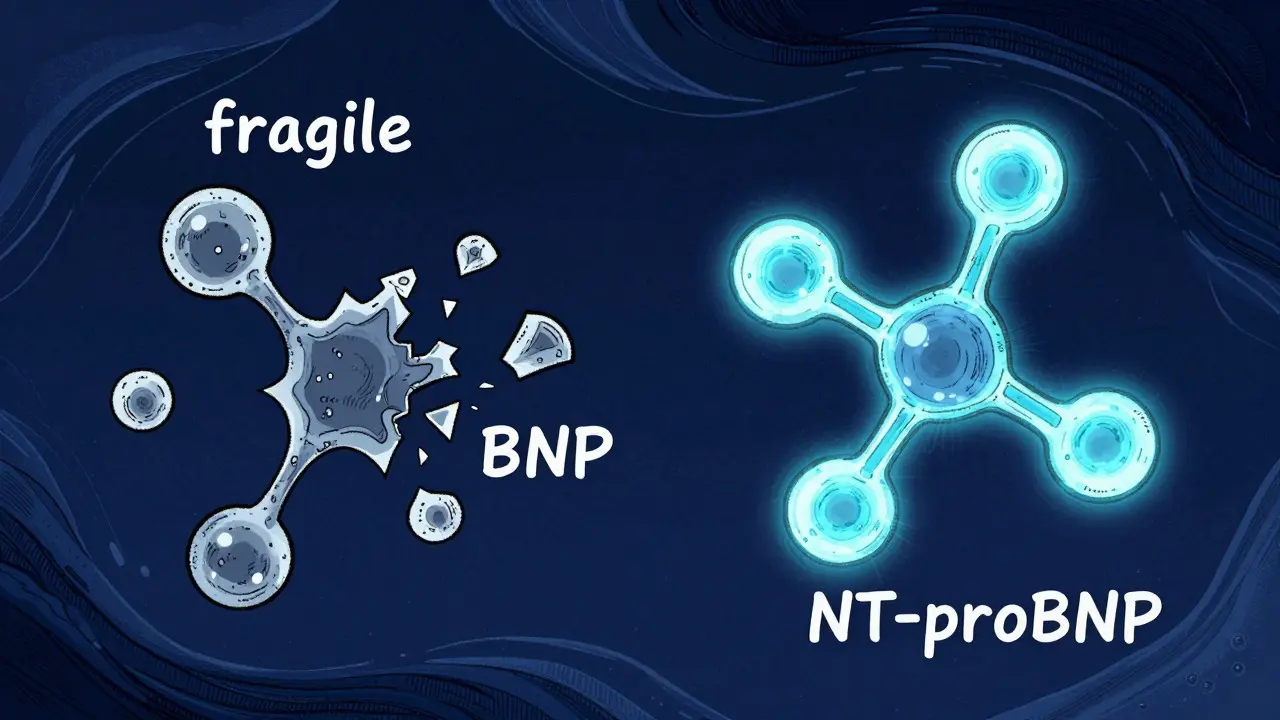
You might wonder why we don't just use BNP (B-type Natriuretic Peptide) directly. The issue is stability. BNP breaks down quickly in the body, with a half-life of only about 20 minutes. This means if a sample sits on a lab bench for too long, the result becomes unreliable. NT-proBNP is different. It is the inactive tail end of the hormone molecule. Because it doesn't get broken down as fast, it stays stable in the blood for 60 to 120 minutes. For a busy hospital lab, this difference is massive. It allows for more flexible sample handling without sacrificing accuracy.
In terms of diagnostic power, studies show NT-proBNP performs slightly better than BNP. A meta-analysis published in Circulation: Heart Failure found that NT-proBNP had a higher diagnostic accuracy score (AUC 0.91) compared to BNP (AUC 0.88). More importantly, it correlates well with what you see on an echocardiogram regarding how well the ventricles are pumping. If you need a number that reflects actual mechanical stress on the heart, NT-proBNP gives you a clearer picture.
The Critical "Rule-Out" Scenario
The most powerful use of this test isn't confirming heart failure; it's ruling it out. When a patient presents with shortness of breath, the biggest question is whether the heart is the culprit. If the NT-proBNP level comes back below a specific threshold, you can confidently tell the patient their heart is likely fine, and you should look elsewhere-like the lungs or anemia.
According to the European Society of Cardiology (ESC) guidelines, a level below 300 pg/mL essentially excludes acute heart failure. In this range, the negative predictive value is around 98%. Think of it this way: if the number is low, there is a 98% chance the patient does not have acute decompensated heart failure. This statistic saves clinics from ordering expensive echocardiograms for patients who actually have a pulmonary exacerbation or anxiety. One cardiologist shared a case where an 82-year-old with COPD had a level of just 120 pg/mL. Instead of a $3,000 echo, they treated the lung issue, saving time and money.
Navigating Age and Kidney Function
Here is where interpretation gets tricky. You cannot just look at a single cutoff number for every patient. Two major factors skew the results: age and kidney health.
Age Matters: As people get older, their baseline NT-proBNP levels rise naturally, even if their hearts are healthy. Levels increase by about 15-20% per decade after age 50. So, a level of 400 pg/mL might be normal for a 75-year-old but concerning for a 40-year-old. Guidelines suggest using age-stratified cutoffs:
- Under 50 years: <450 pg/mL to rule out.
- 50-75 years: <900 pg/mL to rule out.
- Over 75 years: <1,800 pg/mL to rule out (some guidelines vary, but the trend is upward).
Kidney Function (CKD): The kidneys help clear NT-proBNP from the blood. If a patient has Chronic Kidney Disease (CKD), the hormone builds up because it isn't being filtered out efficiently. In patients with Stage 3-4 CKD, levels can be 28-40% higher than in those with normal kidney function, independent of heart status. If you ignore this, you might diagnose heart failure in a patient who just has poor renal clearance. For these patients, clinicians often use a modified rule-out threshold, sometimes as high as 1,200 pg/mL, depending on the severity of the kidney disease.

When Not to Order the Test
Knowing when to order the test is important, but knowing when to skip it is just as valuable. Ordering NT-proBNP in certain contexts leads to confusing results and wasted resources.
- Obese Patients: Obesity lowers NT-proBNP levels. For every 5 units increase in BMI, levels drop by 25-30%. This means an obese patient with genuine heart failure might have a "normal